A busy calendar is not the same thing as a healthy sales pipeline. For SaaS and ERP companies, one qualified sales meeting with a relevant buyer can be more valuable than a week of conversations with people who have no realistic reason to evaluate your product.
The challenge is that "qualified" means different things to different teams. An SDR may celebrate a booked call, while the account executive (AE) considers it a poor fit. Unless both teams agree on the same standard, outbound reporting can reward volume rather than opportunity quality.
This practical guide defines what makes a meeting worth accepting, gives sales leaders a reusable checklist, and shows how to improve the handoff between prospecting and closing—especially when selling B2B software to companies in the United States and Canada.
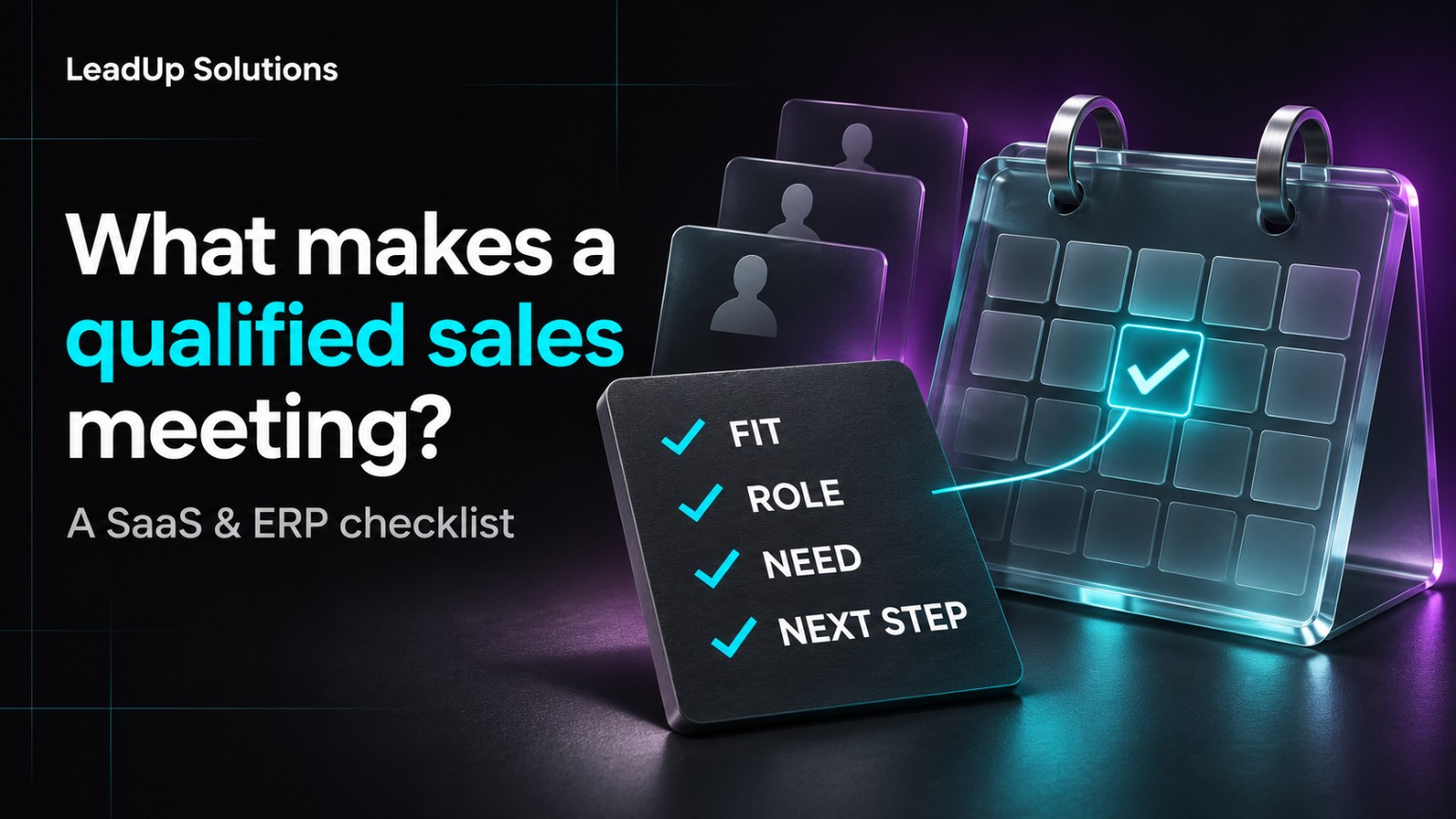
What is a qualified sales meeting?
A qualified sales meeting is a scheduled conversation with a prospect who meets the qualification conditions that the sales and prospecting teams agreed on beforehand. It is not automatically an opportunity, a buying commitment, or a guaranteed sale.
For many B2B SaaS and ERP teams, a useful meeting has four foundational characteristics:
- Fit: The organization matches the ideal customer profile (ICP).
- Role: The attendee has a relevant role in evaluating, influencing, or approving a solution.
- Need: There is a credible problem, initiative, or reason to explore change.
- Next step: Both sides understand why they are meeting and what a productive conversation could accomplish.
The details should match the sales motion. A small SaaS business can qualify a meeting differently from an enterprise ERP vendor selling to a buying committee. What matters is that the rules are explicit and consistently applied.
Booked meeting vs. qualified meeting vs. sales opportunity
These terms are often blurred in dashboards, but they describe different milestones.
| Stage | What it means | What it does not prove |
|---|---|---|
| Booked meeting | A calendar event was scheduled | The account and attendee are relevant |
| Qualified sales meeting | The event meets your agreed qualification criteria | The buyer will purchase |
| Sales-accepted meeting | The AE or sales team has accepted the qualified handoff | A formal opportunity already exists |
| Qualified opportunity | Discovery indicates a viable potential purchase, using your opportunity rules | The deal is certain to close |
For example, a meeting with an operations director at an ICP-fit manufacturer may be well qualified because the team is reviewing an outdated ERP workflow. That does not mean an opportunity should be created before discovery establishes buying scope, priorities, and feasibility.
A good operating model tracks booked, held, accepted, and opportunity-created milestones separately. That prevents one activity metric from masking quality problems downstream.
The four-part qualified sales meeting checklist
Use these four tests as a starting point, then adapt them to your own buyer journey.
1. FIT: Is this the right company?
The account should resemble organizations your solution is designed to serve. An SDR should confirm relevant factors before promising an AE's time.
Questions to check:
- Is the company in a target industry or vertical?
- Is it within your preferred company-size or operational-complexity range?
- Is it located in a region you can serve?
- Does its business model align with your product?
- Are there obvious exclusions—for example, a segment or use case you cannot support?
SaaS example: A workflow automation provider focused on multi-location mid-market organizations should not treat every sole proprietor who wants a free productivity tool as an ICP-fit prospect.
ERP example: A vendor serving manufacturing and distribution should check whether the prospect's operational needs match its implementation capabilities.
Handoff note: Record the account name, relevant ICP attributes, and any important assumptions. If fit is uncertain, mark it as unconfirmed rather than inventing data.
2. ROLE: Is this the right participant?
The attendee does not always need to be the final economic buyer. In complex B2B sales, a champion, evaluator, operational owner, or technical stakeholder can be an excellent starting point.
Questions to check:
- What is the contact's role and responsibility?
- Are they affected by the business problem?
- Can they evaluate solutions or influence the team that does?
- Do they have a credible connection to the buying process?
- Are other stakeholders likely to be needed in future meetings?
For ERP sales, relevant roles might include a CFO, COO, VP of Operations, IT leader, or project sponsor. For SaaS, relevant roles depend on the product: RevOps, Sales Operations, Finance, People Operations, or another functional owner.
Avoid an overly narrow rule: "Must be the CEO" could reject strong meetings with the managers who actually own evaluation and requirements. Define acceptable buying roles, not one job title.
Handoff note: Capture job title, why the contact is relevant, and whether the decision process is known.
3. NEED: Is there a reason to talk?
A prospect's general curiosity is not the same thing as a business need. On the other hand, expecting a fully approved budget before the first discovery call can be too restrictive for early-stage outbound.
The SDR's job is to establish a credible reason for exploration, not conduct the entire sales cycle.
Questions to check:
- What problem or business initiative prompted interest?
- Is the prospect using a manual process, legacy tool, or existing platform?
- Is there a trigger—growth, system consolidation, compliance, or operational friction?
- Why might the company consider changing its current approach?
- Is the need confirmed by the prospect, or merely inferred from external research?
SaaS example: A revenue team mentions that its current handoff between CRM, support, and reporting tools creates missed follow-up. That is a useful reason to explore a new workflow.
ERP example: A distributor says its disconnected inventory and finance processes complicate reporting across locations. That is a credible discovery starting point, even if the project budget is not yet approved.
Handoff note: Quote or accurately summarize the stated challenge, and distinguish confirmed facts from assumptions.
4. NEXT STEP: Does the meeting have a clear purpose?
A calendar invite should represent mutual understanding, not confusion.
Questions to check:
- Has the prospect agreed to a relevant discussion?
- Do they know the company and why the meeting was proposed?
- Is the proposed agenda appropriate for their role and need?
- Is the correct AE or specialist included?
- Are meeting time, time zone, and logistics confirmed?
Do not promise a "product demo" if the sales team intends to hold a discovery conversation. Set expectations before the meeting, so attendance is more likely to lead to a useful discussion.
Handoff note: Document the objective, agreed agenda, timing, relevant attendees, and any promised follow-up.
Copy-and-use sales meeting qualification checklist
Use this table in your CRM, SDR playbook, or meeting-quality review.
| Check | Pass criteria | Status |
|---|---|---|
| Company fit | Account matches documented ICP or approved exception | Yes / No / Unknown |
| Buyer role | Attendee can evaluate, influence, or sponsor relevant work | Yes / No / Unknown |
| Credible need | A relevant challenge or initiative has been identified | Yes / No / Unknown |
| Meeting purpose | Prospect understands and agrees to the intended conversation | Yes / No / Unknown |
| Handoff context | AE receives accurate company, contact, and need notes | Yes / No / Unknown |
| Logistics | Time zone, invitation, attendees, and meeting link are correct | Yes / No / Unknown |
Suggested operating rule: Require confirmed Fit, Role, Need, and Meeting Purpose to classify an appointment as qualified, with documented exceptions for strategic exploration or partner-introduced conversations. The last two checks help ensure that a qualified meeting is also ready to hand off.
This is a practical starting framework, not an industry-mandated standard. Your thresholds should reflect your target market and sales motion.
A scoring model your SDR and AE teams can agree on
For more nuance than a simple yes/no, try a lightweight scorecard:
| Dimension | 0 points | 1 point | 2 points |
|---|---|---|---|
| Fit | Outside ICP | Partial fit or details missing | Clear ICP fit |
| Role | Not relevant | Possible influencer | Confirmed relevant stakeholder |
| Need | No credible reason | Plausible but unverified | Stated, relevant challenge or initiative |
| Next step | Unclear or not agreed | Basic meeting interest | Clear agenda and mutual agreement |
Interpretation:
- 7–8 points: Strong candidate for acceptance, provided there are no hard disqualifiers.
- 5–6 points: Needs closer review or additional qualification.
- 0–4 points: Usually not ready for a standard sales-accepted handoff.
These thresholds are an illustrative internal policy, not a validated industry benchmark. Adjust them based on your actual conversion data. Also apply hard exclusions separately: a 7-point meeting with an account in an unsupported region should not automatically count as qualified.
What an AE should receive before the meeting
A booked calendar event without context forces your AE to restart the qualification work. A good handoff contains a short, structured brief.
Example handoff:
Company: Mid-market US manufacturer
Contact: VP of Operations
Fit: Multi-location manufacturing account within the approved ICP
Need: Prospect described manual inventory reconciliation between sites
Current environment: Uses several disconnected operational tools; exact stack not confirmed
Why this meeting: Explore whether a more integrated process is worth evaluating
Attendees: VP of Operations and assigned AE
Next step: 30-minute discovery discussion; technical specialist may join later
Open questions: Project sponsor, implementation constraints, timing, and budget
The brief does not need to pretend discovery is already done. Honest, incomplete information is more useful than confident guesses.
For Canadian prospects, make the time zone explicit. Canada spans multiple time zones, and an avoidable scheduling error can ruin an otherwise strong introduction.
Common qualification mistakes that waste sales time
Counting every booked call as a win. Booking volume alone does not tell you whether meetings are relevant, attended, or accepted by AEs.
Confusing a senior title with buying relevance. The CEO may be less relevant than the operations leader who owns the workflow.
Treating an inferred pain point as confirmed need. Research can suggest a likely problem; qualification should distinguish that hypothesis from what the buyer actually said.
Requiring too much too early. Enterprise buyers may be exploring requirements before a formal budget exists. If the first call is genuinely discovery, a rigid budget requirement can reject valuable conversations.
Not agreeing on disqualification rules. If one SDR counts a loosely interested contact and one AE rejects it, both teams may think they are following the process. The policy—not the individual—needs clarification.
Skipping the written handoff. An AE should know the account, stakeholder, reason for the meeting, and open questions before joining.
How to measure meeting quality over time
A useful dashboard looks beyond initial booking numbers:
- Booked-to-held rate: Of booked meetings, how many actually took place?
- Sales-acceptance rate: Of meetings handed to sales, how many met the agreed criteria?
- Qualified-meeting-to-opportunity rate: How many accepted conversations became qualified opportunities?
- ICP-fit rate: What share of scheduled conversations were with target accounts?
- Rejected-meeting reasons: What patterns—wrong industry, irrelevant role, no need, no show, or missing notes—should guide improvement?
- Time to handoff and follow-up: Were interested buyers contacted promptly and with context?
Review these metrics by segment and source, not only as a single blended total. ERP buyers, SaaS teams, new markets, and different outreach channels can have very different buying behaviors.
A productive weekly feedback session between SDR leadership and AEs should answer: Which meetings created useful conversations, and what did we learn about targeting or messaging?
What should change for US and Canadian campaigns?
The qualification framework can stay consistent across markets, but targeting, scheduling, and outreach practices should not assume identical conditions everywhere.
Consider the buyer's local business hours, industry terminology, buying roles, and any market-specific constraints. For outbound email and calling, follow the rules that apply to the channels and jurisdictions involved. For instance, US business email is subject to the FTC's CAN-SPAM guidance, while Canadian commercial electronic messages can be subject to CASL requirements. Consult qualified legal guidance for your particular campaigns.
Qualification should measure the business relevance of the conversation. Compliance should be built into how the conversation is initiated.
Should you outsource qualification or build an in-house SDR team?
Both approaches can work if qualification standards are written down and tracked. An in-house team has direct access to internal stakeholders; an outsourced team can provide dedicated prospecting execution, but needs clear rules and ongoing feedback from sales.
If your team is weighing the options, read our companion guide: Outsourced SDR vs. In-House SDR for SaaS and ERP Companies.
Whichever model you choose, make the sales-acceptance criteria part of the agreement from day one.
Frequently asked questions
Does a qualified sales meeting require budget confirmation?
Not always. In early discovery, a buyer may have a genuine need but not yet know the budget. Define when budget is essential for your business rather than applying a universal rule.
Is a meeting qualified if the contact is not the final decision-maker?
It can be. Influencers, project sponsors, and operational owners may be highly relevant participants, particularly for complex SaaS and ERP purchases.
Should no-shows count as qualified meetings?
A prospect may have met your qualification criteria before scheduling, but a no-show is not a held meeting. Track qualification, attendance, and acceptance as separate statuses so reporting stays clear.
What is the difference between BANT and this checklist?
BANT considers Budget, Authority, Need, and Timeline. The Fit–Role–Need–Next Step framework emphasizes account relevance and meeting readiness for an initial outbound handoff. You can adapt or combine frameworks based on when deeper commercial qualification occurs.
Who decides whether an SDR-booked meeting is accepted?
Ideally, SDR and AE leaders define the standard together before outreach begins. AEs then apply documented acceptance rules and provide reasons when a meeting is rejected, making the process measurable and fair.
Better sales meetings start with better qualification
A qualified sales meeting is not simply a meeting that someone agreed to attend. It is a conversation with the right kind of account, a relevant person, a credible reason to explore, and a clear purpose.
For SaaS and ERP teams, consistent qualification protects AE time and gives outbound reporting more meaning. Build the checklist into your prospecting workflow, review outcomes with sales, and refine the criteria using real conversion data.
At LeadUp Solutions, we help B2B SaaS, ERP, and technology companies with targeted appointment setting and lead qualification, supported by coordinated cold calling, email, and LinkedIn outreach. We work around each client's ICP and agreed definition of a qualified meeting—then provide context for the sales handoff.
Want to define a better qualified-meeting standard for your US or Canadian pipeline? Talk with LeadUp Solutions about your target accounts and outbound goals.