Building a B2B SaaS ideal customer profile prevents expensive outreach to the wrong accounts. More SDR activity cannot compensate for an unclear market. Before writing cold emails, booking meetings, or adding another dialer, decide which companies your product is built to serve.
A B2B SaaS ideal customer profile (ICP) gives your sales team a repeatable answer. A focused target account list turns that answer into real businesses you can research, prioritize, and approach with relevant messaging.
This guide explains how SaaS founders and revenue leaders serving the United States and Canada can build an ICP, collect useful account data, prioritize prospects, and validate their assumptions through sales conversations. The sample criteria and scores are illustrative—not promises or universal industry benchmarks.
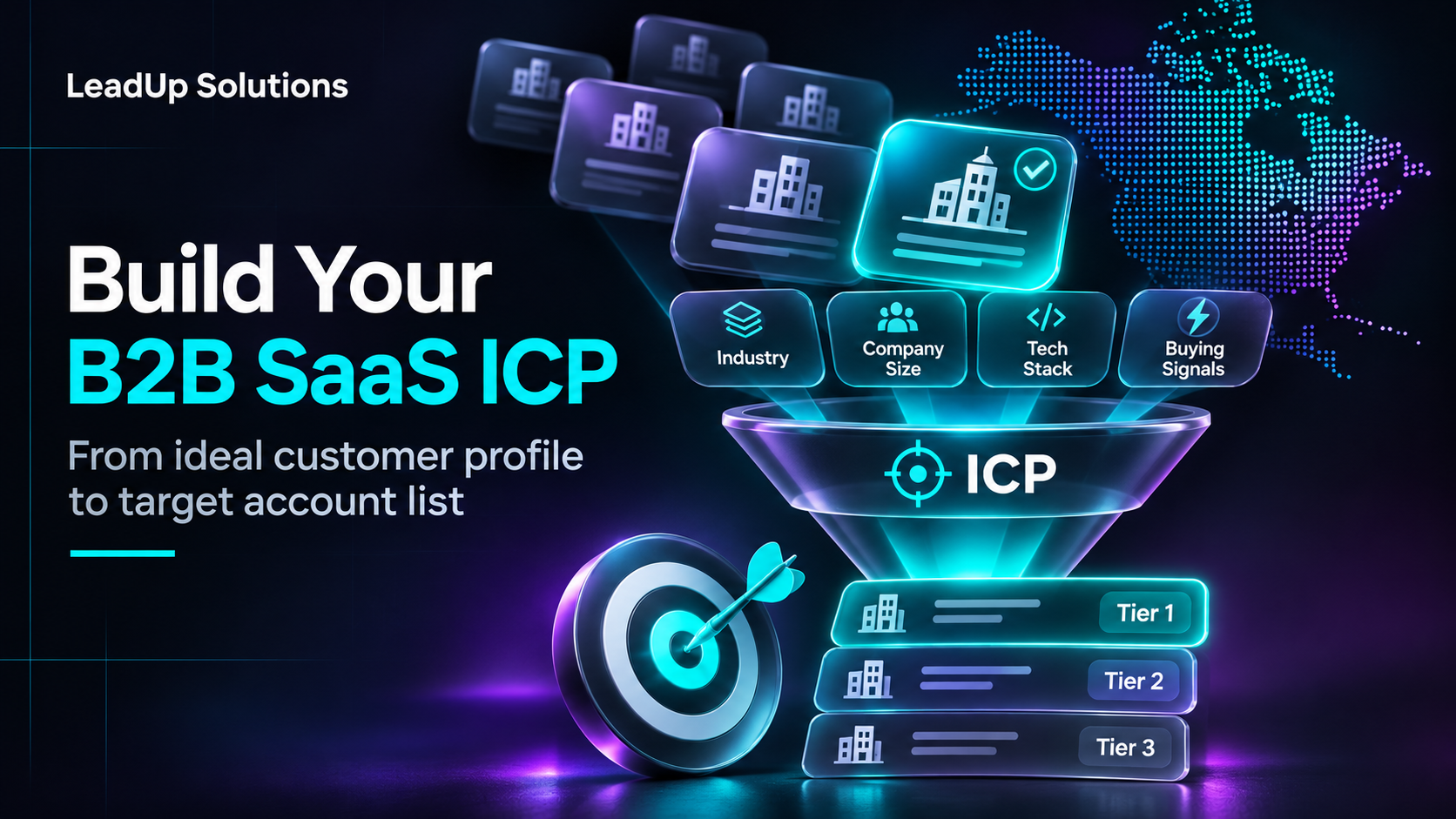
What is a B2B SaaS ideal customer profile?
An ICP describes the kind of organization your product can serve well. It typically includes industry, organization size, geography, business model, operational needs, technology environment, and buying constraints.
It differs from a buyer persona, which describes a relevant person inside the organization—their responsibilities, goals, and part in a purchasing decision. The ICP answers which companies; personas answer who within them, and why.
A target account list (TAL) is the practical selection of real companies that appear to meet the ICP. An account on your list is not automatically an opportunity, and a company that fits your ICP does not automatically have an active need.
Salesforce's ICP guide discusses firmographic, technographic, and behavioral dimensions. HubSpot's ICP template emphasizes learning from strong customers and separating the organization profile from buyer-level needs. Treat these as frameworks; your product and customer evidence should determine your own criteria.
Why a focused target account list improves outbound
An unfiltered database can create a false sense of progress. The team may reach many people without finding companies where the offer is relevant.
Poor-fit lists cause predictable problems:
- SDRs spend time researching or calling businesses outside the intended segment.
- Messaging becomes generic because the companies have unrelated challenges.
- Account executives inherit meetings that do not meet their acceptance standards.
- CRM reporting confuses activity with pipeline quality.
- Data becomes stale while oversized lists remain unused.
This does not mean there is one ideal list size. It means every account should have a reason to be included and an appropriate next action. A focused segment is easier to learn from than several unrelated markets mixed together.
Step 1: Start with customer evidence—or label your hypothesis
If your SaaS company has paying customers, review the accounts you can serve successfully. Do not rank customers solely by contract value. Consider adoption, retention, implementation fit, support burden, and the original business problems they solved.
Ask your sales, product, and customer-success teams:
- Which customers consistently obtain value from the product?
- What workflow, challenge, or event prompted them to evaluate?
- Which industries or organizational structures made implementation straightforward?
- Which accounts were expensive to serve or fundamentally misaligned?
- What objections and integration requirements recur in the strongest opportunities?
Look for patterns, not coincidences. One large customer in a sector does not establish that the entire sector is your best market.
If you are pre-revenue, write down a testable ICP hypothesis based on customer interviews, clear use cases, and verifiable company characteristics. Do not pretend you have win-rate or retention evidence you have not yet collected.
Step 2: Define the company-level filters
Your ICP should be specific enough that two people reviewing the same account generally reach the same conclusion.
Here is a fictional example for a workflow SaaS product selling to operations teams. Its employee ranges and segments are planning assumptions, not market benchmarks.
| ICP dimension | Example criteria | Why it matters |
|---|---|---|
| Industry | B2B services or multi-site operations | Matches the product's core workflow |
| Organization size | 50–500 employees | Hypothesis about coordination complexity |
| Geography | Supported US and Canadian regions | Matches selling and customer-support coverage |
| Business problem | Cross-team work tracked across disconnected tools | Connects company context with use case |
| Technology | Existing CRM and operations tools; exact stack to verify | Helps evaluate integration compatibility |
| Likely buyer roles | VP of Operations, COO, RevOps, IT evaluator | Guides stakeholder research |
| Potential trigger | Expansion, standardization project, workflow change | Suggests a reason to investigate |
| Hard exclusions | Unsupported industry, jurisdiction, or essential integration | Prevents knowingly poor-fit outreach |
Make your negative ICP just as explicit as your positive criteria. For example, an account that needs a mandatory integration your product cannot support is a poor fit even if its industry and employee count look perfect.
Keep the difference between "unknown" and "does not fit." Missing data should trigger review, not invented certainty.
Step 3: Separate fit data from buying signals
A workable target account list should distinguish three types of information.
Firmographics: what the business is
Company size, industry, operating model, and service geography help determine whether an account belongs in your market. Make size categories and industry labels consistent across the whole campaign.
Technographics: what the business uses
A company's software environment can reveal integration constraints, migration questions, or potential complementary tools. But a third-party database or old hiring post can be inaccurate. Record the source and treat unverified technologies as hypotheses.
Business or buying signals: why investigate now
A public expansion plan, new operations executive, transformation project, or hiring pattern might justify research. These signals do not prove a buying decision is underway. An SDR should validate whether the event creates an actual relevant problem.
Do not promote "recently raised funding" or "currently evaluating vendors" to confirmed fact without reliable evidence. Honest qualification protects your brand.
Step 4: Understand the buying roles
Once an organization passes the account-level screen, research its likely buying committee.
For B2B SaaS, relevant stakeholders might include:
- Operational owner: experiences the workflow problem and defines requirements.
- Economic buyer: approves or influences spending.
- Technical evaluator: considers security, integrations, and implementation.
- Daily-user champion: can explain whether the solution works in practice.
- Executive sponsor: connects the initiative with wider business goals.
Depending on the product, these may be different people or overlapping roles. A strict "must be CEO" rule can exclude the team that actually owns the problem. LinkedIn's buying committee guide discusses this multi-stakeholder approach.
First identify roles that matter, then validate real people and responsibilities through appropriate sources. Keep your account research separate from contact records, and collect only the information required for legitimate B2B outreach.
Step 5: Build your target account list in a CRM or spreadsheet
A practical target account list needs traceable evidence, not dozens of decorative columns.
| Field | What to record |
|---|---|
| Account name and domain | Verified official company identity |
| Country and region | US state or Canadian province; relevant time zone |
| Industry and business model | Consistent categories |
| Size or operating scale | Source, estimate range, last checked |
| ICP fit | High, Medium, Low, or Unverified |
| Use-case hypothesis | A specific problem your product may solve |
| Technology evidence | Confirmed, inferred, or unknown |
| Business trigger | Relevant event with source and date |
| Buying roles | Stakeholder functions to research |
| Exclusion status | Pass, review, exclude with reason |
| Tier and owner | Prioritization and person accountable |
| Next action | Validate, research, approach, hold, or exclude |
| Review date | Last meaningful verification |
Fictional example: "Northstar Service Group" could be a hypothetical US multi-location services business. A possible use case is coordinating location-level workflows. Its buyer roles might include operations and IT. Until a credible source confirms the company and relevant attributes, keep it as an example, not an actual prospect or claimed customer.
A useful list is auditable: another teammate can explain why each account is included and where its key facts came from.
Step 6: Prioritize accounts with a simple score
A sample 100-point rubric can support consistent review:
| Criterion | Maximum score | Evidence |
|---|---|---|
| Company fit | 40 | Sector, size, territory and supported business model |
| Use-case relevance | 25 | Evidence of a plausible workflow problem |
| Timely business context | 20 | Recent sourced event related to the offer |
| Research readiness | 15 | Reliable company attributes and identifiable buying roles |
| Total | 100 | An illustrative prioritization score only |
Apply hard exclusions before calculating a total. A company in an unsupported territory should not be rescued by a high score in another category.
Possible tiers:
- Tier 1: Strong ICP match, relevant supporting evidence, and enough context for tailored outreach.
- Tier 2: Promising company fit, but important information still needs verification.
- Tier 3: Weak or uncertain fit; research only if it supports a defined experiment.
- Exclude: Confirmed mismatch against a hard rule.
Do not convert these tiers into invented purchase probabilities. The rubric helps allocate research effort; it does not predict revenue.
Step 7: Verify sources, freshness, and account ownership
Data quality can deteriorate quickly. A company changes location, a prospect changes roles, or an old product listing continues circulating online.
Start with official websites, credible company announcements, permitted business data services, and relevant public documentation. For each meaningful claim, record source, observation date, and confidence. Where a fact matters to the sales approach, cross-check it.
Use three labels:
- Confirmed: supported by a reliable, current source.
- Inferred: plausible, but not directly verified.
- Unknown: insufficient evidence.
Assign a list owner and review cycle. Remove duplicates and check exclusions and suppression records before a campaign begins.
US and Canada: account research is not permission to send anything
A business appearing on a target list does not override outreach regulations. The FTC's CAN-SPAM business guide explains that the US commercial-email rules also apply to B2B marketing messages. In Canada, CRTC guidance on CASL describes applicable consent, identification, and unsubscribe requirements for commercial electronic messages.
Outreach rules can depend on communication channel, jurisdiction, relationship, and other circumstances. Follow applicable laws and platform policies; consult qualified legal guidance before launching. Do not use scraped private personal data or ignore a prospect's opt-out request.
Step 8: Turn the list into a learning-focused outbound pilot
Do not jump from "list completed" to "send the maximum volume." Run a controlled test with clear evaluation criteria.
- Select one narrow ICP segment and document the thesis.
- Review the initial accounts for exclusions and data quality.
- Research likely roles and tailor messaging around a relevant use case.
- Start appropriately compliant outreach with clear ownership and frequency limits.
- Capture why prospects are relevant, unqualified, or not ready.
- Ask account executives which meetings are useful and why.
- Update ICP criteria using actual conversations and opportunity outcomes.
Track ICP-fit rate, positive conversation rate, held meetings, sales-accepted meetings, and qualified opportunities, rather than relying only on sends, dials, or a raw lead count.
For a usable acceptance standard, read What Is a Qualified Sales Meeting? A SaaS & ERP Checklist. It explains Fit, Role, Need, and Next Step as a practical handoff framework.
A 30-day ICP rollout example
The following is an implementation sequence, not a promise that sales outcomes will appear within a month.
Week 1 — Define: review customer evidence; choose a segment; write ICP inclusions, exclusions, and buyer-role hypotheses.
Week 2 — Validate: research accounts from appropriate sources, record missing data, remove confirmed mismatches, and build a reviewable list.
Week 3 — Prioritize: apply your scoring rules, identify relevant stakeholder roles, and prepare tailored messaging with compliance review.
Week 4 — Learn: inspect conversation quality, AE feedback, and meeting relevance; refine the market hypothesis before expanding.
Some enterprise SaaS buying processes take much longer than 30 days, so interpret early feedback appropriately.
Mistakes that weaken a target account list
Treating market size as product fit. A large addressable market does not mean every business in it is an appropriate prospect.
Assuming firmographics prove need. Headcount and industry are useful filters, but they do not confirm a current purchasing initiative.
Confusing missing data with a negative signal. Mark unknown values for review.
Filling every account with unverified personal contacts. First validate the business, then research relevant roles using legitimate methods.
Treating funding or hiring as buying intent. These are potential research clues, not purchase orders.
Failing to define exclusions. A negative ICP protects SDR time as much as the positive ICP.
Ignoring post-meeting outcomes. An ICP is more useful when it evolves with customer results, AE rejection reasons, and retention patterns.
How outsourced SDR execution fits the picture
The product company should own its market strategy, qualification rules, and account data. An experienced outbound partner can support account research, coordinated prospecting, stakeholder outreach, and meeting handoff—but needs the ICP and feedback loop to work well.
Before hiring an outside provider, ask how it validates targets, handles exclusions, documents sources, respects channel rules, and reports meeting quality. If you are deciding between internal and external execution, see our Outsourced SDR vs. In-House SDR guide.
Frequently asked questions
What is the difference between an ICP and a buyer persona?
The ICP describes the organization your software fits. A persona describes an individual stakeholder's responsibilities, concerns, and role in a possible buying decision.
How many target accounts should I start with?
There is no universal correct number. Start with a list your team can research and work thoughtfully. Adjust based on available SDR capacity, segment complexity, data reliability, and the learning goal.
Can an early-stage SaaS startup create an ICP?
Yes, but label it a hypothesis until supported by customer outcomes. Use founder-led discovery, product use cases, and verified company evidence, then update it as you learn.
Do buying signals mean an account is ready to buy?
No. Hiring or expansion may be relevant context; actual need, evaluation interest, and decision process require validation.
Should US and Canadian accounts use the same ICP?
They may share a broad product-fit profile, but territory, buyer context, permitted outreach channels, consent rules, and time zones still require market-specific review.
When should an ICP change?
Update it when customer behavior, product capabilities, market conditions, or conversion evidence change. Set a regular review cadence rather than treating the first version as permanent.
Build a list that creates relevant conversations
The best B2B SaaS ideal customer profile is an operating guide, not a marketing label. Define the type of company your solution can help, choose accounts using evidence, verify buying roles, and listen to what conversations teach you.
LeadUp Solutions supports SaaS, ERP, and B2B technology companies with lead qualification, cold calling, appointment setting, cold email, and LinkedIn outreach, working from your defined ICP and meeting criteria.
If you want to turn a focused list of US and Canadian accounts into more relevant sales conversations, talk to LeadUp Solutions about an outbound pilot.