B2B event follow-up begins before the conference closes or the webinar ends. An attendee list is not a pipeline, a badge scan is not a qualified sales conversation, and a registration form does not automatically authorize every kind of future marketing. The commercial value comes from what your team learned, what the attendee actually requested, and whether you can provide a useful next step.
For B2B SaaS and ERP companies selling in the United States and Canada, events can reveal specific buyer problems that cold outreach might otherwise miss. But a busy booth or a large virtual audience also produces incomplete notes, duplicate records, and very different levels of intent. This playbook shows how to capture that context, route follow-up responsibly, qualify interest, prepare an SDR-to-AE handoff, and measure the outcome without inflating pipeline.
Quick answer: Prioritize people who expressly requested a conversation, give promised resources to those who asked for them, verify that each contact is eligible for the proposed channel, assign an owner and a realistic response window, and record the buyer's actual need. Count sales-accepted meetings and new qualified opportunities separately from registrations, scans, replies, and automated messages.
Why event leads are different from ordinary prospect lists
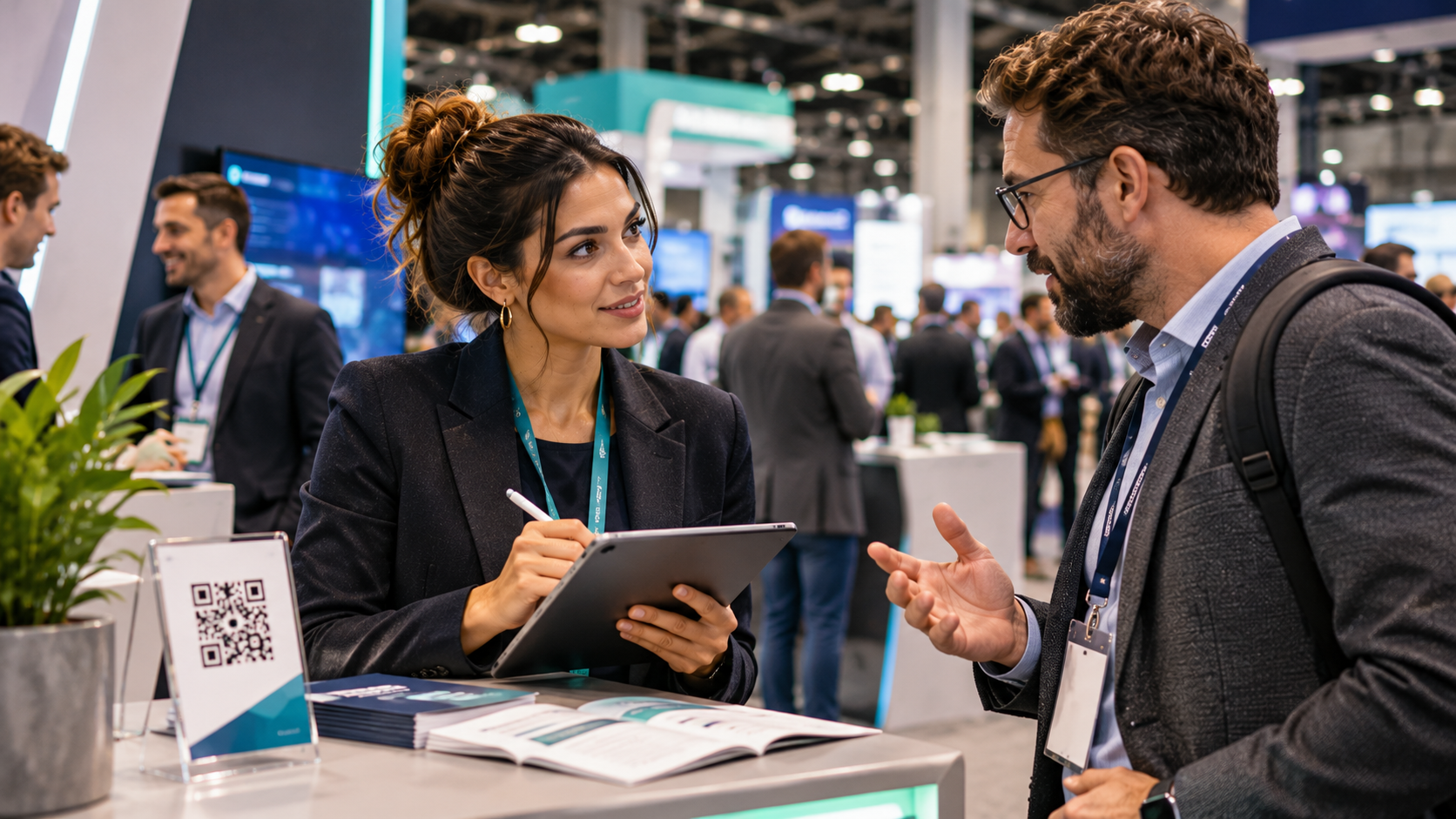
At a trade show, a visitor may have spent fifteen minutes describing a specific operational bottleneck. Someone else may have scanned a QR code only to download a brochure. A third person may have entered the booth by mistake. All three can end up in the same event export unless the team captures what happened.
Webinars create a different problem. Registration can indicate interest in a topic, but registration is not attendance, attendance is not a request for a sales call, and watching a product segment is not conclusive evidence of a project.
These are the questions a useful post-event program should answer:
- What did the person actually do or ask for?
- Was there a conversation, a question, a requested resource, or just attendance?
- Is the company and role relevant to the offer?
- What follow-up was promised, if anything?
- Is this a current customer, active opportunity, partner, student, or new prospect?
- What contact permission and restrictions apply?
- Who owns the next step, and how will they know it was completed?
A program built around those answers will produce a smaller but more credible pipeline than one that treats a purchased attendee list as confirmed buying intent.
LeadUp Solutions lists Event & Webinar Follow-up among its services, including event-tailored messaging, qualification, meeting booking, and reporting outcomes per event. The process below explains how to make that work without assuming all visitors have the same expectations.
1. Separate attendee types before the first follow-up
Use an intent-based taxonomy that the event team and sales team approve before collecting leads.
| Event interaction | Evidence you may have | Appropriate next step | What not to assume |
|---|---|---|---|
| Explicit meeting request | Buyer asked for a discussion and provided agreed contact details | Route to a sales owner with a relevant agenda | That the opportunity is already sales-qualified |
| Detailed booth conversation | Discussion notes, use case, role, follow-up agreement | Respond to the promised next step, if permitted | That a badge scan proves consent |
| Specific webinar question | Asked about capability, workflow or implementation | Answer accurately or involve the right specialist | That every question is a purchase request |
| Webinar attendee, no question | Confirmed participation and topic | Provide requested event materials where appropriate | That attendance permits a cold sales sequence |
| Registered, did not attend | Registration only | Deliver any promised replay under applicable preferences | That the person heard the presentation |
| Downloaded a slide deck or report | Accessed a resource | Fulfill the request and respect preferences | That content consumption equals an SQL |
| Existing customer or open opportunity | Account matching and ownership records | Route to the appropriate account or support owner | That the prospect is new pipeline |
| Partner, vendor or irrelevant attendee | Nonbuyer business context | Classify and close or route as appropriate | That every lead should enter a campaign |
| Opt-out or do-not-contact | Explicit restriction | Honor suppression and record it | That event attendance overrides a prior refusal |
The most useful distinction is not simply “hot, warm, cold.” It's what the attendee asked you to do next.
Cvent's trade-show lead capture guidance emphasizes capturing useful context and qualifiers at the point of interaction rather than expecting an undifferentiated list to support later sales conversations.
2. Prepare the capture process before the event
A good follow-up program is set up while the organizer, booth staff, webinar producer and sales operations team can still agree on common fields.
A practical event-capture checklist
Capture only what the process needs, with appropriate privacy information and safeguards:
- Event ID, event name, event date and whether interaction happened in person, live online, or afterward.
- Account and individual identifiers, with duplicate matching to existing CRM records.
- Actual role, relevant business problem and products or workflows mentioned.
- Interaction type: conversation, question, requested demo, resource, registration, attendance, or referral.
- What material or response was explicitly promised.
- Contact-channel eligibility, preferences and how that basis was obtained.
- Responsible booth representative or webinar host.
- Assigned sales owner, next action, due date and disposition.
Do not secretly enrich personal details that the buyer did not supply or that your company has no appropriate basis to use. Store the minimal information required for an accurate handoff and follow your retention policy.
QR scans, badge scans and business cards mean different things
A badge-scanning app may prove you met someone, but not what you said or whether they agreed to future marketing. A business card identifies a contact, not an unlimited opt-in. Similarly, a webinar registration form may contain a separate marketing consent checkbox, or it may simply process registration to deliver the session.
Preserve the actual contact context—event, conversation notes, preferences, legal basis and record date—so a reviewer can determine what type of message is permitted.
Design recommendation: Include one short free-text box labeled “Buyer question or promised next step” in the booth capture form. Requiring that field for a meeting-request category is often more valuable than adding an arbitrary score.
3. Set an event-specific follow-up SLA
An internal service-level agreement should identify when the request was received, what counts as a meaningful response and which team owns it. Time targets must reflect real coverage, including travel days, time zones and shifts.
An illustrative operating model:
| Priority | Trigger | Suggested handling target | Owner |
|---|---|---|---|
| A — Requested next conversation | Buyer asked for demo, qualification or technical review | Same staffed day or next available business window | Named SDR/AE |
| B — Promised specific material | Team agreed to send a deck, product answer or case study | Complete in the agreed timeframe | Event rep or relevant specialist |
| C — Engaged, undecided | Real conversation but no agreed meeting | Review eligibility and relevance before any outreach | SDR with account owner |
| D — General webinar participation | Attended but did not request sales contact | Fulfill event commitments; opt-in nurture only where permitted | Marketing |
| E — Unqualified or suppressed | Wrong fit, existing support request or opt-out | Route, close or suppress appropriately | Operations |
These are suggested internal categories, not LeadUp's published SLAs or a claim that every lead must receive contact within a fixed number of hours.
Separately record an automated receipt, an attempted contact, and a meaningful human response. A system-generated “we'll be in touch” email should not make the response-time dashboard appear perfect.
Cvent recommends timely, context-specific post-show follow-up; its guidance also underscores that notes and promised next steps matter. Speed alone does not establish eligibility or interest. Source: Cvent trade-show guide.
4. Use different follow-up workflows for trade shows and webinars
In-person conference or trade show
A booth interaction can carry valuable verbal context: the current system, the pain point, the relevant team, the attendee's role, and the exact item the representative agreed to provide.
The handoff should not be “met at trade show—send a sales email.” It should say, for example, “Buyer asked for a technical overview of data migration constraints; representative agreed to introduce a solutions consultant; no project timeline confirmed.”
Use the named event and actual conversation to make the next step understandable. If the visitor merely picked up printed material, don't invent familiarity or claim that you discussed a buying project.
Live webinar
Start with the registration and attendance facts, then add actual interaction signals. A question submitted during the session can be routed for a tailored answer. A product demo request made through an explicit form should be handled as a direct inquiry.
Segment registered but absent, attended without engagement, asked for materials, and requested sales help as different cohorts. Do not mark someone as a qualified meeting based on watching a video.
On-demand webinar replay
A replay viewer may appear days or weeks after the original event. Keep the source event and access date in the CRM, and avoid email that pretends the webinar just ended. A person asking for a replay should first receive the promised replay, under the communication terms they agreed to.
5. Write a follow-up that remembers what was actually said
These examples are for contacts and channels that are appropriate and lawful for the particular situation. Replace the brackets only with verified facts.
Template A — A booth visitor who requested a follow-up call
Subject: Following up on [specific workflow] from [event name]
Hi [First name],
Thanks for speaking with us at [event name]. You mentioned [the problem the visitor actually described], and we agreed that a conversation about [the specific next step] could be useful.
If that's still your priority, here's [approved scheduling option], or feel free to suggest a convenient time. I can also include [the correct specialist] to address [unresolved question].
Best,
[Name]
The first sentence should be deleted rather than invented if the rep cannot verify the interaction.
Template B — A technical question at the booth
Subject: The [topic] information you requested at [event]
Hi [First name],
At [event], you asked whether [specific capability or workflow] is supported. I wanted to send the accurate information rather than guess.
Here's [verified documentation or specialist response]. One part still needs confirmation: [explicit uncertainty].
Would a short technical discussion help, or would the documentation be enough for now?
[Name]
Template C — A webinar attendee requesting a resource
Subject: The [webinar topic] materials you requested
Hi [First name],
Thanks for joining [webinar name]. As requested, here's [actual slides or replay link].
If there's a particular [SaaS or ERP workflow] you'd like clarified, you can reply with a question. You don't need to book a meeting to use the resource.
[Name]
Template D — A registrant who missed the webinar
Subject: Your [webinar topic] replay
Hi [First name],
You registered for [webinar title]. If you still want the session, here's the replay: [verified link].
The discussion covered [accurate brief topic]. If you have a question about a section, you're welcome to reply.
[Name]
Use this only where sending the replay is appropriate to the registration terms and contact preferences. Do not add an unrelated marketing sequence simply because the person registered.
Template E — A conversation with no agreed next step
If there was no explicit commitment and no suitable legal basis for commercial follow-up, do not send an outreach message merely because the name is in the export. Record the interaction and apply appropriate preference and eligibility checks first.
For more detailed reply handling, read our guide to converting outbound replies into qualified conversations.
6. U.S. and Canada: event attendance is not universal permission
Legal rules depend on jurisdiction, message type, source of the contact, specific relationship and prior preferences. A sales operator should not infer consent from a tool label such as “event lead.”
United States: commercial email and CAN-SPAM
The FTC's official CAN-SPAM guide explicitly covers commercial business-to-business email. Where the law applies, email needs accurate sender and subject information, proper business identification, a valid postal address, an appropriate unsubscribe mechanism and timely opt-out handling. Commercial content does not become automatically exempt simply because the recipient met the sender at an event.
The FTC also explains that a company cannot contract away its responsibilities when a vendor sends campaigns on its behalf. If an external SDR firm performs the follow-up, the client and provider should agree who operates suppression and who investigates complaints.
Canada: cards, scans and CASL
The CRTC's CASL FAQ states that receiving a business card may support implied consent under specific conditions, such as relevance to the recipient's business role and no indication that they reject promotional messages. It is not an unconditional rule, and the sender bears responsibility for proving the basis.
The CRTC's guidance on documenting implied consent specifically describes an example of a business card supplied at a trade show. It advises keeping evidence of the conversation and disclosure, and cautions that a confirmation email may itself be a commercial electronic message requiring identifying information and an unsubscribe mechanism.
Likewise, a webinar sign-up, purchased attendee list, or event badge scan is not automatically an unrestricted commercial email permission. Some B2B exemptions exist, but their conditions must be met; do not assume they cover every company-to-company message.
For both markets, phone calls, SMS, privacy and personal-data retention can have additional requirements. Get qualified advice for the actual program. This is an operational overview, not legal advice.
7. Route event leads into the CRM without turning scans into pipeline
Use an agreed integration path between event software, marketing automation, CRM, and the assigned SDR or account owner. Prefer clear ownership and complete context over creating many duplicate contacts.
A useful CRM field set:
| Field | Purpose |
|---|---|
| Event ID and channel | Distinguish trade show, live webinar, or replay |
| Interaction type | Conversation, question, resource request, demo request, attendance |
| Received/captured timestamp | Supports reporting on follow-up windows |
| Attendee source and permission evidence | Documents eligibility and preferences |
| Company, contact and existing account IDs | Prevent duplicates and ownership conflicts |
| Buyer-stated problem or exact question | Protects context |
| Promised action and due date | Makes the obligation visible |
| Assigned owner and fallback | Prevents an unmonitored queue |
| First meaningful response date | Measures real handling, not autoresponder activity |
| Fit and qualification evidence | Distinguishes interest from sales readiness |
| Meeting ID and AE acceptance status | Connects event contact to quality outcomes |
| Opportunity ID and event attribution rule | Supports defensible pipeline reporting |
Test the data flow with sample records before the event. Include a duplicate attendee, an existing customer, an opt-out, a visitor without email, an offline booth capture and a webinar registrant who did not attend.
Do not count every capture as a sales-qualified lead
A badge scan is a capture event. A webinar question is an engagement event. A buyer's stated project need is a qualification signal. A meeting accepted by the sales owner is a downstream outcome.
Our MQL vs. SQL vs. sales-accepted meeting guide explains the stages, while our SDR-to-AE handoff checklist shows how to preserve buyer context once a meeting is booked.
8. Build a practical post-event operating calendar
Use a reviewable schedule with owners—not a rigid multi-touch sequence imposed on everyone.
| When | Activity | Output |
|---|---|---|
| Before the event | Approve ICP, capture fields, legal/privacy disclosures, owner routing and resource links | Working handoff process and sample record |
| During the event | Record conversations and promised next steps promptly | Context-rich, deduplicable lead records |
| First staffed follow-up window | Prioritize explicit buyer requests and deliver promised information | Completed obligations and named owners |
| Following business days | Route genuine questions, review fit, and offer relevant conversations where appropriate | Qualification notes and actual buyer replies |
| Following weeks | Review legitimate nurture eligibility, meeting outcomes and disqualifications | Updated statuses and suppression |
| Event review | Reconcile attendance, contact records, accepted meetings and attribution | Event scorecard and fixes for next time |
A practical way to protect quality is to conduct a daily review of unowned requested follow-ups while the event is active and immediately afterward. Do not call the workflow complete because the initial email campaign reported a high “delivered” rate.
If you need a wider process for buyer-initiated inquiries after an event, our inbound lead response playbook covers routing, SLAs and missed-lead recovery in depth.
9. Measure event ROI using accepted outcomes—not scan counts
Event reports often lead with badges scanned or registrants collected because those numbers are easy to produce. An honest scorecard needs metrics that survive a sales quality review.
| Metric | Definition | What it answers |
|---|---|---|
| Unique event contacts | Deduplicated people captured under an agreed rule | How much reachable event interest was recorded? |
| Meaningful interactions | People who actually discussed a relevant question or made a clear request | What did the team learn? |
| Eligible follow-ups | Contacts for whom the specific planned contact is appropriate | Who can be approached responsibly? |
| Follow-up completion | Promised next steps completed ÷ promised next steps due | Did we keep commitments? |
| Meaningful response rate | Distinct contacted people who respond substantively ÷ distinct people contacted | Are the conversations continuing? |
| Meetings booked | Unique meetings arranged from verified event context | Did a next conversation get scheduled? |
| Meetings held and accepted | Meetings that occurred and met AE acceptance rules | Were they useful? |
| Qualified opportunity creation | New opportunities meeting your normal standards | Did demand materialize? |
| Event-influenced pipeline | Qualified pipeline with an explicitly defined event-touch rule | What value did the event contribute to, without overstating causation? |
| Event cost | Sponsorship, tickets, travel, staff time, tools and other agreed costs | What resources were invested? |
Define a reporting window, attribution model and denominators before comparing conferences. A contact who is already in an active deal can be event-influenced without being a newly sourced opportunity. Do not automatically credit the entire deal amount to the event.
Example: a fictional event report
Suppose a company attends a niche ERP conference and captures 120 unique contacts. On review, 35 have meaningful, documented conversations. Of those, 24 are eligible for the intended follow-up. 18 receive the specific response or material they were promised. 7 reply substantively, 4 agree to a sales conversation and 2 meetings are held and accepted by the AE.
Using the stated denominator:
- Promised follow-up completion: 18 / 24 = 75%, only if all 24 contacts actually had promised actions due in the reporting window. Otherwise use the true due-obligation count.
- Meaningful response rate: 7 / 24 = 29.2% when all 24 were contacted in the defined cohort.
- Sales-accepted meetings: 2. This is a count, not a conversion guarantee.
These numbers are fictional arithmetic examples, not LeadUp performance, an industry average or a forecast. Good reporting should clearly identify whether the 24 eligible contacts were all promised material, contacted, or simply reviewed; the denominator must match the question.
Calculating ROI without claiming all influenced revenue
A simple financial measure is:
[ \text{Event ROI} = \frac{\text{Attributable gross profit} - \text{Event cost}}{\text{Event cost}} \times 100% ]
In practice, event-sourced/influenced attribution may be ambiguous, closed deals may not occur during the reporting window, and recurring services have delivery costs. Don't substitute the full value of an open pipeline for realized gross profit or imply that a tentative meeting is revenue.
If you only have early-stage data, report cost per sales-accepted meeting with clear limitations, and track genuine opportunities separately until commercial results exist. Our appointment-setting metrics framework covers booked, held and accepted stages.
10. Who should own the handoff after a trade show or webinar?
An external SDR partner can help execute follow-up, but the event host still owns what was promised, which prospects are in scope and what claims are approved.
| Workstream | Event/marketing owner | SDR team or provider | Sales/RevOps |
|---|---|---|---|
| Event capture and consent disclosures | Accountable | Uses approved process | Reviews data rules |
| Interaction notes and exact promises | Trains booth/host reps | Receives and verifies handoff | Checks quality |
| Duplicate and existing-account matching | Supplies source data | Flags collisions | Governs CRM ownership |
| Follow-up copy and technical claims | Reviews event context | Drafts and executes approved messages | Approves commercial and specialist claims |
| First human response | Supports requested materials | Owns assigned response | Handles complex escalations |
| Meeting qualification | Consulted | Applies criteria | Defines acceptance |
| Event-source attribution | Owns event metadata | Logs interaction | Controls opportunity reporting |
| Program review | Evaluates event investment | Reports buyer outcomes | Accepts quality and pipeline results |
The specific contract and organization determine assignments. The principle is that each requested next step has one owner and a way to escalate if that owner is unavailable.
For a broader vendor operating framework, see our outsourced SDR onboarding guide.
Copyable trade-show and webinar follow-up checklist
Before the event
- Define the event's ICP, relevant buyer roles and acceptable next steps.
- Set up event ID, CRM capture fields, duplicate handling and fallback owners.
- Confirm privacy notices, consent evidence and applicable contact rules.
- Test badge/QR or webinar imports without silently opting people in.
- Prepare accurate replay/material links and approved technical responses.
During the event
- Capture the conversation's actual topic and the attendee's request.
- Record materials or introductions promised, with an owner and due date.
- Distinguish registration, attendance, booth interaction and direct demo request.
- Flag existing customers, active deals, referrals and do-not-contact cases.
After the event
- Prioritize explicit commitments and eligibility before generic sequences.
- Send relevant messages only through approved channels.
- Record meaningful human responses separately from automation.
- Qualify meetings using agreed SDR-to-AE standards.
- Honor unsubscribe requests and correct account ownership conflicts.
- Review accepted meetings, new opportunities, event cost and attribution.
- Record lessons and process changes before the next event.
Frequently asked questions
How quickly should a sales team follow up after a trade show?
Prompt follow-up is often useful when the visitor explicitly requested a response, but the correct target depends on staffed hours, the agreement made, the buyer's time zone and contact eligibility. Define an SLA your team can fulfill; don't treat a universal 24-hour rule as a guarantee of conversion.
Is every trade-show badge scan a marketing lead?
No. A scan may record an encounter and contact information. You still need appropriate permissions, a defined purpose, the buyer's request or relevant context, and accurate CRM classification before choosing a commercial follow-up.
Can a Canadian business contact be emailed after handing over a card?
Sometimes, subject to CASL's specific conditions and proof requirements. A business card is not universal consent to every marketing sequence. Check the circumstances, relevance to the person's role, any stated refusal and applicable identification/unsubscribe rules.
What should we send to people who registered but missed a webinar?
Where appropriate to their registration and preferences, send a truthful replay or promised resource rather than falsely saying they enjoyed the live session. Don't mark them as attendees or qualified buyers without supporting facts.
Should an outsourced SDR follow up with event attendees?
Yes, if the event owner has authorized the relevant outreach, supplied accurate interaction data, defined eligibility and ownership, and agreed qualification and meeting-handoff rules. The provider should not improvise consent, product guarantees or event conversations.
How should we compare events with different audience sizes?
Compare consistent cohorts and stages—eligible contacts, completed promised follow-ups, held and accepted meetings, genuine opportunities, and attributable costs. A small specialized conference can be commercially useful without winning on raw registration counts.
Turn event conversations into a sensible next step
The value of a trade show or webinar is not the length of the attendee export. It is whether the team remembers the buyer's question, fulfills what it promised and creates a responsible path to an appropriate next conversation.
LeadUp Solutions offers Event & Webinar Follow-up as part of its B2B sales development services: timely, context-specific responses, qualification against agreed standards, meeting booking and transparent event reporting. We also support coordinated outbound and sales handoffs when those are relevant to the buyer and permitted by the outreach rules.
If your SaaS or ERP company is planning an event or has a backlog of conference or webinar contacts to sort through, contact LeadUp Solutions to discuss your event follow-up process. Start with the event, the actual interactions, the follow-up commitments and what a useful sales conversation should look like.