Understanding MQL vs SQL vs sales-accepted meeting is essential when marketing, SDR and account-executive teams report the same pipeline. These terms can describe different kinds of progress, and no single universal definition works for every SaaS or ERP business.
When a marketing-qualified lead is treated like a booked meeting—or an SDR-booked call is counted as a qualified opportunity—leadership gets an inflated picture of sales readiness. The fix is a shared definition of each stage, a clear owner and evidence required before a record advances.
This guide gives SaaS and ERP revenue teams in the United States and Canada a practical lifecycle framework, a distinction between lead qualification and meeting acceptance, example CRM fields, routing rules and reporting formulas.
Quick answer: An MQL meets marketing's documented qualification criteria; an SQL has been qualified by sales under its own policy; a sales-accepted meeting is an appointment that an AE has reviewed and approved against agreed meeting criteria. SAL can represent an intermediate lead-ownership decision, but it is optional. These labels describe related decisions, not interchangeable measures of pipeline or permission to contact someone.
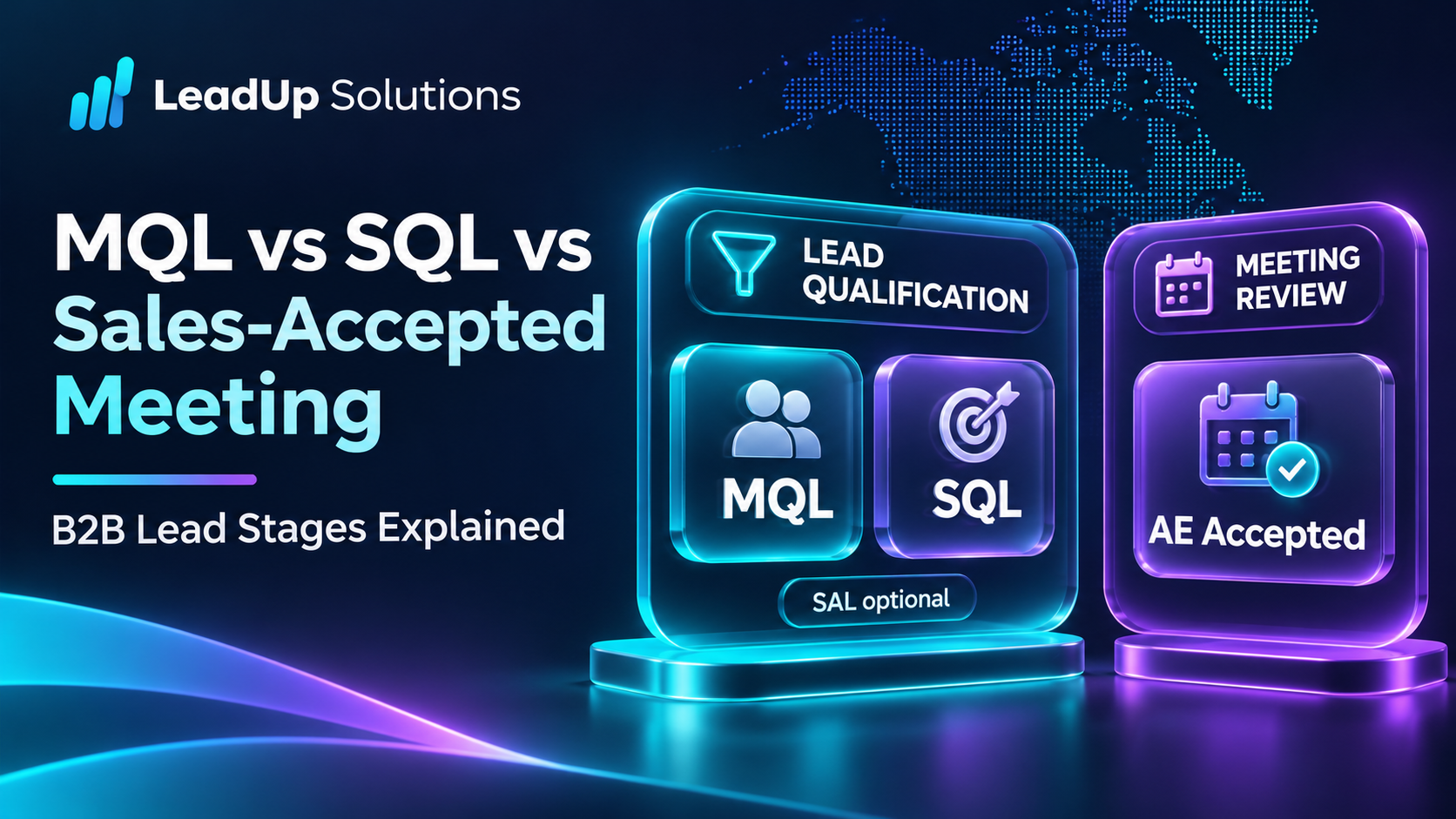
Lead stages serve different decisions
The most useful approach is to define each stage as a documented decision gate with an owner, eligibility rules, required evidence and a next action.
- Lead: A contact or company record requiring research or a qualification decision. The record itself does not imply consent or buying intent.
- MQL (Marketing Qualified Lead): A person or account meeting marketing's agreed threshold of fit and/or relevant engagement for sales review.
- SAL (Sales Accepted Lead): An optional acceptance event in which a named sales owner agrees to take responsibility for reviewing or pursuing a lead.
- SQL (Sales Qualified Lead): A lead that sales has qualified under its documented criteria as a potential customer appropriate for active sales attention.
- Sales-accepted meeting: A separate booking or event with enough confirmed context to satisfy the AE team's meeting-acceptance rules.
- Opportunity: A potential commercial deal recorded after sales confirms the company's own opportunity-creation conditions.
The exact requirements and labels are not universal. HubSpot's lifecycle-stage documentation includes default Lead, Marketing Qualified Lead, Sales Qualified Lead and Opportunity stages; its default set does not require SAL or sales-accepted meeting as lifecycle stages. Organizations can customize their own process. Salesforce's MQL vs SQL guide also distinguishes early qualification signals from sales-readiness.
The important distinction: a lead is not a meeting
You might have one account with three contacts, only one of whom has become an SQL. That account may also have two scheduled meetings: one accepted for discovery and another pending AE review.
Treat lead/contact lifecycle, meeting attendance, AE meeting acceptance, and opportunity stage as related but independent data. An accepted meeting can be rescheduled or missed. A meeting that took place can still be rejected for poor fit. Neither case should automatically rewrite the person's lifecycle stage.
For the detailed meeting-acceptance rubric, use our qualified sales meeting checklist.
MQL: a marketing signal, not a buying commitment
An MQL may arise from a combination of target-account fit and relevant engagement, such as requesting a product resource or participating in a useful event.
Engagement is not the same as a confirmed business need. Someone downloading a guide may be researching for a project, an academic assignment or general professional interest.
A useful MQL rule should capture why a record is considered relevant, what information is known, what remains uncertain, and what sales should do next. If marketing cannot explain the qualification evidence, the label may be misleading.
Example MQL gate — illustrative, not a benchmark
A company might require an account to fall within its supported ICP, a relevant buyer role to be identified, and a meaningful engagement or inquiry to occur. This is a sample internal policy, not a claim that every guide download or event registration deserves sales follow-up.
A scoring model can help organize signals, but preserve which facts earned the score and the scoring version. An unknown buying role should not be converted into a confirmed decision-maker by an automated score.
SQL: a sales judgment grounded in context
SQL usually means the sales team has reviewed relevance and determined that further selling activity is warranted. For a SaaS product, that may involve company fit, a stakeholder with appropriate responsibilities, and a credible use case.
For an ERP implementation partner, the sales team may also need to consider product scope and likely technical constraints. But it should not invent a budget or implementation timeline that a prospect has not confirmed.
SQL criteria should reflect the actual sales motion: early discovery and enterprise procurement are different stages.
For example, an outbound SDR speaking to a relevant operations manager who describes a real workflow problem may have enough verified context for sales qualification without that prospect ever becoming an MQL. Not every SQL originates from inbound marketing, and some sales teams treat qualification differently based on product and buying cycle.
Salesforce's SQL guidance describes intent and sales-readiness signals, while noting that some organizations use intermediate acceptance stages and some do not. Avoid treating any one vendor's defaults as a requirement for your CRM.
Sales-accepted meeting: a quality gate for appointments
A sales-accepted meeting reflects that a particular conversation meets the criteria SDR and AE leaders agreed on before outreach.
Those criteria might cover Fit, Role, Need and Next Step. The meeting's existence does not prove the buyer is ready to purchase, and the scheduled appointment should be tracked separately from attendance.
AE acceptance can happen before or after the call, depending on the policy. The CRM should therefore preserve a booking ID, scheduled time, attendance status, review status, reviewer, decision timestamp and any rejection reason. Do not assume a future accepted meeting is already held or counted as an opportunity.
Our qualified meeting checklist provides a detailed model. For the transfer of notes and ownership, see the SDR-to-AE handoff guide.
Compare the stages side by side
| Decision / stage | Typical owner | Minimum evidence | Next action |
|---|---|---|---|
| New / unqualified lead | Marketing, SDR or operations | Source, correct account/contact identity, fit still unknown | Validate; suppress if ineligible |
| MQL | Marketing | Documented fit and/or meaningful engagement threshold | Submit to sales for review |
| SAL (optional) | Assigned SDR or AE | Sales owner explicitly accepts responsibility | Research, respond or return with reason |
| SQL | Sales | Verified relevance and sales qualification per agreed policy | Explore next step, often discovery |
| Meeting booked | Scheduling owner | Contact agreed to a time and purpose | Transfer context and confirm logistics |
| Meeting accepted by AE | AE / meeting reviewer | Fits accepted meeting criteria, with recorded decision | Prepare discovery or request clarification |
| Meeting held | AE / meeting host | The intended conversation actually took place | Record outcome and next action |
| Opportunity | AE / sales leadership | Explicit opportunity-creation criteria met | Manage buyer evaluation and forecast appropriately |
These are different record types and decisions. A CRM can store MQL/SQL in a lead or lifecycle property, while meeting bookings and acceptance belong on separate activities or meeting records. Some organizations omit MQL for outbound entirely; others use their own stages, such as "Working" or "Recycled."
A sample stage-entry and exit contract
For every stage, publish:
- Entry rule: Which facts or actions make a record eligible?
- Owner: Which team and person are responsible?
- Required evidence: What must be in the CRM?
- Exit rule: What creates the next stage or routes the record elsewhere?
- Failure path: What happens if the lead does not qualify or cannot be reached?
- Audit trail: Which actor or automation changed the status, and when?
A stage should not exist solely because a dashboard designer wants a prettier funnel. Give it a distinct operational meaning, owner or action.
Make acceptance and rejection reasons visible
A lead-routing process should allow the sales team to accept, reject, or request clarification. If sales rejects the record, use a reason code that marketing and SDR managers can act on.
Possible reasons include outside-ICP account, irrelevant function, unsupported territory, duplicated record, insufficient business context, or premature stage classification.
Do not label every rejected lead as "marketing failure." Sometimes qualification rules are unclear or the AE's territory changed. Review the evidence and the policy together.
Separate accept, reject, clarify and recycle
| Outcome | Meaning | Required record |
|---|---|---|
| Accepted | Sales takes ownership under the agreed stage definition | Owner, timestamp, decision reason |
| Clarification | Sales needs a missing fact before deciding | Specific request and responsible person |
| Rejected — not a fit | Confirmed hard exclusion or unsuitable segment | Evidence and standardized reason |
| Recycled — not ready | Potential fit, but no current reason or timing to proceed | Reason and appropriate review criteria |
| Suppressed | Contact preference or channel rule prevents outreach | Suppression state retained through routing |
Never use a recycling action to evade an opt-out. Do not automatically move rejected leads back into sequences without checking the actual reason and communication rules.
Two fictional examples: inbound and outbound do not always follow the same funnel
Example A: Inbound SaaS evaluation
Imagine a fictional US workflow SaaS provider with a verified ICP.
- A relevant operations manager requests a product guide through a channel that permits the requested follow-up. Marketing records the source and account fit.
- Based on a documented combination of role relevance and engagement, marketing classifies the lead as MQL.
- A named sales owner explicitly accepts the lead for review; this business uses an optional SAL stage.
- A sales conversation reveals a specific workflow need and a meaningful reason for discovery. Under this business's written rules, sales marks the record SQL.
- The contact agrees to a discovery meeting. The SDR creates a separate booking record with purpose and time zone; the AE reviews and accepts the meeting.
- After the call, the AE records whether it was held and whether sufficient evidence exists to open an Opportunity.
None of the above proves that a real LeadUp customer took these steps or guarantees a deal.
Example B: Outbound ERP discovery
A fictional ERP partner researches a permitted target account and speaks with an operations stakeholder who describes a possible cross-site reporting issue.
The record can enter as a sales-sourced lead rather than an MQL. If sales verifies the company's fit and the stakeholder's role and need, it may be classified directly as SQL under the partner's policy. A discovery meeting can then be booked and separately accepted by the AE.
This path does not require inventing marketing engagement to make funnel reports look consistent. Nor does it prove an ERP replacement, allocated budget or active vendor selection. If the target is not a fit, record that honestly.
Example C: A booked meeting that is not an opportunity
A prospect agrees to a call but cannot describe a relevant need, or the AE discovers a hard product mismatch. The meeting may be Booked and even Held, yet fail the AE's quality or opportunity gate. Keep every event accurate; do not backfill opportunity status merely to make the funnel appear linear.
Takeaway: Design the route around the real sales motion instead of forcing every account through the same marketing and sales labels.
CRM fields that prevent stage confusion
Use stable IDs and meaningful event timestamps. Account, contact/lead, meeting, and opportunity records should be associated but not treated as a single interchangeable object.
| Field | Level | What it supports |
|---|---|---|
| `account_id`, `lead_id`, `contact_id` | Account/lead/contact | Prevents duplicate identity and incorrect attribution |
| `lead_source`, `campaign_version` | Lead | Distinguishes inbound and outbound paths |
| `icp_fit`, `role_verified` | Account/lead | Evidence for the target-market and persona rules |
| `engagement_evidence`, `score_version` | Lead | Documents MQL rationale, when used |
| `lifecycle_stage`, `stage_changed_at` | Lead/contact | Records formal stage and update time |
| `submitted_to_sales_at`, `sales_owner` | Lead | Tracks handoff and accountability |
| `sales_acceptance`, `sales_acceptance_reason` | Lead | Optional SAL acceptance or return |
| `qualification_evidence` | Lead | SQL decision without guessed budgets or roles |
| `meeting_id`, `meeting_scheduled_at` | Meeting | Unique appointment journey and time |
| `attendance_status`, `held_at` | Meeting | Booked, future, cancelled, no-show, held |
| `ae_meeting_decision`, `ae_reviewed_at` | Meeting | Independent accepted/rejected/pending review |
| `meeting_rejection_reason` | Meeting | Explains quality outcomes |
| `opportunity_id`, `opportunity_created_at` | Opportunity | Valid sales opportunity reporting |
| `suppression_status`, `contact_preference` | Contact | Carries legally relevant channel restrictions |
Keep a change log of status transitions, including actor, date, previous value, new value and reason. A contact can change teams or a meeting can be rescheduled; do not erase the history.
HubSpot implementation nuance: According to HubSpot's lifecycle-stage documentation, default automated lifecycle changes generally advance the stage rather than move it backward. Recycling, corrections and custom SAL/meeting decisions may require deliberate configuration instead of assuming a built-in automatic reversal.
Protect personal and business information with appropriate access permissions. Never use a status update to delete suppression instructions.
Metrics should follow the same stage rules
A good revenue dashboard answers which decision changed, during which time period, for which eligible records.
| Measurement | Example calculation | Denominator caveat |
|---|---|---|
| MQL-to-SAL acceptance | MQLs accepted by sales ÷ MQLs submitted and reviewed | Exclude still-pending reviews from a completed-decision rate |
| MQL-to-SQL conversion | SQLs originating in an MQL cohort ÷ eligible MQLs in that cohort | Allow the cohort to mature; do not count outbound SQLs as MQL conversions |
| Sales review completion | Submitted leads with final decision ÷ leads due for a decision | Keep clarification and pending explicit |
| AE meeting acceptance | Accepted meeting reviews ÷ (Accepted + Rejected) meeting reviews | Not identical to SAL lead acceptance |
| Booked-to-held | Held bookings ÷ appropriately eligible booked meeting cohort | Exclude future bookings from attendance outcomes |
| SQL-to-opportunity | SQL cohort that became qualified opportunities ÷ SQLs in sufficiently mature cohort | Opportunity definition and sales cycle must be consistent |
Worked example — fictional numbers, not a benchmark
Suppose a fictional marketing cohort contains 40 MQLs, of which 30 have reached a completed sales review: 24 accepted as SAL and 6 rejected; the other 10 remain pending. The completed-review SAL acceptance rate is 24 ÷ 30 = 80%. The submission yield so far is 24 ÷ 40 = 60%, but that is not the final acceptance rate because ten decisions remain outstanding.
Suppose 12 of the original 40 MQLs eventually become SQLs during an explicitly defined observation window. The MQL-to-SQL conversion for that cohort is 12 ÷ 40 = 30%, subject to cohort maturity and whether all records had time to progress.
Separately, imagine an outbound SDR team creates 8 sales-sourced SQLs. Those SQLs contribute to sales volume but not to the MQL-to-SQL numerator above. Combining these pathways incorrectly would overstate marketing conversion.
All numbers here are arithmetic teaching examples, not LeadUp results, promised performance or typical SaaS/ERP conversion rates.
Cohorts and attribution: a practical warning
A lead becoming MQL in late October might only receive a sales decision in November. Use either a cohort view (what happened to the October MQLs over time) or a period activity view (which stage changes occurred during November), clearly labelled. Do not compare raw totals from unrelated windows as if they formed one conversion rate.
An owner should publish the metric dictionary, stage rules, source attribution rules and review cadence before reporting. A dashboard with beautiful funnels but inconsistent definitions is not a reliable management tool.
For downstream meeting quality, our published qualified meeting guide covers Fit, Role, Need and Next Step. Keep meeting attendance and AE meeting-acceptance formulas in the meeting-reporting dictionary; do not mix them into lead lifecycle conversion rates.
Do not automate away human accountability
Automation can route records, flag duplicates and prompt incomplete information, but it should not silently turn all positive engagement into sales qualification.
Create validation rules, a responsible owner, and a way to correct errors. If your team uses lead scoring, keep the input evidence and scoring version visible so it can be audited.
An automation QA checklist
A CRM workflow should guard against common errors:
- Check account and lead identity before stage changes; flag duplicates and ownership conflicts.
- Do not convert an MQL into SQL solely because an email was opened or a meeting was booked.
- Do not auto-accept meetings because the AE has a calendar event; apply the meeting-quality decision.
- Preserve the source channel when an outbound lead bypasses the MQL route.
- Record a reviewer and decision time for accepted or rejected SALs and meetings.
- Keep Pending, Clarification, Recycled, Disqualified and Suppressed as distinct operational states.
- Trigger a human review when a rule changes, a source is stale or stage evidence conflicts.
- Audit whether communication preferences survive reassignment or tool synchronization.
Role accountability: Marketing defines MQL evidence with sales; SDRs validate research and early need; AEs own qualification/meeting acceptance under the agreed policy; Sales Operations owns data definitions, routing rules and auditability. Teams may combine these responsibilities, but every gate needs a named owner.
In outsourced SDR partnerships, agree who owns each stage and which data are available to the client. A provider's "qualified lead" should match the client's acceptance rule rather than a separate undocumented definition.
US/Canada communication preferences stay with the record
Lead stages do not grant permission to contact someone by any channel. A person marked MQL may still have opted out of commercial messages.
For US commercial emails, consult the FTC's CAN-SPAM guidance. For Canadian commercial electronic messages, see the CRTC's CASL requirements. Implement appropriate identity, consent or other lawful-basis checks, and suppression procedures as applicable.
Do not use a change from MQL to SQL to bypass a recipient's communication preference.
For the United States, the FTC's CAN-SPAM guide confirms that commercial B2B emails are within its scope. For Canada, the CRTC's CASL guidance describes relevant consent, identification and unsubscribe requirements with specific exemptions and conditions. A lead score, public work address or sales stage does not by itself authorize commercial outreach.
Any legal or channel eligibility must be established independently for the actual message and recipient; this is operational guidance, not legal advice.
Frequently asked questions
Is every meeting an SQL?
No. Meeting booking and sales qualification are separate decisions. A meeting might be scheduled with someone who later proves out of scope.
Is MQL the same as a lead score above a threshold?
Not necessarily. A score can help implement an MQL policy, but the inputs must reflect relevant evidence and the threshold needs internal validation.
What is the difference between SAL and a sales-accepted meeting?
SAL commonly refers to an accepted lead record, while an accepted meeting concerns a particular appointment. Publish exact internal definitions, since usage varies.
When should the opportunity be created?
Only when the AE confirms the organization's opportunity criteria through genuine discovery and relevant buyer context.
Is SAL mandatory before SQL?
No. SAL is an optional acceptance or ownership step that some teams use to formalize the handoff. If your organization does not use it, do not invent a SAL event for reporting.
Can an outbound SQL skip MQL?
Yes, when your documented sales process qualifies an outbound lead directly. Keep its source as outbound and do not count it as marketing conversion.
Can a meeting be accepted before it is held?
Yes, if your AE acceptance policy reviews booked meetings in advance. Attendance must be tracked separately, so an accepted but missed meeting is not reported as held.
Are HubSpot lifecycle stages identical to a custom sales funnel?
Not necessarily. HubSpot has documented defaults and customization options, and your organization may maintain separate meeting-acceptance objects and lead status workflows. Confirm platform behavior before implementing automations.
Translate stage definitions into operational evidence
Once your team agrees on MQL, SQL and meeting-acceptance rules, the B2B appointment-setting metrics guide helps report booked, held and AE-reviewed meetings without confusing pending decisions with rejections.
For the conversation that can justify moving toward a genuine opportunity, see our SaaS and ERP discovery call checklist, which focuses on buyer-stated needs, stakeholders and a mutually agreed next action.
Give every stage a business meaning
The value of distinguishing MQL vs SQL vs sales-accepted meeting is not taxonomy for its own sake. It is knowing what has been verified, who owns the next step, and what evidence supports pipeline reporting.
LeadUp Solutions supports SaaS and ERP businesses with outbound prospecting, lead qualification and appointment setting based on agreed definitions and documented handoffs.
If your teams use the same words for different stages, discuss a clearer qualification process with LeadUp Solutions.