B2B appointment-setting metrics should distinguish a meeting that gets booked from one that actually happens—and from one that the sales team accepts as worth pursuing. When those milestones are combined in a single "meetings generated" number, a busy outbound team can appear successful while account executives spend their days on poor-fit calls.
For SaaS and ERP companies selling into the United States and Canada, meeting quality is especially important. Products can involve specialized workflows, multiple stakeholders and long evaluation cycles. A reasonable dashboard shows how those early conversations progress instead of claiming every calendar invite is pipeline.
This guide gives revenue leaders a practical scorecard, precise formulas, a fictional worked example, a CRM data dictionary and a weekly review process. Quick answer: Track each unique booking, whether it was due, attendance, AE review status and opportunity outcome separately. Use only records eligible for a stage in that stage's denominator; do not treat pending events as failures. All numerical examples here are fictional.
Why count booked, held, accepted and opportunity meetings separately?
A booked meeting is an appointment put on the calendar. A held meeting took place. A sales-accepted meeting satisfies the qualification criteria agreed between the SDR team and sales. A qualified opportunity is created only when further discovery supports your actual opportunity standards.
These stages are related but distinct. Someone can meet your ICP and book a discovery call but reschedule it beyond this month's reporting window. Someone else may attend a call but be outside your target market. Neither record should be silently counted as an accepted opportunity.
Your CRM should preserve each milestone and timestamp. Do not overwrite the booked date with the held date or change "unqualified" into "held" to simplify reporting.
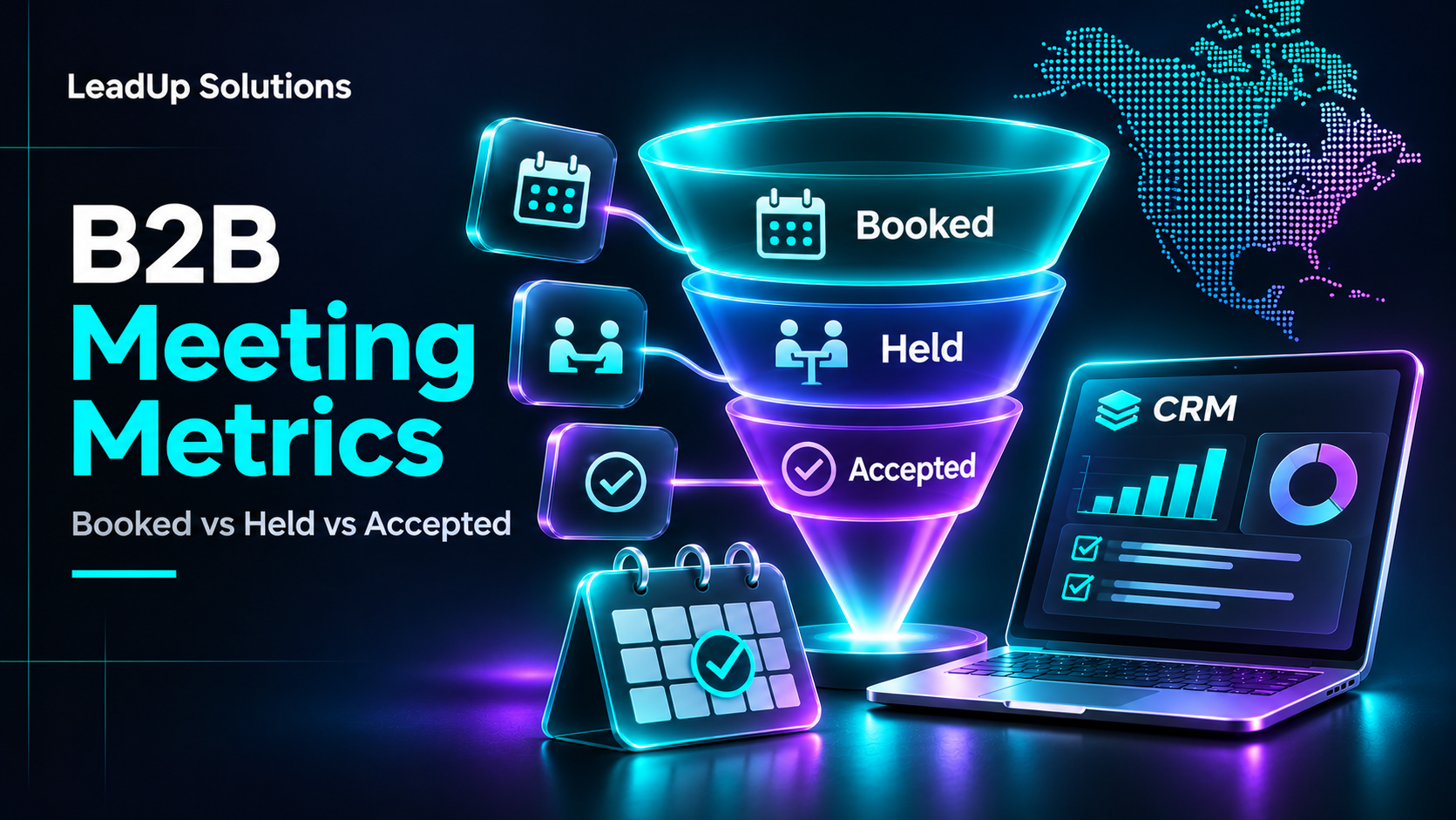
Important: An AE might accept a meeting’s qualification before the scheduled appointment or after the call, depending on the written policy. Accepted and Held are therefore independent dimensions, not universally sequential stages. The cover illustration depicts one possible post-meeting review workflow, not a mandatory process.
Decide what counts as one meeting
A meeting that moves from Tuesday to Friday is normally one booking journey with a reschedule event, not two unique leads. Give each booking a stable identifier and retain original `booked_at`, current `scheduled_for`, attendance outcome and reschedule history.
An appointment that has not reached its scheduled time is Pending, not a no-show. A buyer who cancels in advance is different from a buyer who fails to attend without cancellation. Document those outcomes separately instead of erasing the booking.
The eight metrics worth tracking
| Metric | Working definition | Why it matters |
|---|---|---|
| Accounts reviewed | Unique accounts checked against the current ICP | Research quality and coverage |
| Relevant conversations | Two-way interactions with appropriate stakeholders | Message and role relevance |
| Unique meetings booked | Booking journeys created, not reschedule events | Actual scheduling activity |
| Meetings held | Buyer conversations that took place | Attendance and logistics quality |
| Sales-accepted meetings | Meetings reviewed and accepted against agreed rules | Handoff quality |
| Qualified opportunities | Sales opportunities meeting the agreed criteria | Downstream sales impact |
| AE rejection and clarification reasons | Why a reviewed meeting was not accepted or needs more details | Actionable coaching |
| Opt-outs and compliance exceptions | Correctly recorded contact instructions and issues | Responsible program operation |
Calls placed, emails delivered and connection rates are useful diagnostic measures, but they should not replace buyer-quality metrics.
Calculate rates using explicit denominators
Do not assume that show rate, booking realization and AE acceptance refer to the same denominator.
| Metric | Formula | Important eligibility rule |
|---|---|---|
| Booking realization rate | Held ÷ due booking journeys | Include finalized cancellations and no-shows, exclude future/pending appointments |
| Attendance / show rate | Held ÷ (Held + No-show) | Exclude advance cancellations and pending/rescheduled-future meetings |
| AE acceptance rate | Accepted ÷ (Accepted + Rejected) | Only completed AE decisions; separately report Pending and Clarification |
| ICP-fit rate | ICP-fit accounts ÷ accounts actually reviewed | Use one recorded version of ICP rules |
| Accepted-to-opportunity conversion | Accepted meetings with qualifying opportunities ÷ accepted meetings in a mature cohort | Allow a suitable observation period for the buying cycle |
| Cost per accepted meeting | Fully loaded attributable cost ÷ accepted meetings from a comparable cohort | Disclose included wages, provider fees, tools, data and oversight |
Submission yield (Accepted ÷ all Submitted) is a different metric: it can be shown, but may look low simply because recent submissions have not yet been reviewed. Never silently use it as a final acceptance rate.
These are suggested operational definitions, not universal vendor rules. If your billing contract defines an accepted/billable meeting differently, maintain that billing measure separately. Set the treatment of advance cancellations, organizer no-shows and reschedules in the data dictionary before comparing teams.
Salesforce documents stage-based conversion analysis in its Sales Stage Analysis guidance. HubSpot also defines sequence meeting rate using a particular attribution window. Those examples illustrate why the definition matters as much as the percentage.
Worked example: the same pilot, different correct rates
Imagine a completely fictional pilot with 16 unique bookings. Four have future meeting dates. Of the other 12 due booking journeys, 9 were held, 2 were no-shows, and 1 was cancelled in advance. Assume no unresolved reschedules.
- Booking realization: 9 ÷ 12 = 75%, including the advance cancellation in the denominator.
- Attendance/show rate: 9 ÷ (9 + 2) = 81.8%, excluding the advance cancellation.
- Future bookings: 4 Pending, not counted as missed meetings.
Of the nine held meetings, suppose the AE accepted five, rejected two, and has not yet reviewed two.
- Completed-decision AE acceptance: 5 ÷ 7 = 71.4%.
- Provisional submission yield, if all nine were submitted: 5 ÷ 9 = 55.6%.
Both figures are mathematically correct but answer different questions. The pending two must not be counted as rejected. These are invented numbers for teaching, not LeadUp outcomes, market benchmarks or performance promises.
Align cohort dates before comparing teams
A calendar-month dashboard can produce misleading results if it compares meetings booked this month with meetings held from last month's bookings.
Use at least two views:
- Activity view: Which conversations, bookings, held meetings and AE review decisions happened in the reporting period?
- Cohort view: What eventually happened to meetings first booked in a defined period, after they had enough time to mature?
Track timestamps for each event. For example, a meeting first booked in October and held in November belongs to October’s booking cohort and November’s activity view. Label them explicitly to avoid comparing unrelated denominators.
For example, a late-month booking that takes place next month should not automatically be treated as a no-show in the first month's cohort.
Similarly, an ERP opportunity may not be opened until multiple stakeholder discussions have occurred. A short pilot can measure meeting readiness without establishing a reliable revenue conversion rate.
Distinguish no-show, rescheduled and cancelled
Not every appointment that does not take place at its original time is a failure. Record:
- No-show: The expected participant did not attend without completing the meeting.
- Rescheduled: A new time was mutually agreed.
- Cancelled: The meeting will not happen as planned; record the reason.
- Held: Meaningful conversation took place.
- Disqualified: The account or discussion failed an agreed criterion.
Reschedules should not inflate the booked-meeting count as if every new invite were a new lead. Preserve a stable meeting identifier and appointment history. Define in writing what counts as advance cancellation, buyer no-show and organizer no-show, and how a later rescheduled appointment enters the eligible reporting window.
Set a clear acceptance checklist
A booked call is not a qualified conversation merely because the recipient said yes.
Define requirements such as company fit, role relevance, an actual or credible business need, and a mutually understood meeting purpose. Then specify who can approve exceptions and who records the outcome.
For a working checklist, see What Is a Qualified Sales Meeting?. The measurement dashboard should reference the same definition used by SDRs and AEs.
An AE rejection must carry a reason: wrong segment, irrelevant role, no use case, confused agenda, duplicate, or insufficient handoff context. "Not qualified" without a reason is difficult to improve.
Acceptance may precede attendance. If the AE accepts the meeting in advance, a subsequent cancellation or no-show must remain visible without changing the earlier review decision. If review occurs after the call, keep the meeting Pending until the AE actually decides. Our SDR-to-AE handoff guide provides a ready-to-use transfer schema.
Segment the dashboard before drawing conclusions
A single average can conceal valuable differences. Segment results where there is sufficient data by:
- US vs Canada and, when relevant, region or time zone.
- Industry or vertical.
- Product use case, such as finance ERP vs operational SaaS.
- Target role, such as CFO, COO, IT evaluator or functional owner.
- Channel that initiated the conversation.
- Campaign or message variant.
Avoid inferring that a channel caused the result just because it logged the final touch. A prospect may have received several appropriate messages or been referred internally before booking.
For more on channel coordination, read Cold Calling, Email and LinkedIn: A Coordinated B2B Outreach Plan.
Turn rejection reasons into a weekly quality review
A short meeting between SDR and AE leaders is often more actionable than a large dashboard.
Look at a sample of accepted meetings and rejected handoffs. Ask what the buyer actually said, whether the account fit the ICP, whether the SDR set expectations correctly, and whether the AE received enough context.
Then select a small, documented improvement. Possible actions include removing an irrelevant segment, refining a discovery question, adding a required note, or correcting scheduling instructions. Keep the old and new definitions visible so trend reporting remains interpretable.
Example weekly review agenda
- Confirm definitions and any exceptions.
- Review raw counts and cohort maturity.
- Sample accepted and rejected meetings.
- Identify the two most common fixable issues.
- Assign owners for one or two changes.
- Review prior changes on the next call.
If the process changes substantially, consider maintaining a new reporting version rather than pretending all historical data were collected under the same rules.
Connect meeting quality with cost responsibly
A business can also review cost per sales-accepted meeting, including the fully loaded cost of data, tools, SDR labor, management, and provider fees. Use the same observation window and allocation method when comparing internal and outsourced models.
Cost per booked meeting may look attractive when quality is poor. Cost per opportunity may take longer to mature, particularly in ERP. Both require careful definitions.
Our outsourced SDR versus in-house SDR comparison explores fully loaded cost rather than base salary alone.
Build a simple CRM data dictionary
The reporting team should publish definitions for every field:
| Field | Definition |
|---|---|
| booking_id | Stable identifier for a single booking journey |
| booked_at | Time first scheduled |
| scheduled_for | Current appointment time, including time zone |
| held_at | Time meeting actually occurred, if held |
| attendance_outcome | Held, no-show, rescheduled or cancelled |
| ae_acceptance | Accepted, rejected, pending or not submitted |
| rejection_reason | Controlled value plus optional notes |
| opportunity_id | Linked CRM opportunity if legitimately created |
| campaign_version | ICP, message and process version used |
| submitted_for_acceptance_at | Time SDR requested the AE quality review |
| acceptance_reviewed_at | Time the review decision occurred |
| ae_reviewer_id | Reviewer accountable for the acceptance decision |
| source_channel / segment | Original channel and ICP segment to support drill-downs |
| next_action_owner | Person accountable for the next step |
| consent_or_suppression | Required communication preference/status |
Do not collect more personal information than you need to deliver the service. Restrict access to sensitive records, and carry opt-out preferences with the account.
A one-screen dashboard template
Present the dashboard in three levels:
- Volume and eligibility: reviewed accounts, unique bookings, future bookings, held, no-shows, cancellations and reschedules, with clear dates.
- Meeting quality: submitted reviews, accepted, rejected, pending and clarification requested, with the top rejection reasons.
- Commercial outcomes: cost per accepted meeting, qualified opportunities in sufficiently mature cohorts, ICP/region/channel segments, and the limitations of small sample sizes.
Give sales leaders a record-level table with booking ID, account, SDR/AE owner, meeting date and time zone, attendance, acceptance, next action and rejection reason. Numbers without an audit trail are difficult to coach from.
Automated data-quality checks can flag duplicate booking IDs, meetings marked held before being booked, future meetings tagged no-show, missing time zones and AE decisions without a reviewer. Keep the exceptions visible rather than silently altering the source data.
US and Canada: measure compliance signals as well
Outreach reporting should include suppression and opt-out handling. Commercial B2B email in the United States is covered by the FTC's CAN-SPAM guide. Canadian commercial electronic messages can fall under CASL, including consent, identification and unsubscribe requirements subject to exceptions.
A campaign that books many meetings while mishandling opt-outs is not a healthy program. Calling, privacy, and professional-network policies may also apply independently.
Frequently asked questions
Is a booked meeting the same as a sales-accepted meeting?
No. Booking is a scheduling event; acceptance applies agreed qualification criteria. Keep the two measures separate.
Should rescheduled calls count twice?
Generally not as two unique buyer meetings. Track reschedule events, while preserving one stable meeting journey unless genuinely separate conversations were booked.
What is a good appointment-setting conversion rate?
There is no universal reliable rate across SaaS, ERP, different markets and sales cycles. Establish definitions, review your own historical data, and look for comparable segments before choosing internal targets.
When should an opportunity be created?
When your sales team confirms its actual opportunity criteria through appropriate discovery, not merely because an SDR booked an appointment.
Five mistakes to catch before sharing a metrics report
1. Mixing cohorts: Bookings in November are compared with October's held meetings without a cohort explanation.
2. Counting reschedules as new bookings: Each calendar change inflates acquisition.
3. Treating pending AE reviews as rejections: A review queue backlog depresses reported acceptance.
4. Comparing teams on inconsistent definitions: One program counts held only, while another counts every booked meeting.
5. Ignoring contact preferences and quality: A large activity count cannot compensate for poor fit or mishandled opt-outs.
Use the metrics to improve the process
A weak attendance trend should trigger investigation rather than more calendar invitations. Our guide to reducing qualified B2B meeting no-shows covers buyer confirmation, time-zone checks, no-show classifications and respectful rescheduling.
Also keep lead qualification separate from meeting outcomes: the MQL vs SQL vs Sales-Accepted Meeting guide shows why lifecycle stages should not be collapsed into a single booking funnel.
Better meeting metrics produce better decisions
Useful B2B appointment-setting metrics connect researched accounts and relevant conversations to booked, held, accepted, and eventually qualified opportunities. The dashboard should make the process more honest, not merely more impressive.
LeadUp Solutions supports SaaS and ERP sales teams with lead qualification, appointment setting and managed outbound based on explicit ICP and meeting criteria.
If your calendar is full but your sales team questions the quality of meetings, talk to LeadUp Solutions about a measurable outbound program.