ERP prospecting is not simply finding a CFO's email address or booking a call with the first IT director who responds. Enterprise resource planning (ERP) decisions can affect finance, supply chain, operations, information technology, and the people who will use the system every day. That means a useful sales conversation often starts with one relevant stakeholder—but it rarely ends there.
For ERP vendors, implementation partners, and B2B sales leaders targeting the United States and Canada, prospecting should answer three questions: Which accounts are worth researching? Who can explain the business problem? And how do you identify the wider group that may need to evaluate a solution?
This guide offers a practical buying-committee map, role-specific outreach angles, a sample account-research template, and a simple SDR-to-account-executive (AE) handoff. The examples are illustrative, not claims about actual LeadUp customers or guaranteed results.
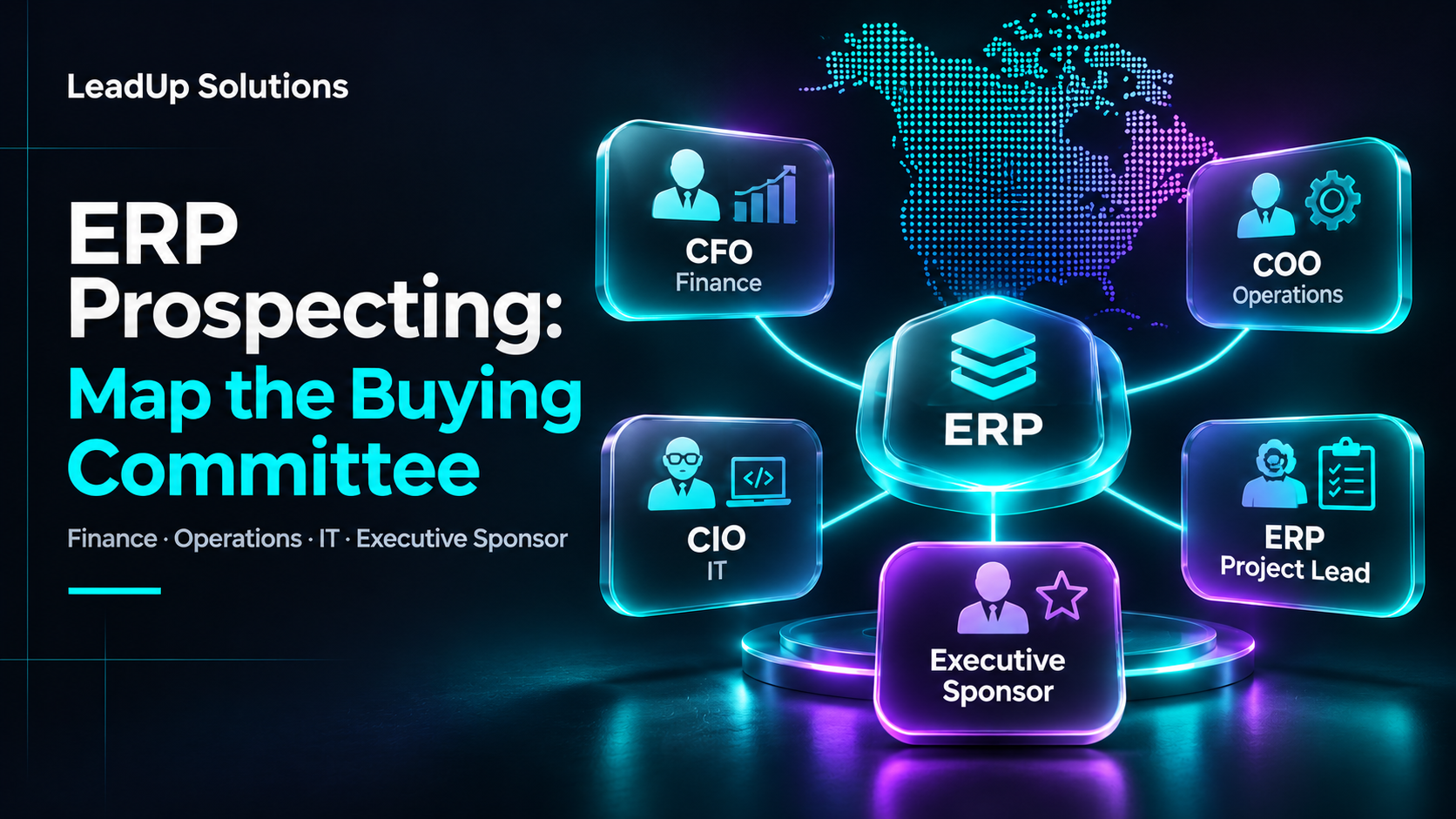
Why ERP buying committees are different
An ERP evaluation is rarely a single-department software purchase. A finance leader may care about close processes and reporting; an operations leader about inventory and fulfillment; IT about integration, access controls, and data migration; and an executive sponsor about business priorities, cost, and organizational change.
That cross-functional reality is reflected in ERP implementation guidance. Microsoft's Dynamics 365 implementation strategy calls for business-process owners, senior stakeholders, and IT collaboration. Oracle's ERP implementation planning guidance emphasizes project roles, a steering or executive committee, and sponsorship. SAP's implementation team guidance likewise highlights representation from the business functions affected by the system.
Important distinction: The buying committee evaluating and approving a vendor is not necessarily identical to the implementation team that will deploy the system. However, the roles and concerns involved in implementation offer a useful starting point for identifying who may influence vendor selection. Confirm the actual buying process rather than assuming everyone must attend the first meeting.
Start with the account, not the job title
Before searching for contacts, decide whether the organization fits the ERP offer you represent.
An ERP provider specializing in manufacturers should not automatically prospect every company with a CFO. Consider:
- Industry and operational model: Manufacturing, distribution, professional services, retail, or other supported sectors.
- Company complexity: Multiple entities, warehouses, locations, reporting requirements, or workflows that your product can realistically support.
- Geography and delivery coverage: US states or Canadian provinces where sales, implementation, and support are feasible.
- Solution scope: Finance, inventory, procurement, production, reporting, or another supported use case.
- Technology and integration constraints: Confirmed platforms, integration needs, and any clear incompatibilities.
- Timing and context: A publicly announced transformation, expansion, or leadership change might justify research, but does not prove purchase intent.
If you need a structured approach, read our B2B SaaS ICP and target account list guide. Its evidence, exclusions, and account-prioritization principles also apply to ERP sales, with ERP-specific filters.
A target account is a research candidate. It is not a qualified sales opportunity until the relevant needs and buying context have been validated.
The ERP buying committee: seven roles to investigate
The exact structure varies by business, ERP scope, and project stage. Map responsibilities first, then verify who actually holds them inside a target account.
| Stakeholder | Common titles | What they may care about | Useful discovery direction |
|---|---|---|---|
| Executive sponsor | CEO, President, Business Unit Leader | Strategic fit, risk, organizational change | Why is this initiative important to the business? |
| Economic buyer | CFO, Finance Executive, sometimes COO | Business case, budget, total ownership cost | What outcomes would justify investment? |
| Business-process owner | Controller, VP Finance, VP Operations | Reporting, reconciliation, workflow accuracy | Which process currently creates the most friction? |
| Operations stakeholder | COO, Supply Chain or Manufacturing Director | Planning, inventory, purchasing, throughput | Which cross-team handoffs break down? |
| IT and security evaluator | CIO, IT Director, Enterprise Architect | Integration, access, security, reliability | What systems and constraints must be considered? |
| Project or transformation lead | ERP Program Manager, PMO Lead | Scope, milestones, resources, change management | How is evaluation and implementation work organized? |
| User champion | Finance Manager, Warehouse Lead, Department SME | Usability, training, exceptions, day-to-day work | What would need to improve for end users? |
These are potential roles, not a mandatory list of seven attendees. In a smaller company, the CFO may sponsor, approve, and lead the project. In a large organization, a steering committee may establish formal decision rights.
Deloitte's ERP selection guidance makes an important distinction: gather perspectives broadly, but define the smaller group responsible for the final decision. That is a useful principle for prospecting too—map stakeholders without demanding a meeting with everyone.
1. The CFO and finance team: connect to business outcomes
A CFO or senior finance leader can be relevant when the ERP initiative involves consolidated reporting, financial controls, period-end close, entity visibility, or investment approval.
Useful opening hypothesis: "As your business grows, is the finance team having to reconcile information across several systems to complete reporting?"
Do not tell a finance leader that their close process is broken unless you have evidence. Instead, ask a question that makes it easy for them to correct your assumption.
When a controller or finance systems manager is the operational owner, that person may know more about current pain than the CFO. A meeting with that stakeholder can be valuable, even if executive sponsorship is still unconfirmed.
SDR qualification note: Record the confirmed finance challenge and which stakeholder owns the evaluation—not a guessed ERP budget.
2. The COO and operations team: understand cross-functional work
For distribution, manufacturing, and multi-location businesses, operations stakeholders may care about procurement, order management, inventory visibility, scheduling, or disconnected planning processes.
Useful opening hypothesis: "Are your operational teams working from one dependable view of inventory and orders, or do different locations still reconcile information manually?"
The goal is to identify a relevant problem and the people affected, not to run a technical demo on the first contact.
An operations leader may influence requirements while a finance or IT team has formal purchasing authority. Ask how those groups typically participate in major systems decisions.
SDR qualification note: Capture the business workflow described in the prospect's own words, any known systems involved, and who would need to review a potential change.
3. The CIO, IT director, and technical evaluators: respect constraints
ERP solutions touch multiple business systems. Technical stakeholders may influence platform architecture, identity and access, security requirements, integration, data migration, reliability, and delivery risk.
Useful opening hypothesis: "When your organization evaluates enterprise systems, which integration and data-migration requirements are non-negotiable?"
Be careful not to use "cloud ERP" as a universal answer. Some companies face contractual, integration, or sector-specific requirements that shape architecture decisions.
IT may have veto power over technical fit without owning the original business problem. Microsoft's project governance guidance stresses business and technical collaboration and clear roles. That makes it sensible for sales teams to understand both sides, while confirming each buyer's actual decision rights.
SDR qualification note: Record critical integration or security concerns only when confirmed; do not claim compliance certifications or capabilities your product team has not verified.
4. The executive sponsor: look for strategic direction, not just rank
An executive sponsor often connects a systems initiative to business priorities, provides organizational support, and resolves cross-functional obstacles.
That person might be the CEO, CFO, COO, CIO, or division leader, depending on the project. The job title alone does not establish sponsorship.
Useful question: "Who is accountable for the business outcome if the company decides to change its ERP platform?"
If the answer is unknown, do not automatically reject the account. In early-stage prospecting, the practical next step may be a conversation with the process owner who can explain whether a larger initiative exists.
5. The ERP project lead: find the person coordinating evaluation
Some companies have a transformation director, program manager, enterprise applications lead, or ERP project manager tasked with turning requirements into a viable plan.
These stakeholders may know the evaluation timeline, functional workstreams, decision checkpoints, technical dependencies, and meeting participants.
Useful question: "Is there already an internal team coordinating requirements and vendor evaluation, or is that still being defined?"
Do not assume that a job opening for an ERP project manager means a new vendor selection is underway. It may relate to an existing deployment or optimization project.
6. The end-user champion: uncover the workflows that matter
Finance managers, planners, procurement staff, warehouse leads, and other subject-matter experts may identify process failures that executives do not see directly.
Their feedback can reveal whether a proposed solution is relevant, but they may not control funding or vendor selection. Treat them as possible champions or evaluators, not automatically as decision-makers.
Useful question: "Which part of the process would your team most want to improve if a systems change became possible?"
A strong champion can help clarify the business case, while a later conversation identifies who can authorize the project.
7. Procurement, legal, and compliance: know when they enter
In some organizations, procurement, legal, risk, and privacy teams participate later, evaluating commercial terms, contracting, security reviews, vendor onboarding, and data handling.
They are not always useful first contacts for a cold prospecting campaign. Identify when they tend to enter the evaluation, and avoid representing those requirements as solved before your specialists review them.
An ERP buying map is a working hypothesis until the prospective customer confirms who participates in decisions.
How to find stakeholders without guessing
A disciplined approach to ERP prospecting separates evidence from inference.
Account research: Start with the official website, public company reports, credible news releases, relevant job descriptions, and appropriate business databases. Use these to understand the organization and form a product-fit hypothesis.
Role research: Look for the likely department owner, senior sponsor, and technical evaluator. Public professional profiles may help verify current roles, subject to platform policies and applicable rules.
Conversation validation: Ask the first relevant prospect how major systems initiatives are evaluated. Do not assume a person holds purchasing authority based only on their title.
CRM hygiene: Label each stakeholder as verified, inferred, or unknown. Record the evidence source and when it was checked. A stale role is worse than an honest blank field.
Avoid scraping private personal information or suggesting unverified employees as contacts. Contact research must follow the laws, platform rules, and internal policies that apply to your campaign.
A practical ERP account-mapping template
An SDR can maintain a simple view like this in the CRM:
| Field | Example entry |
|---|---|
| Account | Northstar Industrial Group (fictional example) |
| Target segment | Multi-site manufacturing |
| ICP fit | Potential fit; company size still needs verification |
| Business problem hypothesis | Disconnected inventory and financial reconciliation |
| Confirmed pain point | Unknown—must be validated |
| Finance stakeholder | Role to research: CFO or Controller |
| Operations stakeholder | Role to research: VP Operations |
| Technical stakeholder | Role to research: IT Director |
| Sponsor | Unknown |
| Project owner | Unknown |
| Evaluation status | Not confirmed |
| Next action | Validate operations context with a relevant stakeholder |
Fictional example: Northstar Industrial Group is only an illustration, not a real LeadUp prospect or a claimed case study. The account should stay in a research stage until relevant company facts and the problem are confirmed.
This template keeps SDRs from converting "we think they might have a problem" into a CRM field that says "active ERP project."
Build a contact sequence around the business problem
ERP outreach tends to be more useful when tailored to each stakeholder's role.
| Role | Initial message angle | What to avoid |
|---|---|---|
| Finance | Reporting, reconciliation, financial visibility | Unsupported savings or ROI claims |
| Operations | Cross-location handoffs, inventory, planning | Assuming their existing workflows are failing |
| IT | Integration and migration requirements | Promising implementation compatibility without discovery |
| Executive sponsor | Organizational priorities and evaluation ownership | Asking for a full budget in the first email |
| Project lead | Governance, requirements and timing | Claiming they are actively shopping for vendors |
Keep language professional and specific. Use one relevant question that invites correction rather than writing a long pitch full of assumptions.
A multi-contact plan should not mean bombarding every executive at an account simultaneously. Coordinate outreach across the account, track responses and opt-outs, and stop or adjust when a contact asks you not to follow up.
For US business email, consult the FTC's CAN-SPAM business guidance. For commercial electronic messages into Canada, review CRTC guidance on CASL. Applicable calling and privacy rules require separate consideration. These links are informational, not legal advice.
What should count as a qualified ERP prospecting meeting?
A booked meeting is useful when it meets the qualification standard agreed with the sales team. The first conversation does not need to establish every committee member or secure a purchasing decision.
A sensible early-stage checklist asks:
- Does the account fit the ERP vendor's industry, size, geography, and product scope?
- Is the contact relevant to the process or a plausible member of the buying group?
- Is there a confirmed or credibly explored business challenge aligned with the solution?
- Does the prospect understand why they are meeting and what the agenda is?
- What is known—and still unknown—about other decision participants?
If a company meets the fit criteria but the attendee has no relevant responsibility, the meeting should not be presented as a fully qualified ERP opportunity.
For a reusable meeting-acceptance framework, see our qualified sales meeting checklist for SaaS and ERP.
Give the AE a buying-map handoff, not just a calendar invitation
An AE should be able to see why the conversation exists, which roles are confirmed, and where further discovery is needed.
Illustrative handoff (not an actual customer):
Account: Mid-market US manufacturer, verified within target segment
Contact: Director of Operations; role verified
Business context: Prospect says two facilities reconcile inventory reports manually
Potential use case: Cross-site visibility; product fit requires discovery
Buying group known: Operations stakeholder identified; finance sponsor and IT evaluator not yet confirmed
Reason for meeting: Explore current workflow and whether there is a formal systems-review initiative
Proposed attendees: Operations director and AE
Open questions: Existing ERP, project ownership, integration constraints, timeline, and decision process
This is more valuable than a handoff that merely says "Interested in ERP." It also avoids pretending that early discovery has already established a budget or vendor shortlist.
Five pitfalls to avoid in ERP stakeholder prospecting
1. Reaching only the most senior title. The CEO may not own the systems evaluation. Find the operational owner and verify executive participation later.
2. Treating IT as the only buyer. ERP touches finance, operations, and end users. Ignoring them can mean missing the real business case.
3. Treating an implementation role as a buying role without evidence. A project manager in an ongoing ERP implementation is not proof the company is shopping for new software.
4. Overstating signals. Expansion news or a relevant job posting can justify a hypothesis but does not demonstrate an active purchase project.
5. Calling every calendar invitation an opportunity. Track initial interest, held meetings, sales acceptance, and qualified opportunities separately.
A 30-day plan to test ERP prospecting quality
Use this as a planning sequence, not as a performance guarantee.
Week 1 — Choose a segment. Pick a supported ERP use case and account profile. Document exclusions, roles, and evidence standards.
Week 2 — Build the buying-map hypotheses. Research a focused set of companies, identify likely operational, financial, and technical roles, and mark uncertainty clearly.
Week 3 — Launch coordinated outreach. Use market-appropriate, compliant messaging centered on a relevant business question. Record objections and role corrections.
Week 4 — Review with AEs. Examine which conversations led to useful discovery, where decision participants were missing, and what the market taught you. Refine the targeting and role map.
ERP evaluation cycles may be long, so an early pilot should prioritize learning quality and qualified conversations rather than pretending that opportunities or revenue will appear on a fixed schedule.
Frequently asked questions
Who usually makes the final ERP purchasing decision?
There is no universal title. A CFO, COO, CEO, CIO, or formal steering committee may hold decision authority, depending on organizational structure and project scope. Confirm decision rights with the prospect rather than guessing.
Should SDRs book the CFO or the IT director first?
Start with the most relevant person for the problem your solution solves. For finance-led ERP needs that may be the CFO or controller; for integration-led problems it could be IT; for operational process change it could be a COO or operations manager. Validate the wider buying group later.
How many stakeholders belong in an ERP buying committee?
There is no fixed number suitable for every account. Map the functional responsibilities relevant to the purchase, then identify actual participants as the evaluation develops.
Can a meeting be qualified before the entire committee is mapped?
Yes, if the account, contact, need, and meeting purpose satisfy your agreed criteria. Unknown committee members should be recorded as an open discovery item, not presented as confirmed.
Does ERP buying committee research differ between the US and Canada?
The underlying stakeholder functions often overlap, but business hours, regional operations, procurement requirements, legal considerations, and outreach rules may differ. Review the actual market context and applicable requirements before prospecting.
Can an outsourced SDR team handle ERP prospecting?
An outsourced team can support account targeting, first conversations, stakeholder discovery, and qualified meeting handoffs when the vendor provides clear ICP and product rules. Technical solution design and complex discovery should involve the appropriate ERP specialists.
Build relationships with the right ERP stakeholders
Effective ERP prospecting begins with the business problem, not a database of impressive job titles. Choose accounts your ERP offering can serve, map the likely finance, operations, IT, and executive participants, and let real conversations clarify the buying process.
LeadUp Solutions supports ERP vendors, SaaS providers, and B2B technology businesses with targeted cold calling, lead qualification, appointment setting, email, and LinkedIn outreach. We work from the client's ICP and meeting criteria, then hand sales teams conversations with documented context.
Want to reach relevant ERP stakeholders in the United States and Canada without relying on a generic contact list? Speak with LeadUp Solutions about a focused outbound program.