A 30-day B2B outbound pilot can help SaaS and ERP companies test a specific market, message, and prospecting process before committing to a larger outbound sales program. Its purpose is not to guarantee revenue or manufacture a packed calendar in one month. Its value is in learning whether you are reaching the right accounts, starting relevant conversations, and delivering meetings that your sales team genuinely wants.
For founders, heads of sales, and revenue leaders targeting the United States and Canada, a structured pilot also makes it easier to distinguish problems with your offer from problems with targeting, outreach execution, or handoff quality.
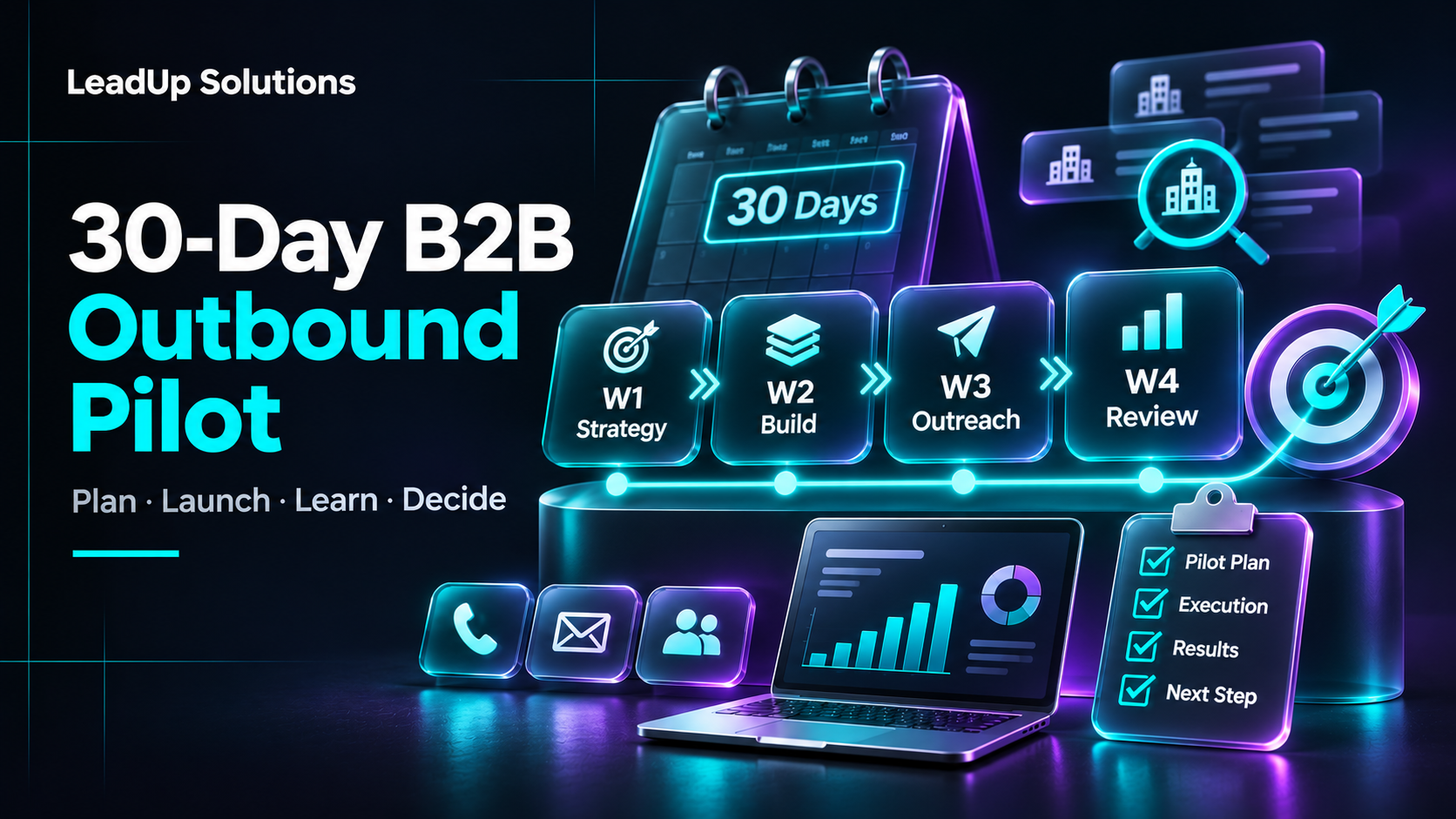
Here is a practical plan for 30 calendar days, with deliverables, review points, and decision criteria. The example timelines and scorecards are suggested planning frameworks, not universal performance benchmarks.
What is a B2B outbound pilot?
An outbound pilot is a time-boxed, controlled experiment used to evaluate a prospecting approach in a defined buyer segment. It tests assumptions about account fit, prospect roles, messaging, permitted outreach channels, and qualification.
A useful pilot helps your team answer five questions:
- Are the companies on the list genuinely aligned with our ideal customer profile (ICP)?
- Are we approaching stakeholders with a credible connection to the product's use case?
- Do prospects recognize the business problem described in our outreach?
- When a meeting is booked, does the prospect understand its purpose and does the account executive (AE) accept the handoff?
- Which elements should continue, change, or stop after the experiment?
The right outcome might be a small number of strong conversations, a more reliable account list, or evidence that the proposed segment is not worth pursuing. A pilot that exposes poor market fit early can be valuable even without generating new opportunities.
When should a SaaS or ERP company run a 30-day pilot?
A pilot makes sense when your company has an offer worth discussing, a testable ICP, and someone ready to handle relevant discovery meetings.
It is useful for evaluating an outsourced SDR partner, entering a narrowly defined US or Canadian segment, or validating a new outbound message before scaling an existing team.
A pilot may be premature if product positioning is constantly changing, no one can take sales calls, the offer cannot be explained to an appropriate stakeholder, or applicable outreach requirements are not understood.
ERP sales may involve multiple business functions and long evaluation cycles. SaaS sales motions vary too: a focused departmental software product can have a different qualification standard from an enterprise platform. Your pilot should match the actual buying context.
Define a one-page pilot charter before launching
Write down the experiment first. Agreeing on definitions early prevents disagreements later about whether a calendar invitation counts as a success.
| Item | What the charter should say |
|---|---|
| Business question | What exactly will the pilot test? |
| ICP | Industry, company size, supported territory, use case, exclusions |
| Primary personas | Operational owner, financial stakeholder, technical evaluator or other relevant roles |
| Offer | The specific product problem and value hypothesis |
| Channels | Approved, legally reviewed communication methods |
| Success evidence | Account fit, genuine engagement, meeting acceptance and learning |
| Meeting acceptance | Fit, relevant role, need and clear purpose |
| Owners | Who manages the list, approves copy, handles meetings and reviews quality |
| Boundaries | Budget, time, data, privacy, compliance and stopping conditions |
| Decisions | Continue, retest with changes, or stop |
Example (hypothetical): A workflow SaaS business could test whether operations leaders at mid-market US service firms find a workflow-consolidation conversation relevant. That statement is a hypothesis, not a claim about LeadUp's campaign results.
For the pilot to be meaningful, record major changes in targeting and messaging. If you change every variable halfway through, you may learn less about the original approach.
Week 1 — Days 1–7: Choose the ICP and define qualification
Start with one customer segment where your product has a credible use case. Document supported industries, company sizes, locations, technology requirements, and any hard exclusions.
If you already have customers, study which kinds of businesses gain value from the product. If you do not, label the target profile as a hypothesis. Avoid pretending that broad industry categories prove purchase intent.
Our related guide on building a B2B SaaS ideal customer profile and target account list explains how to separate confirmed evidence from assumptions and rank accounts without fictional conversion probabilities.
Agree on what qualifies as a meeting
Before prospecting starts, decide what the SDR team must establish and what the AE team will accept.
A practical starting checklist covers:
- Fit: The company matches the agreed ICP.
- Role: The person has a meaningful connection to the buying process or problem.
- Need: The conversation identifies a relevant problem, initiative, or credible reason to explore.
- Next step: The prospect understands and agrees to a clear meeting purpose.
Do not require a fully approved budget for every exploratory meeting unless that is truly a condition of your sales motion. Also, do not count every booked call as a qualified opportunity.
For a detailed acceptance framework, use our qualified sales meeting checklist.
Establish a real baseline
If previous campaigns exist, record their actual account segments, relevant replies, meeting outcomes, and rejection reasons. If there is no reliable historical information, explicitly mark the baseline as unavailable.
Week 1 deliverable: Approved ICP, exclusions, stakeholder hypotheses, meeting standards, and a one-page pilot charter.
Week 2 — Days 8–14: Build the account list and outreach system
This week turns planning into an operational process. The goal is a reviewed, CRM-ready set of accounts and approved messages—not a huge unverified spreadsheet.
Research the target list
For every proposed account, capture its official domain, industry, territory, company-size evidence, use-case hypothesis, data source, last verification date, and exclusion status.
Separate confirmed information from inference. A job posting that mentions ERP does not necessarily mean the company is purchasing a new ERP platform; it may already be implementing one.
Research relevant roles without inventing named contacts. For ERP, your initial map may involve finance, operations, IT, and executive sponsors. See our ERP buying committee prospecting guide for examples.
Write messages around one clear problem
A useful first message gives a relevant reason for the conversation, explains the offer accurately, and makes it easy for the prospect to correct your assumption.
For a workflow SaaS product, you might ask whether a team struggles to coordinate tasks across separate systems. For an ERP provider, you might ask how multiple locations consolidate inventory and finance reporting. These are example hypotheses—never claim that a specific business has such a problem without evidence.
Tailor messages to each stakeholder's responsibility. A CFO may care about reporting and financial controls, while an operations leader may care about processes and execution. Avoid promising cost savings or implementation compatibility without proof.
Prepare your CRM statuses
Use simple stage definitions that everyone understands.
| Stage | Meaning |
|---|---|
| Account reviewed | Fit checked and evidence recorded |
| Outreach eligible | Approved under relevant campaign and legal rules |
| Contacted | An outreach activity was logged |
| Engaged | Relevant response or conversation |
| Meeting booked | A calendar event exists |
| Meeting held | The event took place |
| Sales accepted | AE approves the handoff using agreed standards |
| Opportunity created | Sales qualifies a real opportunity |
| Disqualified / opted out | Exclusion or suppression documented |
A HubSpot prospecting strategy guide emphasizes building targeting rules and qualification into repeatable CRM processes. Use defined statuses so your team can compare outcomes rather than just count activity.
Define channel ownership
You can test calling, email, LinkedIn, or a combination, but only if each channel has an appropriate compliance process, approved messaging, and manageable frequency.
Set suppression rules and ensure a prospect's opt-out is respected. Prospecting should not become simultaneous high-volume pressure from multiple reps.
Week 2 deliverable: Validated list, approved talk tracks and messages, CRM tracking fields, channel rules, and assigned ownership.
Week 3 — Days 15–21: Launch a controlled outbound test
Start with a volume your SDR team can execute and quality-check. There is no evidence-based universal number of calls, emails, or meetings that a SaaS or ERP pilot must generate.
The first goal is to understand whether the right accounts are responding to the offer.
Look at conversation quality
Sample actual outreach and ask:
- Did the rep reach the intended stakeholder?
- Was the product introduction accurate and respectful?
- Was the use-case question relevant rather than generic?
- Did the prospect confirm a need or simply express curiosity?
- Were objections and exclusions recorded correctly?
- Was there a clear, mutually understood next step?
When a conversation fails, capture why. The issue may be a poor account match, the wrong role, vague messaging, or a product problem.
Keep SDR and AE feedback connected
Schedule regular reviews between whoever manages prospecting and whoever takes sales calls. AEs should explain why they accept or reject a handoff. This feedback is especially important when outreach is outsourced.
When an AE declines a meeting, record whether the issue was fit, role, need, incorrect expectations, missing notes, or something else. Do not change the definition of qualified after the fact just to improve reported results.
Track changes deliberately
If you revise a message or narrow a segment, keep a record. Otherwise the final report cannot distinguish the original test from the revised one.
Do not scale volume simply because the number of calls looks healthy. Relevant engagement and meeting quality matter more.
Week 3 deliverable: Documented outreach activity, sample quality reviews, genuine response themes, and AE feedback.
Week 4 — Days 22–30: Review results and decide
The last phase should make the learning visible and support a decision about what happens next.
Define metrics precisely
| Metric | What it measures |
|---|---|
| ICP-fit rate | Reviewed accounts meeting documented fit rules |
| Relevant engagement | Conversations linked to the offer and target role |
| Meetings booked | Appointments scheduled, regardless of later attendance |
| Meetings held | Appointments that occurred |
| AE acceptance | Meetings that meet the agreed handoff standards |
| Opportunity creation | Accepted conversations that become qualified opportunities |
| Rejection reasons | Why meetings or accounts did not progress |
| Operational quality | Accuracy of data, reporting and handoff execution |
A Salesforce outbound sales overview discusses why conversion and pipeline data matter, while HubSpot's prospecting funnel guide distinguishes early-stage outreach from actual opportunities.
For any rate, name the numerator and denominator. For example, booked-to-held rate uses held meetings over booked meetings that had a chance to occur during the observation window. If the sample is tiny, or there has not been time for a meeting to take place, state the limitation.
Do not equate 30 days with a proven revenue engine
A 30-day pilot may reveal the quality of targeting, responses, and first meetings. It may not provide enough time to observe enterprise ERP deal cycles, meaningful closed-won revenue, or stable opportunity-conversion trends.
If an opportunity has not yet matured, record its stage and keep it under observation rather than counting it as a loss or inventing projected revenue.
Week 4 deliverable: Findings with evidence and limitations, an updated target-market hypothesis, and a decision on next steps.
A practical day-30 decision framework
At the end of the pilot, choose an outcome supported by the evidence.
Option A: Continue with controlled expansion
This makes sense when the target accounts fit well, relevant prospects engage, the AEs accept the handoffs, and the process can be operated consistently and responsibly.
You might add another carefully chosen segment or modest additional capacity, while preserving the quality controls that worked.
Option B: Refine and test again
Perhaps buyer fit looked promising, but the team used the wrong roles, messages lacked specificity, or there was too little time to gather meaningful signals.
Specify which assumptions will change, document the new version, and run another reviewable test. Do not treat an inconclusive result as proof of success or failure.
Option C: Stop or redirect
If the evidence repeatedly shows unsupported product requirements, poor fit, insufficient buyer relevance, or unacceptable operational risk, stop before investing more in the same approach.
The value of a controlled experiment is that it makes a different decision possible.
What should an outsourced SDR pilot include?
If your company hires an outsourced prospecting partner, write the scope down. Do not assume every service is included in a single retainer.
Useful partner deliverables include:
- Approved ICP and exclusions.
- Account-list research standards and ownership.
- Reviewed cold calling, email and LinkedIn messaging.
- Named campaign owner and reporting cadence.
- CRM activity and clear outcome dispositions.
- Qualified-meeting definition and written AE handoff requirements.
- Review of accepted and rejected meetings.
- An end-of-pilot report and an agreed data-export/offboarding process.
Ask who owns the account history, who approves changes, which tools and data are included, and how suppression requests are preserved after the engagement.
For a broader comparison, see our outsourced SDR vs. in-house SDR guide.
US and Canada: make compliance a prerequisite
Even a well-scoped pilot must follow applicable communications, privacy, and platform rules.
United States: The FTC explains that the CAN-SPAM Act applies to B2B commercial email, with requirements including accurate sender information, nondeceptive subject lines, required contact information, and a meaningful opt-out process.
Canada: The CRTC's guidance on CASL requirements explains that commercial electronic messages generally require valid express or implied consent, identification, and an unsubscribe process, subject to detailed exceptions. CRTC FAQs clarify that messages sent from outside Canada may still fall within CASL.
Phone and social outreach need separate assessment based on the country, channel, recipient and applicable platform policies. A business appearing in your prospect database does not create blanket permission to contact it by every method.
These are planning considerations, not legal advice. Obtain qualified advice for the particular campaign.
Frequently asked questions
Is 30 days long enough to evaluate outbound sales?
It can be long enough to assess account research, messaging, outreach quality, and early meetings. It is not necessarily enough to establish revenue performance or mature pipeline conversion.
How many qualified meetings should a pilot guarantee?
There is no universal responsible guarantee. Target market, product, data quality, outreach permissions, and sales readiness all matter. Define useful learning and qualification standards instead of making an unsupported promise.
Should we test all channels at once?
Only if the team can coordinate them and measure results without confusing attribution. A focused test of fewer channels may generate cleaner learning than a broad launch.
What if the pilot books no meetings?
Review targeting, data, contact relevance, outreach execution, message clarity, and actual buyer feedback. Zero meetings may indicate an issue, but activity and context are needed to interpret the outcome.
Do SDRs or AEs decide what is qualified?
Both groups should agree on the standards before launch. AEs should provide documented acceptance feedback, and SDRs should use that feedback to improve targeting and handoffs.
Can a company run a pilot without outsourcing?
Yes. The same experimental framework works for in-house teams, outsourced partners, and hybrid prospecting operations.
Build an outbound process you can actually evaluate
A useful 30-day B2B outbound pilot starts with a narrow market hypothesis, establishes qualification rules before outreach, records buyer feedback honestly, and closes with a defensible recommendation.
For SaaS and ERP businesses, the best lesson might be which buyer segment responds, which message requires work, or whether the sales handoff needs improvement—not simply how many activities the team completed.
LeadUp Solutions helps B2B SaaS, ERP, and technology businesses with cold calling, lead qualification, appointment setting, cold email and LinkedIn outreach. Its pilot model is designed to test fit, targeting, messaging, and meeting qualification before a larger commitment.
Want to explore a defined, accountable outbound pilot for the US or Canadian market? Book a discovery conversation with LeadUp Solutions to discuss your ICP, buyer segments and success criteria.