B2B multichannel outreach works best when cold calling, email, and LinkedIn support a single relevant conversation—not when three separate systems send overlapping pitches to the same buyer.
For SaaS, ERP, and B2B technology teams selling to companies in the United States and Canada, coordination is a practical operating advantage. A relevant phone conversation can clarify who owns a business problem. An appropriate email can summarize context or provide useful information. LinkedIn can help a rep understand the prospect's professional role and company environment. Each channel has a job, but the account history and the message should stay consistent.
This guide explains how to build a practical outreach plan, select channels responsibly, coordinate your SDRs and account executives (AEs), and measure whether conversations become sales-accepted meetings rather than simply more activity.
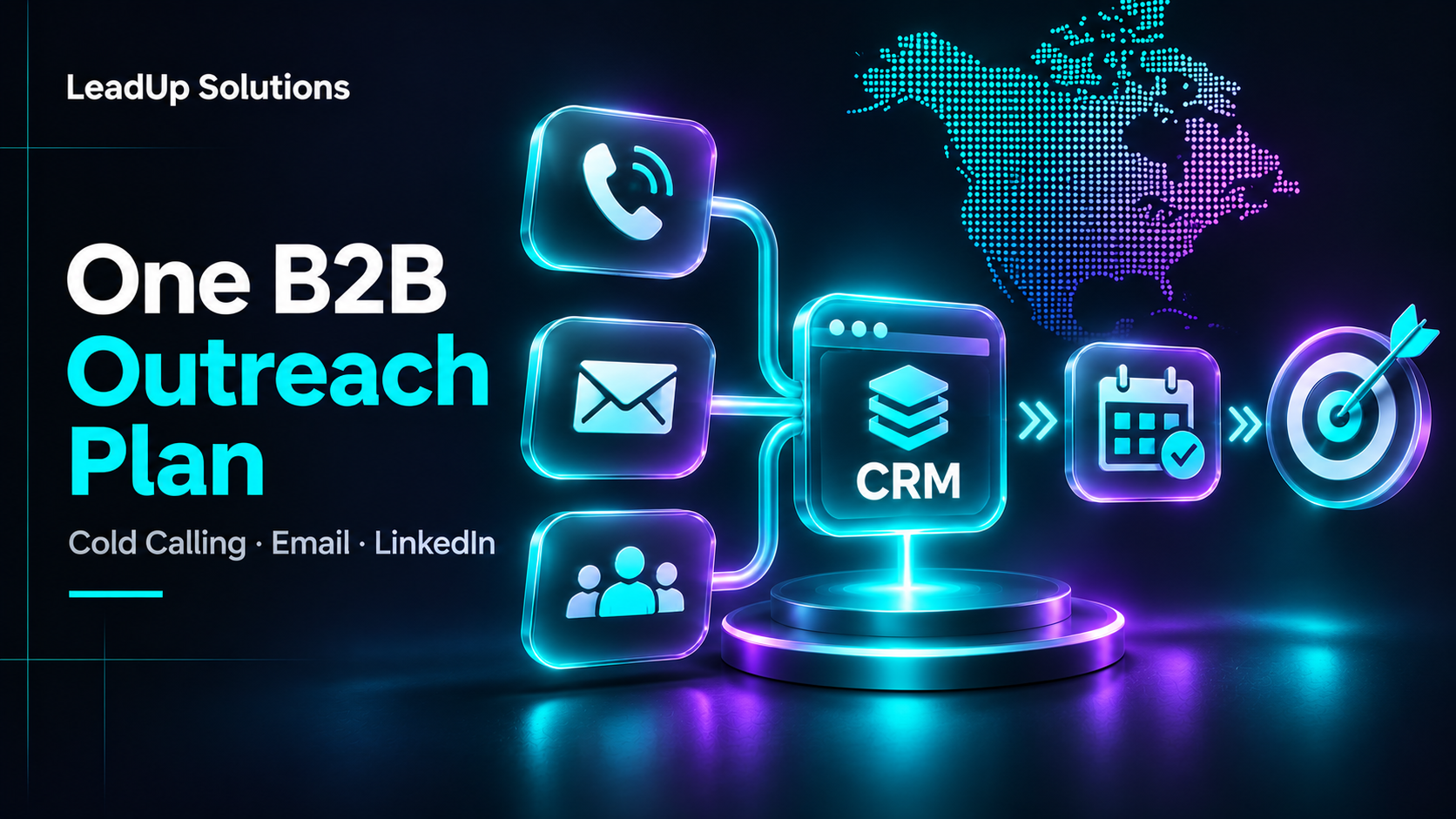
What coordinated B2B outreach actually means
A multichannel approach uses more than one route to reach a potential buyer. A coordinated approach also ensures that outreach is relevant, approved, and informed by the prospect's previous interactions.
It does not mean contacting someone by phone, email, and LinkedIn at the same moment. It does not mean treating every contact method found in a database as permission to use it. And it does not mean adding more touches until someone responds.
A coordinated approach has five essentials:
- One ICP: The account must match the ideal customer profile before the team invests in outreach.
- One business hypothesis: The call, email, and social context relate to a coherent potential use case.
- One owner and history: The CRM shows who contacted whom, what happened, and the appropriate next action.
- Channel-specific permission and rules: Each step must be appropriate for the recipient, jurisdiction, and platform.
- One outcome standard: Success is defined by relevant engagement and qualified sales conversations, not touch count.
When your channels share context, the prospect does not have to explain the same conversation from scratch every time.
Start with the right accounts and relevant stakeholders
Before building a calling or email sequence, choose the accounts worth approaching. An ERP vendor might target manufacturers with a particular operational complexity; a SaaS company might focus on a defined kind of revenue or operations team.
Use inclusion and exclusion rules: industry, company size, region, supported workflows, product fit, and important technical constraints. Document what is verified and what is only an assumption.
Our B2B SaaS ICP and target account list guide provides a practical account-selection template.
Next, distinguish the account from its stakeholders. In ERP, finance, operations, and IT may each have different questions about the same possible initiative. Our ERP buying committee guide explains how to map those responsibilities without assuming that the most senior title is always the right first contact.
For each account, record the business use-case hypothesis, most relevant buyer role, source and freshness of account information, approved contact channels, and exclusion or suppression status. Unknown contact details should remain unknown rather than being guessed.
Give every channel a clear job
Calls, emails, and LinkedIn interactions each have strengths and limitations.
| Channel | Useful role in the process | Typical risk to manage |
|---|---|---|
| Cold calling | Establish role relevance, ask a concise question, and hear live objections | Poor timing, intrusive or noncompliant calls, weak call notes |
| Offer concise context, a relevant question, or written follow-up when permitted | Generic bulk templates, inaccurate claims, unlawful commercial messages | |
| Research professional roles and business context; build a professional connection where appropriate | Unwanted mass messaging, automation abuse, platform-policy violations | |
| CRM | Coordinate ownership, history, qualification, suppression, and handoff | Duplicate accounts, stale records, conflicting statuses |
Avoid declaring one channel the universal winner. The effective mix depends on your market, the buyer's preferences, your offer, data quality, and which outreach activities are permitted.
A useful rule: Choose a channel because it improves the prospect's experience or the relevance of the conversation, not merely because the contact's details are available.
Design one message around one business problem
A good outreach plan starts with a plausible, product-relevant problem and a question the prospect can easily confirm or correct.
For example, a hypothetical SaaS company serving mid-market operations teams might explore whether cross-functional handoffs require too much manual coordination. An ERP vendor might ask whether finance and inventory data need to be reconciled across multiple locations.
Those are illustrative hypotheses, not facts about any named prospect.
Write a short message architecture:
- Who: A defined buyer role at an ICP-fit business.
- Why this account: A verified industry or organizational characteristic.
- Why this problem: A credible use-case hypothesis tied to your offering.
- Why speak: A specific, low-pressure reason to exchange information.
- What next: A clear invitation to a relevant discovery conversation, with no invented urgency.
Different channels can express the same idea in different formats. The call may use a short opening question, while an allowed email can explain more context. LinkedIn research can help the rep adjust the language to the stakeholder's actual responsibilities.
A sample cross-channel outreach plan
The sequence below is a planning example, not a recommendation to contact everyone at these intervals or a compliance safe harbor. Every proposed step must pass jurisdiction-specific and platform-specific checks, and the recipient's preferences take priority.
| Stage | Possible action | Purpose | Required guardrail |
|---|---|---|---|
| Research | Check ICP, role and account evidence | Establish relevance | No invented need or unverified personal data |
| Initial contact | Choose one appropriate permitted channel | Ask a concise, relevant question | Check legal basis, suppression and timing |
| Follow-up | Use an approved second interaction if justified | Add relevant context, not repetition | Stop if the prospect declines or opts out |
| Response | Answer through the recipient's preferred channel | Clarify need and role | Record the response and update ownership |
| Qualification | Confirm fit, role, need and meeting purpose | Determine if the AE should engage | Apply documented acceptance criteria |
| Handoff or stop | Book a qualified conversation—or close the loop | Respect the buyer's decision | No parallel outreach after a decline |
There is intentionally no universal day-by-day touch quota here. A sequence appropriate for one jurisdiction or buyer relationship may not be appropriate for another. A silent contact should not automatically trigger an endless series of attempts.
When the prospect replies, the team should leave the scheduled sequence and move into a human-led response workflow.
Cold calling: lead with relevance, not a script marathon
A useful B2B call opener is short, accurate, and easy to decline.
Illustrative opener:
“Hi, I work with teams evaluating how to improve [specific operational process]. I understand you oversee [verified area]. Is this a relevant topic for your team, or is someone else responsible?”
The bracketed fields require actual research; they are not placeholders to fill with guesses.
On a live conversation, listen for the contact's real responsibilities and whether the issue merits further discussion. Do not treat a quick “send me information” as a qualified meeting or a confirmed buying project.
Log a concise call outcome: relevant role, interested, not now, referral to another function, no fit, do-not-contact, or another documented status. Keep factual notes and avoid unnecessary personal details.
Calling rules differ by country, jurisdiction, type of line, and method. Even where a particular US business-to-business call may be exempt from one FTC rule, other requirements can still apply. Review the FTC's Telemarketing Sales Rule guidance and obtain advice on other applicable rules before implementing a calling workflow.
Email: make the message useful and truthful
A cold email should answer three questions quickly: why this company, why this problem, and why this person?
Illustrative email (only where sending is permitted):
Subject: Question about [specific workflow] at [company]
Hi [first name],
I noticed [verified business context]. We work with B2B teams evaluating ways to improve [relevant process].
Is this something your team is exploring, or does another function own the area? If it is relevant, I'd be glad to explain the approach briefly.
[Appropriate identification and other legally required information]
Do not invent a mutual connection, claim to have researched a company when you have not, use a deceptive subject line, or imply that a reply is required.
Email compliance is particularly important for cross-border outbound. In the US, the FTC's CAN-SPAM guide explains that commercial B2B email is covered and outlines truthful sender details, a postal address, and an effective opt-out mechanism, among other requirements.
In Canada, CRTC guidance on CASL generally requires applicable consent, identification information, and a functioning unsubscribe mechanism for commercial electronic messages, subject to the law's exceptions and detailed conditions. Do not assume that a publicly available work email automatically gives permission to send a sales campaign.
The example is not a compliant production-ready email template. Your legal and operational review must supply the required details for the specific message and jurisdiction.
LinkedIn: use professional context, not mass automation
LinkedIn can help an SDR understand current responsibilities, relevant public company updates, and the people involved in a potential buying process.
Useful actions may include checking that a job title is current, identifying the function most connected to a use case, and participating in relevant professional discussions. Where it is appropriate to connect or message, keep the interaction brief and honest.
Avoid treating every profile view or connection acceptance as buyer intent. Likewise, do not assume LinkedIn messaging is automatically exempt from commercial-message laws. Applicable regulations and LinkedIn's current policies should be reviewed before running a campaign, particularly when considering automation or data collection.
Illustrative connection context:
“I work with B2B technology teams focused on [industry-relevant operational topic]. Your role in [verified function] caught my attention. I'd be interested in connecting if that subject is relevant.”
A connection request is not a license to send repetitive sales pitches. If someone responds negatively or asks not to be contacted, update the shared record and honor the request across the campaign.
Put one CRM record at the center
The most important part of coordination is often the least visible: consistent data and ownership.
At a minimum, your CRM should distinguish:
| Field | Why it matters |
|---|---|
| Account and contact identity | Prevents duplicates and incorrect personalization |
| ICP fit and source | Shows why an account belongs in the campaign |
| Approved channels | Stops reps from assuming every method is permissible |
| Account owner | Prevents overlapping outreach from different reps |
| Latest interaction and outcome | Makes the next step responsive to what actually happened |
| Contact preference and opt-out | Enforces recipient instructions and suppression |
| Buyer role and business need | Supports qualification and AE preparation |
| Next permitted action | Keeps the sequence purposeful and controlled |
| Meeting and acceptance status | Separates calendar activity from useful opportunities |
Do not let each channel tool become its own uncoordinated source of truth. An opt-out or “wrong person” response needs to be visible to everyone working the account.
Where systems cannot sync in real time, define a reliable operating procedure and do not assume integration is working merely because tools are connected.
Establish the rules for when outreach stops
A professional outbound process needs stopping rules, not only contact rules.
Pause or stop future touches when:
- The recipient asks not to receive further contact.
- The address or identity is unreliable.
- The account is outside your ICP or a hard exclusion applies.
- Another rep has already started a relevant conversation with the same person.
- A meeting is booked and the buyer is receiving preparation or scheduling messages instead.
- A compliance concern has been raised and not resolved.
A prospect's response should change the workflow. For instance, if a buyer requests information by email after a call, do not continue unrelated automated calls. Confirm that any follow-up is appropriate under the applicable rules, then respond to the actual request.
Keep suppression records secure and durable enough to prevent repeat outreach. Follow applicable retention and privacy requirements.
How to qualify a meeting across channels
The channel that generated interest is less important than the quality of the conversation handed to sales.
Use the same standard for calls, emails and LinkedIn:
- Fit: Does the company match the agreed ICP?
- Role: Is the contact relevant to the evaluation or business problem?
- Need: Is there a credible, relevant issue or initiative?
- Next step: Is there a mutually understood purpose for the meeting?
A response like “interesting—send details” may warrant an appropriate reply, but it is not automatically an AE-accepted discovery meeting.
See our SaaS and ERP qualified sales meeting checklist for a reusable acceptance rubric and handoff example.
For an AE handoff, capture the original channel, verified account details, the contact's actual words or summarized business issue, other stakeholders identified, any commitments made, and open questions. Do not exaggerate the prospect's interest to make a campaign report look better.
Measure outcomes without rewarding spam
Count activity for diagnosis, but evaluate the program based on buyer relevance and sales acceptance.
| Measure | Useful interpretation |
|---|---|
| Accounts validated | How much of the targeted market passed ICP review |
| Relevant conversations | Whether messages reach appropriate stakeholders |
| Channel engagement | Where meaningful engagement occurred, with attribution caveats |
| Meetings booked | Appointments placed on calendars |
| Meetings held | Whether qualified prospects actually attended |
| Sales-accepted meetings | Whether AEs agree the handoff met the standard |
| Qualified opportunities | Whether discovery created a real opportunity |
| Rejection and opt-out reasons | What should change in targeting and messaging |
Report the underlying counts alongside rates. For example, the sales-acceptance rate needs a clear denominator: meetings actually submitted for acceptance. Do not label all positive replies as qualified meetings.
Avoid giving one channel all the credit when a buyer saw several relevant touchpoints. First-touch and last-touch reporting are simplified views, not proof that one action caused the outcome.
A modest number of strong meetings is more meaningful than a large number of low-fit calendar bookings.
A practical 30-day implementation plan
If your team is building the process from scratch, use a controlled pilot rather than launching a complex sequence at full volume.
Week 1 — Define: Approve the ICP, exclusions, buying roles, channel permissions, and meeting-acceptance standards.
Week 2 — Build: Validate target accounts, prepare channel-appropriate messages, configure CRM statuses, suppression handling, and QA checks.
Week 3 — Execute carefully: Begin with manageable, approved outreach. Review samples of calls and messages for relevance and accuracy. Adjust only with documented changes.
Week 4 — Learn and decide: Review actual conversation quality, meeting attendance, AE acceptance, opt-outs, and relevant opportunity progress. Decide whether to continue, refine, or stop.
For a fuller experiment framework, see How to Structure a 30-Day B2B Outbound Pilot. That guide explains what can be learned in a month and why one month may be insufficient to prove long-cycle SaaS or ERP revenue performance.
US and Canada: build legal review into channel design
These are separate regulatory markets. The fact that a company sells B2B software does not make every phone call, email, or social message automatically permissible.
US commercial email: The FTC's CAN-SPAM compliance guide applies to B2B marketing emails and addresses required identification, accurate message details and opt-out handling.
Canadian commercial electronic messages: The CRTC's CASL overview explains the general consent, identification and unsubscribe framework, including exceptions and specific conditions. Review whether the law applies to the message, recipient and relationship; a blanket “B2B exemption” is not a safe assumption.
Calls and LinkedIn: Assess relevant federal, provincial/state, privacy, calling, recording, and platform rules independently. Some rules have exemptions and others do not. For US calling, the FTC's Telemarketing Sales Rule guidance is only one part of the analysis.
Have qualified advisors review the precise campaign before launch. This article is operational guidance, not legal advice or a guarantee of compliance.
Common mistakes in multichannel B2B prospecting
Running three disconnected campaigns. If each channel has separate ownership and stale records, the prospect receives redundant or contradictory messages.
Contacting more often instead of improving fit. Poor targeting is not fixed by increasing outreach frequency.
Confusing a public profile with permission to message. Available information is not the same as unrestricted consent.
Using identical copy everywhere. Calls, emails, and professional-network interactions require different formats and expectations.
Ignoring a response because automation is still running. A reply should cause the next step to be reviewed and adjusted.
Counting meetings without AE feedback. Bookings that do not meet the agreed qualification standard distort pipeline reporting.
Assuming North American rules are uniform. Canadian commercial electronic message rules can differ materially from US requirements, and calling rules need their own review.
Frequently asked questions
Is calling, email, or LinkedIn the best B2B channel?
There is no universal best channel. Choose based on your target roles, product, evidence, communication preferences, and applicable rules. A coordinated approach is valuable only when each channel has a useful, permitted purpose.
How many touches should a B2B outbound sequence include?
There is no universally appropriate number. Use a conservative, reviewed approach that accounts for recipient preferences, legal requirements, channel policies, and the quality of each interaction. More attempts do not automatically mean better conversations.
Should SDRs contact several stakeholders at one account?
Sometimes, when the buying process reasonably involves different functions. Coordinate ownership and messaging so the organization does not receive overlapping, intrusive outreach. Our ERP prospecting guide explains how to map roles without assuming everyone is a decision-maker.
Does an email reply mean a qualified meeting?
No. A reply can indicate interest, request information, raise an objection, or decline. Apply your documented Fit, Role, Need, and Next Step standard before presenting the conversation as sales accepted.
Can an outsourced SDR team manage all three channels?
An outsourced team may support coordinated calling, email and LinkedIn outreach if scope, permissions, CRM access, training, quality review, and data ownership are agreed in advance. Evaluate the provider on relevance and handoff quality, not just message volume.
What if the buyer asks to stop one channel but not another?
Honor the expressed preference, review its scope, update your suppression and contact records, and do not use another channel as a workaround to evade an opt-out. Follow all applicable legal requirements.
One outreach system, better sales conversations
A credible B2B multichannel outreach program is not a collection of disconnected cadences. It is an account-focused operating system: researched targets, a relevant business hypothesis, appropriately permitted channels, one CRM record, clear stopping rules, and consistent standards for qualified meetings.
At LeadUp Solutions, we support SaaS, ERP, and B2B technology businesses with coordinated cold calling, email outreach, LinkedIn outreach, lead qualification and appointment setting. Our work starts with the client's ICP and agreed meeting criteria, then aims to hand the sales team conversations supported by useful context.
If you are planning a more coordinated outbound program in the US or Canada, talk to LeadUp Solutions about your target accounts, channel mix, and what a qualified meeting should mean for your business.