B2B buying signals are facts or observations that might indicate a business is researching a solution, experiencing a change, or beginning a purchase process. They are not guarantees that a company has approved a budget, that an executive wants to speak with a vendor, or that a sales opportunity exists. A hiring announcement, increased content interest or a software migration project can be worth investigating without proving any of those conclusions.
For B2B SaaS and ERP companies selling in the United States and Canada, the useful question is: What did we observe, how reliable and current is it, which business problem could it relate to, and what next action is justified? This guide explains the distinction between first-party and third-party intent, account events and buyer-confirmed need, with a practical research-priority model, outreach safeguards and an SDR handoff checklist.
Quick answer: Confirm ICP fit; record the original signal, source, event date and possible alternative meanings; seek independent supporting evidence; map the responsible business function; and assess contact eligibility and existing account ownership separately. Then decide whether to respond, research further, offer an appropriately permitted conversation, or do nothing. A high intent score is not a qualified meeting or permission to contact someone.

What counts as a B2B buying signal?
A signal is evidence that could change how a sales team assesses an account's potential business problem. It can be direct, such as a real buyer requesting a demonstration, or indirect, such as a manufacturer opening a new facility. The more indirect the evidence, the greater the need for caution.
| Research concept | What it might tell you | What it does not establish |
|---|---|---|
| ICP fit | The account resembles an approved customer segment | Active buying interest |
| Trigger event | A verified business change occurred | The change requires your product |
| First-party intent | Someone interacted with your own business | Confirmed budget or authority |
| Third-party intent | A data provider reports account/topic research | A named buyer is ready to talk |
| Buyer-confirmed need | A relevant person explicitly described a problem | An approved purchase |
| Qualified opportunity | Normal sales qualification criteria were satisfied | The deal will close |
Gartner's research summary on combining multiple intent signals explains why demand-generation teams should triangulate signals rather than rely on a single source. The framework here is an operational interpretation of that principle, not a claimed Gartner standard or proprietary performance benchmark.
1. Separate first-party, third-party and public event evidence
First-party interactions include a direct demo request, a specific technical inquiry, a trial question, a permission-based conversation after a webinar, or a request to be contacted. These provide valuable context because the exact buyer request may be recorded. However, a downloaded guide is not automatically a purchase initiative, and registration does not necessarily mean attendance.
Third-party intent is activity reported by an outside provider, often grouped by company and topic. One provider may derive its score from publisher content consumption, another from review-site interactions or other permitted signals. Ask how identities and organizations are matched, how current the records are, and whether the reported topic actually matches what your company sells.
Public trigger events include acquisitions, expansions, executive appointments, published technology initiatives, procurement announcements, or relevant hiring plans. A trigger makes an account worth researching; it is not a statement from the buyer about wanting a new vendor.
Questions to ask an intent-data vendor
Before a score drives SDR activity, ask:
- Is the signal account-level or contact-level? Which part is observed, and which is inferred?
- What original event or type of research generated it?
- When was the activity recorded? Is the timestamp distinct from the export date?
- How are shared networks, subsidiaries and large corporate parents handled?
- Is the topic specific enough for our ICP and buyer problem?
- What geographic and source-coverage limitations are known?
- What licenses, consent, privacy terms and restrictions govern downstream use?
- Can the provider substantiate a claimed predictive score with comparable evidence?
If the methodology is unknown, classify the record as unverified intent. Do not convert an opaque badge into a factual claim about the recipient.
2. Grade evidence rather than calling every account “hot”
A useful SDR queue separates buying interest from weak research hypotheses.
| Evidence type | Suggested interpretation | Responsible action |
|---|---|---|
| Direct meeting request | Actual buyer-requested next step | Respond as requested |
| Specific integration or commercial question | Interest in an identifiable topic | Provide an accurate answer or specialist |
| Multiple relevant independently verified events | Possible business change or project | Research who owns the issue |
| Single credible expansion or hiring event | Change occurred, need unconfirmed | Explore possible relevance |
| Unknown “surging intent” badge | Probabilistic provider claim | Verify methodology and other evidence |
| Generic content download or social reaction | Limited topic engagement | Avoid equating it with buying |
| Wrong-fit or suppressed account | Disallowed or irrelevant prospecting | Correct, exclude or suppress |
A high signal level is not a numerical purchase probability. Claiming “this company is 95% ready to buy” requires evidence that actually supports that prediction; a category-research score alone usually cannot do that.
3. Capture original sources, dates and unresolved questions
Every activated account should have a short provenance record. Otherwise, SDRs will begin conversations with unsupported assumptions.
Keep relevant fields such as account ID, verified domain, subsidiary relationship, original evidence, source/provider, event date, research date, ICP segment, possible process affected, alternate explanations, existing account owner, verified role, suppression status, allowed channel and next decision owner.
Use clear labels: verified fact, corroborated interpretation, plausible hypothesis, conflicting, and unknown. A company can have a verified new facility while its supposed ERP replacement plan remains unknown.
Freshness matters. A job opening found in today's vendor import may have been posted months ago. Compare the event's actual date against the reporting window and the problem's likely lifecycle. Do not write “congratulations on your announcement yesterday” because an old press release just entered your CRM.
Independent corroboration requires independent origins. Three news sites reproducing the same company press release are not three different pieces of evidence.
Our B2B prospect list-building data-quality guide provides detailed source, role and duplicate checks.
4. Translate triggers into testable buyer questions
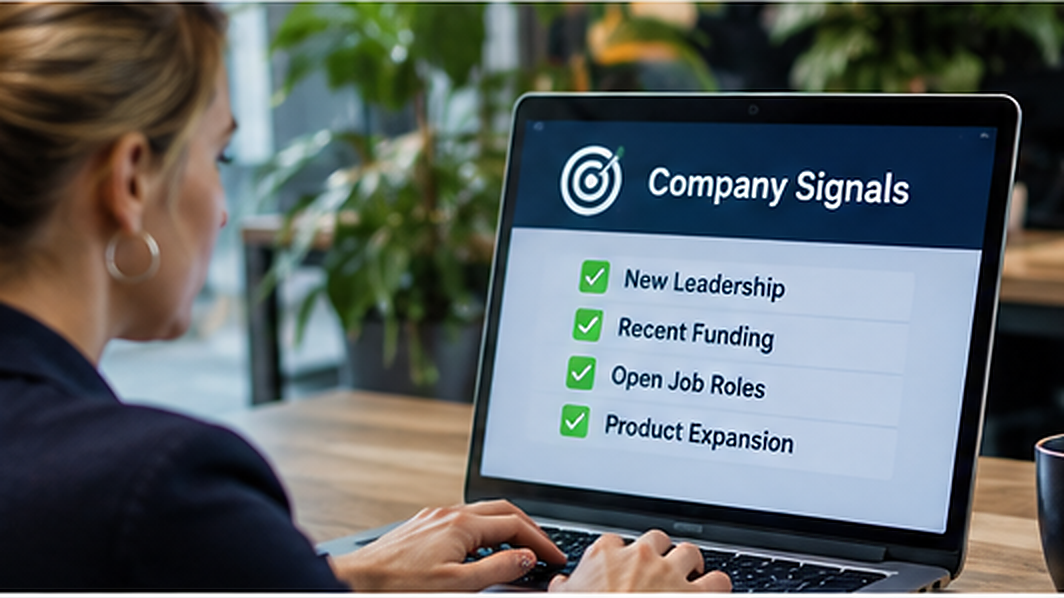
Illustrative research scene: on-screen labels show possible signal categories, not verified buying intent or findings about a real account.
A signal can justify a question without justifying a claim.
| Observed signal | Possible workflow question | A reasonable alternative explanation |
|---|---|---|
| Manufacturer adds a warehouse | Is cross-site inventory reconciliation getting harder? | Existing ERP already covers it |
| SaaS business hires a RevOps lead | Is CRM ownership or handoff being redesigned? | Ordinary replacement hire |
| Organization acquires another company | Will data or process consolidation be needed? | Companies may remain independent |
| Buyer asks for API integration documentation | Is a technical requirement being evaluated? | Educational research only |
| Vendor reports increased research on CRM | Is the account exploring this market category? | Unrelated browsing or inaccurate attribution |
| Firm announces a security initiative | Does a defined capability need evaluation? | General policy communication |
For example, a legitimate public distribution-center expansion does not permit an SDR to say, “We know you're replacing your ERP.” A defensible CRM note would read: “Facility opening confirmed; inventory reporting may be relevant; no budget, system-change plan, timeline or stakeholder interest confirmed.”
Link the research to a specific function affected by the event. An ERP expansion could involve operations, IT and finance, but the responsible buyer differs by actual problem. Map stakeholder roles rather than emailing executives indiscriminately.
See our ERP buying-committee guide and SaaS ICP framework for account fit and functional ownership.
5. Build a five-question research-to-action workshop
The sales and research teams can use a short workshop to decide which signals actually deserve action.

Work through the same five questions for each candidate account:
- Does the business satisfy approved ICP and exclusion rules?
- What precisely happened, and are the original source and date reliable?
- What verified buyer workflow might be affected—and what else could explain the event?
- Who already owns this account, and what do channel preferences and eligibility allow?
- Does the evidence justify responding, researching, asking an appropriate question, or closing the record?
| Situation | Decision | What to record |
|---|---|---|
| Explicit request for a specific resource | Fulfill the actual request | Promised item, owner, due date |
| Credible corroborated business change | Research the likely affected function | Source, hypothesis and unknowns |
| Opaque account-level intent score | Seek more evidence before activation | Provider limitations |
| Existing open opportunity | Route to current account executive | Ownership and context |
| No relevant problem or prohibited contact | Do not activate | Exclusion or restriction reason |
A professional sales operation should allow no action as a legitimate result of the audit. Research quality is not measured by how many CRM records can be forced into a messaging sequence.
6. Use a transparent priority rubric—not a fake buying probability
Some teams need to sort research queues. A simple illustrative scoring model may help:
| Dimension | 0 points | 1 point | 2 points |
|---|---|---|---|
| ICP fit | Wrong or unknown | Partial | Verified |
| Source quality | Opaque or outdated | Credible but incomplete | Current original evidence |
| Problem relevance | No supported link | Plausible | Specific verified relevance |
| Corroboration | None | Some supporting context | Independent sources |
| Account ownership | Conflict/unknown | Needs confirmation | Assigned and reconciled |
A 0–10 total is research priority, not a 0–100% chance of purchase. Two hypothetical examples:
- Account A scores 2+2+2+2+2 = 10 because fit and evidence are clear.
- Account B scores 1+0+1+0+0 = 2 because the only signal is an unexplained category badge.
Those figures are fictional, not LeadUp results or calibrated benchmark data. Even Account A may have no procurement initiative and may not be eligible for the chosen contact channel.
Never include suppression in a score that can be outweighed by other points. Contact eligibility is a hard gate. A verified opt-out or wrong recipient makes the proposed action inappropriate regardless of research quality.
7. Verify outreach eligibility in the United States and Canada
An intent signal does not grant commercial messaging permission.
United States
The FTC CAN-SPAM business guide applies to commercial B2B email and addresses truthful sender identity, subject lines, appropriate opt-out information, honoring removals and responsibility when another company sends emails on the business's behalf.
A valid work address and a relevant company event do not eliminate these obligations. Other rules can affect calling, SMS, recorded messages, privacy or particular number types; evaluate the actual channel.
Canada
The CRTC implied-consent guidance explains why publishing a business email does not automatically create unrestricted consent. The context, relevance to the recipient's duties and absence of a statement against unsolicited commercial messages are important where the sender is relying on conspicuous publication.
The CRTC CASL FAQ covers consent, identification, unsubscribe and relevant exceptions. A third-party “high-intent” label is not an independent consent basis.
Professional networking
LinkedIn's automated-activity guidance prohibits unauthorized third-party scraping and automation. A provider's ability to collect a profile or trigger does not mean the method is authorized.
Follow actual legal, contractual and privacy requirements; have qualified experts review the real campaign. This is general operational advice, not legal advice.
8. Make signal-led messaging truthful and proportional

Illustrative business conversation; it does not depict a real LeadUp client or imply that any company has confirmed a purchasing project.
A public event can supply honest context, but not magical knowledge of a buyer's plans.
Template A: verified regional expansion
Subject: Question about [specific confirmed expansion]
Hi [First name],
I noticed [Company]'s public announcement of [specific event]. Congratulations.
We work on [accurately described workflow] for [relevant organizations]. I don't know whether that area has become more complex for your team.
Is [specific function] something you're reviewing, or is the existing process working well?
Best,
[Name]
This example is appropriate only where the actual contact, channel and content are permitted. Do not imply a live ERP replacement or funding decision unless the buyer has confirmed it.
Template B: genuine product question
Subject: The [technical topic] details you requested
Hi [First name],
You asked about [specific requirement]. Here is [verified documentation or approved specialist answer].
One point still needs confirmation: [known limitation]. If useful, I can connect you with [appropriate expert] to resolve that exact question.
Best,
[Name]
Respond to the stated need; do not add a person to unrelated campaigns merely because they requested a resource.
Template C: opaque intent score only
Do not send: “I know your company is in the market for our software.”
Instead, research the account's real business context and source methodology, and check actual contact eligibility. If you cannot establish relevance, don't manufacture it.
For truthful message construction, see SaaS cold email personalization and our coordinated email, calling and LinkedIn plan.
9. Measure signal-to-outcome quality with correct denominators
Intent programs often collect events while sales measures accounts, people and opportunities. Mixing those units can create meaningless performance rates.
| Metric | Purpose |
|---|---|
| Observed signals | Count distinct events, not necessarily distinct companies |
| Accounts reviewed | Deduplicated research cohort |
| Source validation pass rate | Share meeting approved evidence/date requirements |
| Eligible activation | Records passing ownership and channel safeguards |
| Substantive buyer responses | Distinct, appropriately contacted people who replied meaningfully |
| Buyer-confirmed relevant problems | Actual stated needs, not score flags |
| Meetings held and accepted | Downstream sales-quality outcomes |
| Qualified new opportunities | Governed opportunity-creation evidence |
| Exceptions | Data corrections, suppression, policy and ownership incidents |
Fictional comparison—not an industry benchmark
Suppose Group A has 40 verified-ICP accounts with corroborated trigger evidence, and Group B has 40 verified-ICP accounts with a generic category-intent score. After eligibility review, 20 in Group A and 15 in Group B are appropriate for a particular outreach test. Six Group A accounts and two Group B accounts reply substantively.
The resulting illustrative response shares are 6/20 = 30% and 2/15 ≈ 13.3%. These numbers are invented teaching examples—not LeadUp performance, an average, or proof that one source caused better results. Cohorts can differ in offer, timing, role, geography and other factors. Audit those differences before interpreting them.
Our B2B outbound campaign audit explains how to verify conversion denominators and find actual bottlenecks.
10. A seven-day buying-signal research sprint
A small pilot can validate the research process without claiming revenue results:
| Day | Work | Output |
|---|---|---|
| 1 | Define ICP, buyer problems, approved sources and exclusions | Research brief |
| 2 | Review provider methodology, data freshness and permissions | Source-risk register |
| 3 | Deduplicate a bounded candidate-account list | Account cohort |
| 4 | Verify events, dates and alternate explanations | Evidence notes |
| 5 | Map owner, stakeholder roles and eligibility gates | Research/activation decisions |
| 6 | Prepare approved answers or one bounded permissible outreach test | Test brief |
| 7 | Review data quality, exceptions and early feedback | Decision memo and review date |
A one-week sprint cannot validate full financial ROI for a months-long buying cycle. It can produce clearer evidence and fewer bad outreach decisions.
11. Preserve uncertainty when handing an account to sales
An SDR handoff should distinguish the real event from the imagined purchasing initiative.
Fictional account brief:
Company: Example Manufacturing
Verified observation: Official announcement of a new distribution site
Potential workflow: Cross-location inventory reconciliation
Source: Original public announcement with reviewed date
Known: Expansion is confirmed; company matches the approved segment
Unknown: System replacement, budget, project timing, internal approval and buyer identity
Ownership: Check CRM before assigning
Contact eligibility: Review the proposed channel separately
Next step: Verify the responsible business function; do not claim an active ERP evaluation
This is much more useful than “Hot ERP lead—call CFO.” A genuinely qualified sales meeting requires relevant buyer evidence and the client's normal acceptance standard, not a research-score threshold.
Copyable B2B buying-signal checklist
Signal research
- Confirm approved ICP and account hierarchy.
- Record actual event, original source and event/review dates.
- Distinguish observed facts from hypotheses.
- Consider alternate explanations and source limitations.
- Seek independent corroboration for high-impact claims.
- Mark unclear or conflicting information explicitly.
Activation
- Verify business owner and stakeholder responsibilities.
- Check existing customers, opportunities and account exclusions.
- Respect provider licenses, platforms and contact restrictions.
- Verify country, channel, suppression and preferences before outreach.
- Use only truthful and proportionate buyer-facing claims.
- Assign next research or buyer action to one named owner.
Quality review
- Count events, companies, people and meetings separately.
- Don't treat vendor scores as purchase probabilities.
- Preserve meaningful buyer responses and actual problem statements.
- Apply held and AE-accepted meeting definitions consistently.
- Review exceptions and learn from both activated and rejected accounts.
Frequently asked questions
What are examples of strong B2B buying signals?
A direct product evaluation or a relevant buyer question provides stronger evidence of specific interest than an unexplained account score. Verified expansion or technology initiatives can suggest useful research questions, but still do not prove purchase approval.
Is intent data the same as a qualified lead?
No. Some intent data describes probabilistic topic research at the company level. A qualified lead or accepted meeting needs separate evidence about an actual relevant person and buying issue.
Do hiring announcements prove an ERP project?
No. Hiring may mean backfill, ordinary operations or an in-house change rather than buying a new platform. Verify what the job posting actually states and record uncertainty.
Can an SDR message someone because of a LinkedIn post?
A post may provide permissible professional context, but it is not blanket permission for sales messages or evidence of a purchasing project. Respect the platform's collection and automation rules and applicable communication requirements.
How soon must a team act on a buying trigger?
Respond to legitimate direct requests in a suitable staffed timeframe. Indirect triggers often require research and ownership checks first. There is no universal safe “contact within 24 hours” rule for every signal type.
What is a good intent score?
There is no universal threshold across providers. A score is meaningful only when its underlying event, accuracy, relevance and relationship to observed outcomes are understood; it is not automatically a sales-readiness probability.
Make buyer research a source of better questions
B2B buying signals create value when SDRs can distinguish verified facts from guesses, identify the right operational problem and respect buyer preferences. Those disciplines can help SaaS and ERP teams prioritize research and avoid false claims in sales conversations.
LeadUp Solutions provides Prospect Research & List Building, Lead Qualification, B2B Cold Calling and managed outbound services. Signal-led research can complement those offerings, but no account score or trigger guarantees an appointment.
If you're entering the U.S. or Canadian market or rethinking a prospecting list that produces too many irrelevant conversations, contact LeadUp Solutions to discuss an evidence-based targeting and qualification approach. Start with the accounts and problems you can verify, then decide what outreach is justified.