SaaS cold email personalization should make an initial message more relevant, not make a stranger feel watched or misled. The best account research is modest, verifiable and connected to a real use case. An email that claims "I saw your funding announcement" when no such announcement exists can damage trust before a conversation begins.
For B2B SaaS companies selling to the US and Canada, disciplined personalization begins with the ideal customer profile (ICP), a clear buyer role and approved communication practices. This guide explains how to research an account, label evidence, turn it into a relevant email, review AI-assisted drafts, protect sender reputation, and measure whether conversations are genuinely useful.
Quick answer: Personalize a cold email with one verified, relevant account or role detail, connect it to one genuine product capability, ask one respectful question, and give the recipient an easy way to decline. If research is inconclusive, remove the claim rather than inventing one. Before sending, verify that the particular message and recipient meet the applicable outreach rules.
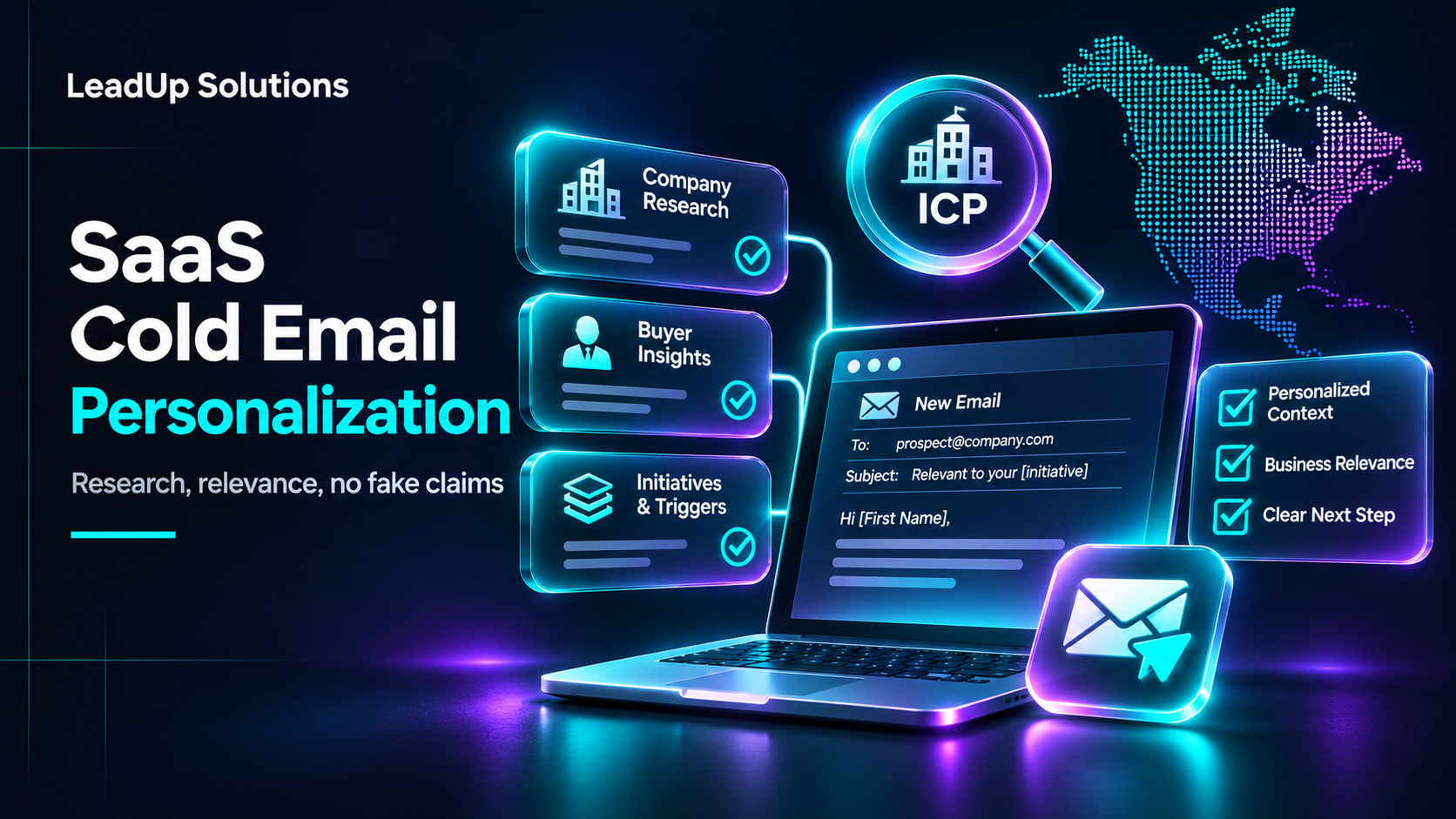
Personalization is relevance, not a first-name variable
Adding a name to a generic email is not the same as demonstrating relevance. A credible message explains why this organization might reasonably care about a problem your product can address, while remaining honest about what you actually know.
Useful personalization can involve a verified company category, a public operational context, or the recipient's published responsibility. It should not assume private performance data, software pain, budget, or buying plans.
An SDR should know the difference between confirmed, inferred, and unknown information. The message should not convert an inference into a factual claim.
| Evidence label | Meaning | How to write about it |
|---|---|---|
| Confirmed | Current, reliable evidence supports the exact company or role detail | Mention it accurately and without exaggeration |
| Inferred | A reasonable hypothesis, but the prospect has not confirmed it | Ask a neutral question or omit the hypothesis |
| Unknown | No sufficient evidence or a stale/conflicting source | Do not personalize around it |
| Disqualified | Verified reason this account or channel should not be targeted | Exclude and log the reason |
For example, "the company publicly announced a new office" may be confirmed; "therefore its CRM is failing" is not. Research should help identify a relevant question, not manufacture a sales problem.
Begin with a defined segment and problem
A strong email is easier to write when the team chooses a narrow audience.
For instance, a workflow SaaS product might focus on operations leaders at multi-location service companies. That is a better starting point than "all businesses using software." For a structured approach, see our B2B SaaS ICP guide.
Document your industry's terminology, supported use cases, any integrations the product can genuinely support, and hard exclusions. If the product cannot solve the recipient's likely needs, good copy will not create fit.
A simple role-to-message map
| Buyer role | Topic to investigate | What not to claim |
|---|---|---|
| VP Operations | Cross-team handoffs and work visibility | That the company is operationally inefficient |
| Revenue Operations | CRM-to-reporting processes and sales handoffs | That their current platform or data is broken |
| Finance leader | Reporting and approvals, if the product supports them | Specific financial losses or return on investment |
| IT evaluator | Approved integration and security scope | Certifications or integrations you have not verified |
The goal is to research one problem hypothesis per persona, not to write a different invented story for every named contact.
Create a source-backed research note
Before writing, collect only relevant account-level facts from appropriate sources.
| Research field | Useful example | Important limit |
|---|---|---|
| Company website | Verified official domain | Do not infer revenue from website design |
| Industry and operating model | B2B distribution with multiple regions | Confirm from a suitable source |
| Relevant executive role | Operations function named on company site | Check whether still current |
| Public initiative | Official announcement about new facilities | Does not prove active software buying |
| Technology context | Publicly documented integration requirement | Old job postings may be stale |
| Use-case hypothesis | Cross-team reporting might matter | Label as hypothesis |
Keep a source URL and checked date for claims that materially influence the opening message. Avoid collecting personal information unrelated to a legitimate B2B sales purpose or violating platform policies.
Use a one-line research card in the CRM
An SDR or AI-assisted writing workflow should require:
| Field | Example or rule |
|---|---|
account_domain |
Verified official company website |
buyer_role |
Confirmed functional responsibility or Unknown |
personalization_fact |
One verifiable and relevant observation |
source_url and checked_at |
Link and date tied to that observation |
evidence_status |
Confirmed / Inferred / Unknown |
approved_use_case |
Product capability validated by your team |
message_eligibility |
Applicable legal/policy conditions checked |
suppression_status |
No prohibited contact or opt-out |
reviewer and campaign_version |
Accountability for approved claims and wording |
Fictional example: A hypothetical company, "Northstar Workflow Group," has several regional offices according to its official website. If that fact is verified, an SDR could ask whether regional coordination is an area of interest. The SDR cannot assert that Northstar has a failed reporting system or an approved software budget.
The contact's email being found in a dataset is not sufficient evidence of role relevance, permission to contact, or a verified company claim.
Build the email around four short elements
A practical email structure is:
- Relevant context: A verifiable connection to the company or role.
- Product-relevant hypothesis: A business challenge that organizations of this type sometimes face.
- Low-pressure question: An invitation to confirm or correct whether the subject matters.
- Clear next step: An appropriate conversation if it is relevant, without misleading promises.
The tone should be professional rather than artificially familiar. Avoid implying a prior relationship, mutual referral or previous research activity that did not happen.
Before and after: replace invented certainty with a relevant question
Avoid this fictional claim:
"Saw you're losing hours every week because your CRM is outdated. We can fix that with a 40% productivity boost."
Unless backed by appropriate evidence, both the internal performance claim and promised result are unsupported.
Use a research-grounded alternative:
"I noticed [verified company context]. Since your role covers [verified function], I wondered whether [supported workflow topic] is something your team is evaluating, or whether the current approach is working well."
Replace each bracket only after verifying it. If you cannot verify the company-specific fact, use a straightforward role-relevant question without pretending you conducted personalized research.
Editing rule: A personalization claim is helpful only if the recipient could reasonably understand where it came from and why it is relevant to the actual product.
Three illustrative personalized email examples
These examples are fictional content structures, not send-ready legal templates. Insert truthful company details and satisfy applicable sender identity, consent and unsubscribe requirements before sending. Each template needs a proper sender signature, truthful identification, any legally required mailing address, and an appropriate opt-out mechanism where required. Don't copy the placeholders into a live sequence without verification.
Example A: Operations SaaS
Subject: Question about cross-site workflow reporting
Hello [Name], I noticed [verified company context]. Teams coordinating work across several locations sometimes evaluate ways to reduce manual handoffs. Is that a relevant priority for your operations group, or is someone else responsible for the process? If useful, I can share how our platform addresses [verified product capability].
The first sentence must reflect actual evidence. If no relevant fact is available, do not manufacture one.
Example B: Revenue operations SaaS
Subject: CRM-to-reporting workflow at [Company]
Hello [Name], your role appears to cover [verified responsibility]. We support teams looking to connect [specific supported workflow] with their existing reporting processes. Is that something your team is exploring, or is the current approach working well?
This is a fit question, not a statement that the company's reporting is broken.
Example C: ERP partner outreach
Subject: Finance and operations systems question
Hello [Name], I work with ERP teams evaluating [verified service scope]. I understand your organization operates in [confirmed business context]. Would a discussion about integration requirements be relevant, or is there a more appropriate colleague to ask?
An ERP partner should not promise integrations or certifications without product-team validation.
Example D: When there is no reliable company news
Subject: Question for the [team/function] owner
Hi [first name],
I work with SaaS teams addressing [specific, approved workflow]. Is improving [relevant process] something your team is exploring, or is the current approach meeting your needs? If this topic belongs to another function, I appreciate the correction.
[Truthful sender signature and all applicable required disclosures and opt-out details]
Why this example matters: It avoids fake references to funding, hiring or software problems while still being clear about the offer. It must not be sent unless the recipient and channel satisfy the relevant outreach requirements.
Subject lines should set honest expectations
A useful subject line states the topic rather than pretending the email is a reply or internal message. Avoid deceptive "Re:" or "Fwd:" prefixes when there was no prior exchange.
Short and clear is typically easier for a professional recipient to understand, but there is no magic word count that guarantees responses.
Test subject lines only after ensuring the underlying email is relevant and permissible. A high open rate is not proof of a qualified business conversation.
| Avoid | Prefer when accurate | Reason |
|---|---|---|
Re: our discussion when there was none |
Question about [verified workflow] |
No false thread or prior relationship |
Urgent: your CRM is failing |
[Relevant team] workflow question |
No fabricated crisis |
Congratulations on your funding without evidence |
Question for your operations team |
No invented company news |
Guaranteed 40% savings |
Exploring [approved solution area] |
No unsubstantiated results claim |
Subject lines should reflect the actual message. Testing subject variants cannot substitute for a lawful channel and accurate content.
Make the email easy to understand and decline
The message should identify the commercial context and avoid excessive pressure. A prospect must be able to disregard or decline a message without being subjected to escalating contact.
If someone asks not to receive further marketing, update suppression records across the campaign. Do not switch to another channel as a workaround.
For an integrated approach across calls, email and professional networks, see our coordinated B2B outreach guide.
A response-aware follow-up workflow
A follow-up should respond to the actual last interaction, not blindly execute a predetermined sequence:
- No response: Review whether one relevant, permitted follow-up adds useful context; do not assume unlimited touches.
- Information requested: Provide only appropriate, accurate information relevant to that request and respect channel restrictions.
- Wrong role: Update the CRM; research an appropriate function without seeking unnecessary private details.
- Qualified interest: Confirm Fit, Role, Need and Purpose before presenting an AE meeting.
- Not interested or opt-out: Record the applicable suppression, stop marketing and do not use another channel to get around the refusal.
Store response type, next authorized action, owner and date. Avoid continuing automated sequences after a real reply.
US and Canada: legal permission comes before copy quality
US commercial email: The FTC CAN-SPAM guide explicitly covers B2B marketing messages, not just mass email. It addresses truthful header and subject information, identification as advertising, a valid physical postal address, an opt-out mechanism, and prompt honoring of opt-out requests. A marketing email's required disclosures do not disappear because the message has been individually personalized. The sender and any company sending on its behalf must supervise compliance.
Canadian commercial electronic messages (CASL): The CRTC's CASL overview describes requirements for applicable consent, sender identification and a working unsubscribe mechanism, with specific exceptions and conditions. CRTC guidance on implied consent explains that conspicuous publication of a business email address can support implied consent only when conditions are satisfied: there is no statement against unsolicited commercial messages and the content is relevant to the recipient's business role or duties. The sender must be able to support that conclusion with evidence.
A publicly accessible work email therefore does not create blanket consent. Record the URL where the address was published, when it was obtained, whether restrictions appeared, and the rationale for role relevance, if relying on that basis. CRTC CASL FAQs explain why the conspicuous-publication rule is narrower than simple online availability. Commercial messages sent to Canada from abroad may also fall under CASL.
Example decision: An SDR finds a Canadian finance officer's work email in a data enrichment tool. That fact alone does not establish CASL implied consent via conspicuous publication. Further checks are needed; if no lawful basis applies, do not send a marketing message.
These are editorial compliance considerations, not legal advice or permission for a particular campaign. Have qualified counsel review the relevant market, recipient type, message purpose, platform policies, and actual data collection before outreach.
Email deliverability and domain health are separate from personalization
Even accurate emails may be rejected or sent to spam if the sending setup is poor. Google's sender guidelines describe requirements for senders delivering to personal Gmail accounts: basic SPF or DKIM authentication, valid DNS, TLS, acceptable formatting and spam-rate controls, with additional SPF, DKIM, DMARC and one-click unsubscribe requirements for senders crossing the specified bulk-sending threshold.
Do not assume one-click unsubscribe is required for every message from every sender: Google applies additional rules to high-volume senders and marketing/subscribed messages; legal requirements such as CAN-SPAM and CASL apply independently of Gmail's provider thresholds.
Before executing a permitted campaign:
- Verify SPF/DKIM and suitable DMARC configuration and alignment for the sending domain, as applicable.
- Ensure the company controls the sending identity and does not impersonate another domain.
- Review bounce handling, opt-outs, complaints and suppression across the actual tools.
- Follow provider-specific bulk-sender rules where applicable, including one-click unsubscribe.
- Confirm sending volumes and monitoring reflect the real infrastructure, not an unsupported "safe daily limit."
Meeting an email provider's requirements is not a guarantee of inbox placement or legal compliance. Avoid suggesting that domain rotation, deceptive identity practices or high-volume blasting are acceptable workarounds.
Use AI research assistance without inventing facts
AI can help organize known facts, summarize approved product features and draft alternative wording. It should not be permitted to invent company news, claim a prospect's internal system is failing, or fabricate client case studies.
An effective review prompt might ask: "Highlight every sentence that asserts something about the prospect and label it confirmed, inferred or unsupported." An editor should then check the sources before authorizing outreach.
Never treat a generated citation as a verified source until the link and underlying claim have been examined.
An AI-assisted drafting QA procedure
Use AI as a drafting and checking assistant, not as the authoritative source of facts:
- Input: Only approved product capabilities, ICP rules, validated account research and the target buying role.
- Draft: Generate one concise, respectful message tied to one possible business question.
- Claim audit: Extract each statement about the specific prospect, competitor, vendor and expected outcome.
- Evidence review: Require a source and checked date for each factual claim. Otherwise rewrite as a clearly stated hypothesis or delete.
- Policy review: Check the jurisdiction, permitted channel, sender identity and suppression status.
- Human approval: Have the authorized reviewer approve the final content before any actual sending.
Copyable review instruction (editorial use):
Review this SaaS outbound draft for fabricated personalization, invented buyer pain, unsupported ROI claims, false prior relationships and unnecessary personal data. For every prospect-specific statement, return Confirmed, Inferred or Unsupported, cite the supplied evidence, and propose wording that does not assert unverified facts. Do not invent sources or authorize sending.
Do not put private, unnecessary contact data into AI tools unless your organization's approved processing and privacy controls permit it.
Measure quality beyond reply rate
Personalization succeeds only when it helps a relevant buying conversation—not when it produces the largest open-rate percentage. Track engagement stages with clear definitions.
| Indicator | What it means | What it cannot prove |
|---|---|---|
| Delivered messages | Sending system recorded delivery/acceptance | That a human read the message |
| Meaningful reply | A response about relevance, need, role or timing | That the buyer wants a demo |
| Positive interest | Prospect expresses interest in discussing a supported topic | That a buying project is approved |
| Information request | Recipient asks for specific information | That a qualified meeting has occurred |
| Booked meeting | Calendar invitation agreed and scheduled | That the meeting was held or accepted |
| Sales-accepted meeting | AE confirms the agreed quality criteria | That the deal will close |
| Opt-outs and complaints | Signals that outreach preferences or quality need attention | That sending more messages is appropriate |
Be cautious with open rates. Email-client privacy protections, image-loading behavior and automated security scanning can make opens an unreliable measure of genuine buyer engagement. Clicks can also be affected by security systems. Prioritize relevant replies, held meetings, AE acceptance and properly matured opportunities.
For comparison, define the denominator and observation period. Compare similarly targeted, legally eligible campaigns rather than claiming a generic personalization uplift from a few messages.
A polite "thanks" is not equivalent to a qualified sales meeting. Our qualified meeting checklist offers a practical framework for evaluating Fit, Role, Need and Next Step.
A focused editorial experiment
If you want to compare messages, change one meaningful variable at a time—for example, a generic role-based question versus a verified company-context opening—while holding ICP and sending conditions as consistent as practical.
Record the actual messages, sources, eligible recipients, responses, and rejection reasons. A small test can generate useful qualitative learning, but it does not establish statistically reliable uplift or a guaranteed sales result.
A practical QA checklist before sending
Before approving a message, ask:
- Does the company fit the ICP, and is the role relevant?
- Is every prospect-specific claim verified or transparently framed as a question?
- Does the offer match an actual approved product capability?
- Is the subject line truthful?
- Is the channel allowed for this recipient and jurisdiction?
- Have suppression and contact preferences been checked?
- Is there one understandable, low-pressure next step?
If the answer to an essential question is no, revise or do not send.
Pre-send approval matrix
| Gate | Pass condition | Owner |
|---|---|---|
| ICP and role | Relevant account and stakeholder | SDR or account researcher |
| Factual claims | Verified and current; no made-up events | Research reviewer |
| Offer accuracy | Product capabilities and proof points approved | Product/sales owner |
| Legal/channel eligibility | Applicable consent, identifiers and opt-out rules reviewed | Authorized compliance owner |
| Technical readiness | Authentication, provider requirements and suppression work | Email operations |
| Buyer experience | Clear subject, low-pressure question and no unnecessary data | Campaign editor |
Require a recorded decision before sending; do not treat a high generic AI confidence score as approval.
Frequently asked questions
Is using a prospect's first name enough personalization?
No. Relevance comes from aligning the message with a plausible business context and stakeholder role, not merely adding a variable.
Can I mention funding or a job posting?
Only if the source is reliable and current, and the connection to your product is reasonable. Such events are not proof of purchase intent.
Should every cold email ask for a meeting?
Not necessarily. A concise qualification question can be more appropriate when you do not yet know whether the problem exists.
Can AI write complete personalized sequences?
AI can help draft and review, but factual validation, legal permission, channel suitability and quality control remain essential.
Is a publicly listed Canadian work email enough for a campaign?
Not automatically. CASL implied consent through conspicuous publication has conditions, including role relevance and no accompanying statement against commercial messages. Preserve supporting evidence and seek appropriate legal review.
Does adding a personal detail guarantee a higher reply rate?
No. A detail can be irrelevant, intrusive, wrong, or stale. Evaluate whether it makes the message more useful and whether a relevant buyer actually engages.
Are SPF, DKIM and DMARC substitutes for consent?
No. They are email authentication controls. Compliance with Google or another mailbox provider's technical requirements does not establish permission to send a commercial message.
Connect truthful personalization to the sales workflow
A well-researched message still needs the right market, contact owner and outreach permissions. Our US and Canada outbound territory-planning guide covers those operational checks without treating public contact information as automatic authorization.
Once a recipient engages, the MQL vs SQL vs Sales-Accepted Meeting guide can help your revenue team distinguish marketing engagement, actual sales qualification and a separately accepted appointment.
Make every email worth reading
Effective SaaS cold email personalization is grounded in evidence, product fit and respect for the recipient. It does not require invasive research or false urgency.
LeadUp Solutions supports B2B SaaS and ERP companies with cold email, cold calling, LinkedIn outreach and lead qualification, coordinated around a documented ICP and appropriate channel rules.
If you need a more focused US or Canadian outbound motion, speak with LeadUp Solutions about your target market and qualification standards.