An outsourced SDR partner evaluation should go beyond sales presentations, attractive dashboards and the price on a proposal. A vendor can promise substantial outreach activity, but that does not automatically translate into relevant conversations or meetings your account executives are willing to accept.
For US and Canadian SaaS and ERP businesses, an effective evaluation examines targeting, qualification standards, message control, quality assurance, data ownership, team management and transparent reporting. These factors shape what happens after the contract is signed.
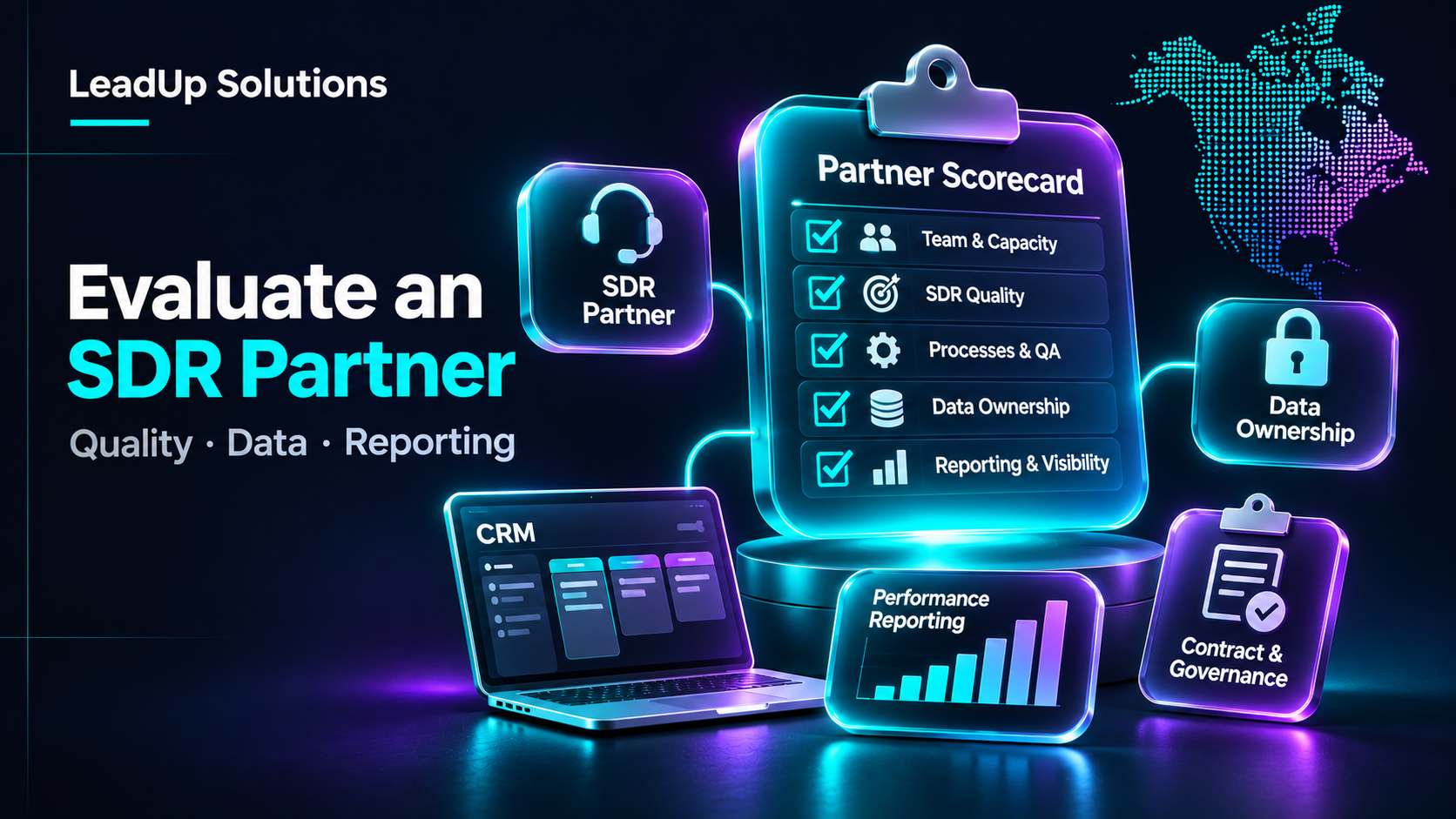
This guide gives B2B buyers a structured vendor-comparison method: hard pass/fail gates, a weighted scorecard with an example calculation, evidence requests, interview questions, CRM and compliance checks, pilot criteria, and an exit checklist. The framework is a decision aid—not an independent certification, guarantee of meetings, or industry-standard scoring model.
Quick answer: An effective outsourced SDR partner evaluation checks whether the provider can reach the right accounts lawfully, demonstrate approved messaging and coaching, define a genuinely qualified meeting, give your sales team useful CRM evidence, protect and export your data, and work within a transparent contract. Compare vendors on demonstrated practices, not only price or forecasted meeting counts.
Start by defining what you need the partner to operate
Before interviewing providers, document your own sales motion.
Which industries and company types fit your ICP? Which buyer functions matter? Are you selling a relatively straightforward SaaS workflow or a complex ERP program? Who in your company will take the sales meetings? How will a meeting be accepted?
A provider cannot responsibly define your entire go-to-market strategy without participation from product and sales leadership. Outsourcing execution does not mean outsourcing accountability for claims about your solution.
Use our ICP and target account guide to establish criteria before evaluating SDR capacity.
Set hard pass/fail gates before you score a provider
A weighted score should not compensate for an unacceptable risk. Identify non-negotiable requirements before anyone assigns a numerical grade.
| Non-negotiable gate | Evidence you can request | If it fails |
|---|---|---|
| Your product and target market are supported | Written ICP, industry exclusions and honest service scope | Do not proceed until the gap is resolved |
| Outreach channels have an approvable compliance process | Channel-specific review, suppression workflow and accountable owner | Pause evaluation; obtain qualified review |
| CRM and client-data access are appropriate | Role-based permissions, data-export demonstration and written offboarding terms | Treat unresolved access or data lock-in as a blocker |
| Claims and messages require approval | Example version control and escalation for unsupported statements | Require corrective process before launch |
| Meeting criteria can be audited | Sample handoff with Fit, Role, Need and Next Step | Do not pay on vague "appointments" without agreement |
| Contract and responsibilities are clear | Scope, charges, confidentiality, subcontractors and termination terms | Resolve legal/commercial gaps before signing |
These are suggested procurement controls, not an assertion that each row is a legal requirement in every situation. Define what is mandatory for your actual company and data, then score the remaining eligible vendors.
Evaluate seven operating dimensions
| Dimension | Evidence of a capable process | Warning sign |
|---|---|---|
| ICP and account data | A sourced sample list with exclusions, freshness and uncertainty labels | Raw list volume with no targeting logic |
| SDR training | Documented product onboarding and escalation for complex questions | Every client gets the same generic script |
| Messaging governance | Approval history, truthful claims and audience-specific examples | Fake prospect insights or unauthorized promises |
| Qualification and handoff | Written acceptance rubric and actionable AE feedback | Every booked call is automatically "qualified" |
| CRM and reporting | Record-level access, stage history and suppression sync | Only a vendor-owned summary dashboard |
| QA and management | Sampling protocol, reviewer identity and coaching follow-up | Only cherry-picked calls and no correction loop |
| Data, security and contract | Least-privilege access, exportability, clear obligations and exit terms | Hidden subprocessors, locked data or vague charges |
Ask for redacted artifacts or demonstrations, not confidential customer contact lists or unconsented recordings. A provider that can explain what it doesn't yet know is often more useful than one that fills every field with invented certainty.
This process should remain independent of any provider's marketing claims—including ours. The objective is to help the buyer make a defensible comparison.
1. Examine how the provider chooses target accounts
Ask how the provider translates your ICP into search criteria, sources and exclusions.
A useful answer should distinguish company-level targeting from contact-level research and explain how stale or uncertain data is handled. The vendor should know how to mark a company "unknown" rather than inventing a technology stack or purchasing signal.
Also ask about duplicate prevention, shared account ownership and mechanisms to avoid contacting excluded companies.
A simple account-data sample test
Request a small synthetic or appropriately redacted sample that shows how the vendor would handle an approved US/Canadian SaaS or ERP ICP. Ask the provider to identify source, check date, account fit, relevant function, uncertainty and suppression status.
Do not ask for a real prospect list as a free sample if obtaining or sharing it would violate privacy, contracts or platform rules. Evaluate the research method and supporting evidence. A vendor should be able to say "unverified" rather than claiming an account is actively buying because it posted an ERP role.
Compare the same ICP brief across vendors, or the scores will measure different assignments.
2. Assess product understanding and SDR enablement
A partner should show how its SDR team learns your product, expected use cases, unsupported claims, objection handling and escalation triggers.
For ERP, the team may need to identify finance, operations and IT roles while avoiding unsupported promises about integration and deployment. For SaaS, it may need to understand the workflow your product actually improves.
Ask how coaching changes after AEs reject meetings, not only how new SDRs are trained on day one.
A realistic onboarding demonstration
Have the provider explain its process for learning:
- What your SaaS or ERP product genuinely does—and cannot do.
- The buyer personas and their actual responsibilities.
- Approved industry use cases and exclusions.
- How reps handle common objections without inventing success stories.
- What they do when an ERP buyer asks about migration, architecture, certifications or implementation commitments.
- How the AE's rejection reasons trigger a change to research or messaging.
This is not a request for an all-purpose "perfect script." A credible SDR team recognizes when it should bring in a product specialist instead of promising unsupported functionality.
3. Review the quality assurance process
A credible QA process inspects relevance, accuracy, listening, record keeping, opt-out handling and handoff context.
Questions to ask:
- Who reviews calls and messages?
- How are samples chosen without cherry-picking?
- What issues require immediate correction?
- Can the client review redacted examples where legally permissible?
- What gets recorded when a rep makes an unsupported claim?
- How are repeat problems escalated to management?
The answers should fit the provider's scope and your actual requirements. An elaborate dashboard without a process for corrective action may add little value.
Inspect the QA feedback loop, not only a polished sample
A useful demonstration connects sample selection → evaluation → coaching → correction → re-review. Look for notes showing why a call was reviewed and what changed afterward.
| QA question | Example of evidence |
|---|---|
| How are interactions sampled? | Documented random/risk-based rules, not only chosen wins |
| What is evaluated? | Role relevance, evidence accuracy, listening, contact preferences and handoff notes |
| Who reviews? | Named supervisor, reviewer eligibility and escalation owner |
| What happens after an issue? | Corrective action, due date and documented follow-up |
| How does sales feedback arrive? | AE rejection reasons linked to the corresponding SDR interaction |
| How are critical errors handled? | A clear pause-and-escalate path for misleading or impermissible outreach |
There is no universal QA score that proves a vendor will deliver profitable pipeline. Ask whether the standard is documented and consistently applied. The sample must be legally accessible, with suitable redaction and call-recording permissions.
4. Define qualified meetings together
Before launch, document the difference between booked, held, sales-accepted and opportunity-created stages.
Confirm account fit, buyer role, credible need and meeting purpose. Define no-shows, reschedules, duplicates, rejected meetings and exception approval.
See our qualified sales meeting checklist and SDR-to-AE handoff framework.
If the provider's billable meeting definition differs from your AE's acceptance rule, resolve that mismatch before discussing performance targets.
Require a meeting-level evidence record
A handoff should contain a stable account_id, contact_id, and meeting_id; confirmed ICP fit; relevant role; buyer-stated issue or reason to explore; agreed discussion purpose; time zone and participants; open questions; and named AE owner.
Track Booked, Held, AE Accepted, Opportunity Created and Billable as distinct states or events. An AE might accept meeting quality before the call and the buyer might later cancel; preserve both facts. Make it clear how duplicates, no-shows, cancellations, reschedules, rejected meetings and credits affect invoices.
Our qualified sales meeting checklist provides the acceptance rationale; the SDR-to-AE handoff guide gives a reusable CRM transfer template.
Do not accept a vendor's claimed "90% meeting quality" without seeing the denominator, stage definition, review authority, sample size and reporting period. The percentage in that sentence is a hypothetical example of an unsupported vendor claim—not an actual vendor result.
5. Verify CRM access and data ownership
Ask whether you will have timely access to account research, interaction histories, meeting details, role notes, exclusions and suppression status.
Define data export rights, retention, confidentiality, permitted subprocessors and what happens when the partnership ends.
A provider that keeps all account history in a system you cannot access creates operational dependency. Even with a fully managed service, the client needs enough transparency to evaluate the work.
A client-controlled data and access checklist
Ask the vendor to demonstrate—not merely describe—the following where applicable:
- Least-privilege CRM access: Named users, defined roles, appropriate MFA and timely access revocation.
- Readable exports: Accounts, activity history, handoff notes, approved copy and meeting outcomes in an agreed transferable format.
- Suppression transfer: Unsubscribes, do-not-contact instructions and other lawful-use restrictions survive handoff and offboarding.
- Data boundaries: What personal data the vendor processes, where it is stored, which subprocessors can access it and for what purposes.
- Incident response: Who to notify, how quickly, how evidence is retained and how access is suspended if a problem is found.
- Exit procedure: A real test of export, removal of vendor access, and agreed retention/deletion obligations.
This is an illustrative vendor-risk checklist rather than an assertion that every SDR partner must implement the same technology. The NIST SP 1326 due-diligence guide, published in 2026, provides a broader framework for evaluating technology suppliers. SDR buyers can adapt its evidence-first approach to CRM access and outsourced tools without pretending the guide certifies SDR agencies or defines a mandatory sales-industry standard.
Brand promise versus contract: LeadUp's site says clients own their pipeline data. Any vendor—including LeadUp—should explain the actual contractual rights and accessible export procedure behind such a claim.
6. Understand staffing and management
A named account manager does not automatically mean dedicated SDR capacity. Ask whether reps are dedicated or shared, what supervision is included, how quality is maintained during staffing changes and who owns campaign decisions.
For an ongoing program, continuity and product knowledge can be important. For a small pilot, a carefully scoped, accountable test may be more appropriate than immediate scale.
Avoid vendor claims about specific capacity or time to launch unless those commitments can be evidenced and placed in the agreement.
Staffing questions worth asking before contract approval
| Ask the provider | Why it matters |
|---|---|
| Is the SDR assigned to one client or shared? | Capacity and account familiarity differ |
| Who is the day-to-day supervisor? | A named account manager is not necessarily the SDR coach |
| Who covers leave and turnover? | Continuous prospect context should not disappear with a rep |
| Who approves changes to ICP and outreach claims? | Client and provider authority need boundaries |
| How are US and Canadian buyer business hours handled? | Local scheduling and calling requirements can vary |
| Can you show onboarding and corrective-training artifacts? | Process evidence is stronger than a claim of an "experienced team" |
Do not require an arbitrary fixed ramp-up period or staffing ratio as though it were a universal benchmark. Request the staffing commitment the provider can actually deliver and verify.
7. Compare commercial models on scope, not hype
The same monthly invoice can include different services across providers.
Review data sources, tool costs, calling infrastructure, campaign setup, scripting, management, QA, reporting, and any geographic or language requirements.
Pricing can involve a managed retainer, a dedicated SDR seat, per-qualified-meeting charges, or a hybrid. A pilot is generally a time-boxed engagement structure, not automatically a fourth billing formula.
For a detailed comparison of pricing, qualified-meeting billability and contract risks, read Outsourced SDR Pricing Models: Retainer vs Per Meeting vs Hybrid. For a build-versus-buy comparison, see Outsourced SDR vs In-House SDR. Both resources support a more informed vendor shortlist, but actual fees must come from an itemized written proposal.
Compare whether the quoted price includes account research, channel tools, data, calling setup, management, quality assurance, CRM integration, legal/compliance review and required client oversight. Get a written definition of what makes a meeting billable and whether no-shows or duplicate bookings trigger replacement, credit or charges.
Do not equate a low cost per booking with a low cost per accepted opportunity.
A weighted outsourced SDR partner evaluation scorecard
The weights below are illustrative buyer preferences, not validated industry benchmarks. Choose the weights to reflect your ICP, sales motion, regulatory exposure and operational priorities. Complete the hard pass/fail gates first, then compare only vendors that meet those requirements.
Copyable criteria and weights
| Criterion | Weight | Evidence to examine |
|---|---|---|
| ICP and data quality | 20 | Sourced accounts, exclusions, freshness and uncertainty |
| Qualification and AE handoff | 20 | Accepted-meeting rubric and actual review/handoff workflow |
| SDR coaching and QA | 15 | QA sampling and documented corrective feedback |
| CRM transparency and reporting | 15 | Activity-level visibility, exports and traceability |
| Product training and message control | 10 | Approved claims, onboarding and objection coaching |
| Data protection and governance | 10 | Access control, suppression and offboarding procedure |
| Commercial fit and scope | 10 | Itemized fees, deliverables, credits and exit terms |
| Total | 100 |
Score each dimension using a consistent 1–5 scale
| Score | Meaning |
|---|---|
| 1 | Serious concerns or almost no relevant evidence |
| 2 | Some process exists, but important gaps remain |
| 3 | Meets baseline expectations with documented evidence |
| 4 | Strong, repeatable approach with useful examples |
| 5 | Consistently demonstrated and aligned with your specific use case |
Formula: Weighted points for each criterion = `criterion weight × (rating ÷ 5)`. Sum the seven weighted results for a score out of 100. When evidence is missing, mark the criterion Not verified and ask for it; do not silently award a five because the sales pitch sounded confident.
Worked example — entirely fictional
Imagine a hypothetical vendor that passed the hard gates. Its seven ratings in table order are 4, 5, 3, 4, 4, 5, 3.
| Criterion | Weight | Rating / 5 | Weighted points |
|---|---|---|---|
| ICP and data | 20 | 4 | 16 |
| Qualification and handoff | 20 | 5 | 20 |
| Coaching and QA | 15 | 3 | 9 |
| CRM transparency | 15 | 4 | 12 |
| Product training | 10 | 4 | 8 |
| Data governance | 10 | 5 | 10 |
| Commercial fit | 10 | 3 | 6 |
| Total | 100 | 81 / 100 |
Calculation: 16 + 20 + 9 + 12 + 8 + 10 + 6 = 81. This is not a LeadUp score, real vendor performance, independent endorsement or prediction of meetings. The number is only a demonstration of how to use the worksheet. A second hypothetical vendor with 88 points but an unresolved legal/permission blocker should not automatically win.
Prevent scorecard bias
Give every eligible provider the same ICP brief, evidence requests, time window and scoring rubric. Record who assigned each rating and the supporting artifact. If two reviewers disagree, document the reason instead of averaging away a material concern.
A strong score is useful for shortlisting and structured negotiation; a well-run pilot and real AE feedback should still determine whether a partnership deserves expansion.
Vendor interview questions: what evidence should you expect?
Ask the same questions of every shortlisted provider. A useful answer describes the process and shows a suitable record, demonstration or contractual commitment. Do not insist on another client's private prospect data or unconsented recordings.
| Question | A credible answer or artifact |
|---|---|
| "How will you research our ICP?" | A documented source, check date, exclusion rules and uncertainty markers |
| "How do reps validate buyer need?" | Buyer-stated evidence distinguished from hypotheses |
| "How do you learn our SaaS or ERP product?" | Onboarding, approved messaging and escalation for technical claims |
| "What counts as a qualified and billable meeting?" | Fit, Role, Need and Purpose standard plus explicit booking/attendance/AE review rules |
| "What happens after an AE rejects a meeting?" | Rejection reason, coaching feedback, dispute/credit process |
| "What can we inspect in the CRM?" | Record-level activity, ownership, source and disposition |
| "How are data and accounts protected?" | Named access permissions, export and documented offboarding |
| "Who manages reps during turnover or leave?" | Clear management and coverage commitments |
| "What exactly is included in the fee?" | Itemized research, data, software, management, QA and internal dependencies |
| "How do you review US and Canadian channel rules?" | Named compliance owner, suppression process and jurisdiction-specific escalation |
| "What would cause you to pause a campaign?" | Willingness to stop for compliance, low fit, misleading claims or security issues |
A practical evidence pack to request
For a shortlist review, ask the provider for redacted or synthetic examples of:
- An ICP-to-account research record with source dates and clear exclusions.
- An approved message or talk track with version history and an unsupported-claim escalation rule.
- A meeting handoff showing role, buyer-stated need, agreed purpose and AE decision.
- A QA review showing why a call was sampled, what feedback was given and how the fix was checked.
- A CRM export demonstration showing statuses, event timestamps, contact preferences and next-action ownership.
- A statement of work covering staffing, billing triggers, review periods, credits, tools, access rights and exit.
For every artifact, record Evidence reviewed / Needs clarification / Not provided, its date and the reviewer. Missing evidence should not receive a perfect score simply because the provider sounds confident.
A credible vendor can explain where its process does not fit your sales motion. Do not award points for unconditional revenue or meeting promises.
Run a controlled pilot before scaling
A pilot evaluates how the partner operates your actual outbound motion, not just whether it can generate calendar activity. Document the test before outreach begins.
Define the pilot in writing
- Scope: One clear ICP segment, permitted territory, agreed channels and exclusions.
- Preparation: Approved product claims, research method, outreach assets, CRM access and buyer-role map.
- Execution: Named client/provider owners, contact-preference checks, quality assurance and a weekly feedback meeting.
- Acceptance: Booked, held, AE-accepted and opportunity-created outcomes recorded separately, with dispute reasons.
- Commercials: Total pilot costs, included tools, billability, cancellation rules and exit/export rights.
- Decision: Explicit criteria for continue, refine, pause or stop, including who can authorize a change.
A 30-day B2B outbound pilot can test process readiness, targeting and buyer conversation quality. It is usually not enough by itself to establish a mature ERP revenue conversion rate.
Evidence-based pilot decision table
| Decision | Evidence to examine | Next action |
|---|---|---|
| Continue | Relevant conversations, transparent handoffs, usable AE feedback, no unresolved blocker | Expand gradually to an approved segment |
| Refine | Specific fit, research, scripting or scheduling problems with testable causes | Agree on corrective owners and retest |
| Pause | Open compliance, security, misleading-claims or serious data-integrity concern | Stop affected activity until properly resolved |
| Stop | Hard ICP mismatch, repeated low-value meetings or breached non-negotiable condition | Close pilot, reconcile charges and retrieve agreed records |
Don't invent a universal threshold such as "10 meetings means success." Agree on reasonable process and quality expectations for the particular product, target market and sales cycle. Show raw counts, denominators, review dates and small-sample limitations.
Pilot closeout and data continuity
The closeout report should include the account segment tested, channel-eligible records, outreach versions, accepted/rejected meetings, complaint/opt-out exceptions, actual costs, lessons, and a clear owner for any pending buyer conversations.
Before expansion or exit, verify the agreed access and data export process. Confirm who owns the prospect research and notes, how exclusions and suppression history transfer, and when vendor access is revoked. A well-run pilot can legitimately conclude that the partnership should stop.
Compliance and security are not optional extras
For commercial email in the US, review the FTC CAN-SPAM guidance. Canadian commercial electronic messages can be subject to CRTC CASL requirements; calling and professional-network rules need their own assessment.
Define who approves content, checks contact permissions, handles complaints, secures account data and responds to incidents. Contract terms cannot make unlawful outreach acceptable.
United States: The FTC CAN-SPAM guide covers commercial B2B email. It explains that hiring a separate sender does not remove the promoted company's own compliance responsibility. Truthful sender information, applicable disclosures, opt-out handling and suppression matter even when the SDR agency executes the campaign.
Canada: CRTC guidance on CASL describes consent, identification and unsubscribe obligations for relevant commercial electronic messages, with defined conditions and exceptions. Internationally operated campaigns that reach Canada need the appropriate eligibility checks and records, not merely a purchased B2B address list.
Calling, recording, privacy and professional-network rules can vary independently by jurisdiction, technology and recipient. A vendor must not treat permission for email as automatic permission for calls or LinkedIn automation. Obtain qualified legal review for the intended campaign.
Provider oversight: The client should approve product claims, designate decision-makers for questions about lawful channels, ensure complaints reach the correct owner, and verify that suppression and secure data-handling instructions survive staff or vendor changes.
Ask qualified counsel to review legal obligations specific to your campaign.
Common vendor selection mistakes
Selecting on quoted cost alone. Delivery scope and accepted outcomes matter.
Believing every meeting count. Check AE acceptance and actual buyer relevance.
Ignoring data export rights. You need a viable exit process.
Skipping product onboarding. Generic talk tracks may misrepresent the solution.
Failing to review call quality. Activity volume is not a substitute for coaching.
Scaling before the pilot is understood. First determine whether account fit and messaging are viable.
Frequently asked questions
Should a provider guarantee meetings?
Any performance commitment should be carefully defined, evidenced and contracted. Be wary of unconditional guarantees that ignore buyer behavior, market fit and the quality standard.
Is a dedicated SDR always better?
No. The right structure depends on work complexity, required continuity, provider management and your internal capacity.
Can an outsourced provider use our CRM?
Often, subject to technical support, contractual terms, role-based access and security review. Verify rather than assume.
Which metric matters most?
No single metric is sufficient. Pair account relevance and meeting acceptance with operational transparency, compliance and downstream opportunity feedback.
Is an 85/100 score proof a provider is the best?
No. The score depends on your weighted criteria, the available evidence and reviewer judgment. A provider with unresolved compliance or data-access blockers should not win solely through a high total.
Should I ask for another customer's prospect database or recordings?
No, not without the appropriate rights and permissions. A properly redacted artifact or synthetic demonstration is often sufficient to evaluate process maturity without disclosing third-party data.
Should meetings booked be treated as qualified meetings?
Not automatically. Define Fit, Role, Need and Purpose, with an explicit AE review. Track attendance and billability separately.
What should happen to my CRM data after the contract ends?
Specify export format, access rights, suppression history, retention/deletion responsibilities and account ownership. Verify the actual export procedure during the pilot, not only after termination.
Check campaign quality beyond the vendor proposal
An SDR provider's message-approval process should prevent invented prospect details and unsupported product claims. Our SaaS cold email personalization guide explains evidence labels, AI draft review and sender safeguards that can be checked during vendor onboarding.
Ask how the provider handles cancelled meetings and attendance problems too. The B2B meeting no-show reduction guide supplies practical questions for scheduling ownership, buyer-friendly reminders and accurate attendance reporting.
Choose a partner you can manage and trust
An outsourced SDR partner evaluation should establish whether the provider can represent your product responsibly, reach appropriate buyers, preserve your pipeline data and learn from sales feedback.
LeadUp Solutions provides managed B2B outreach, cold calling, lead qualification and appointment setting, with engagement scope discussed around each client's ICP and sales process.
If you are comparing outbound partners for SaaS or ERP prospecting in the US and Canada, request a discovery discussion with LeadUp Solutions.