A practical US and Canada B2B outbound territory plan does more than divide a map into regions. It connects ideal customer profiles, business-hour coverage, language and industry needs, account ownership, and the rules that apply to each outreach channel.
For SaaS and ERP providers, the United States and Canada share some buyer roles and technology needs, but they are not one interchangeable market. A single undifferentiated "North America" campaign can overlook important differences in geography, decision processes, time zones and permitted communication methods.
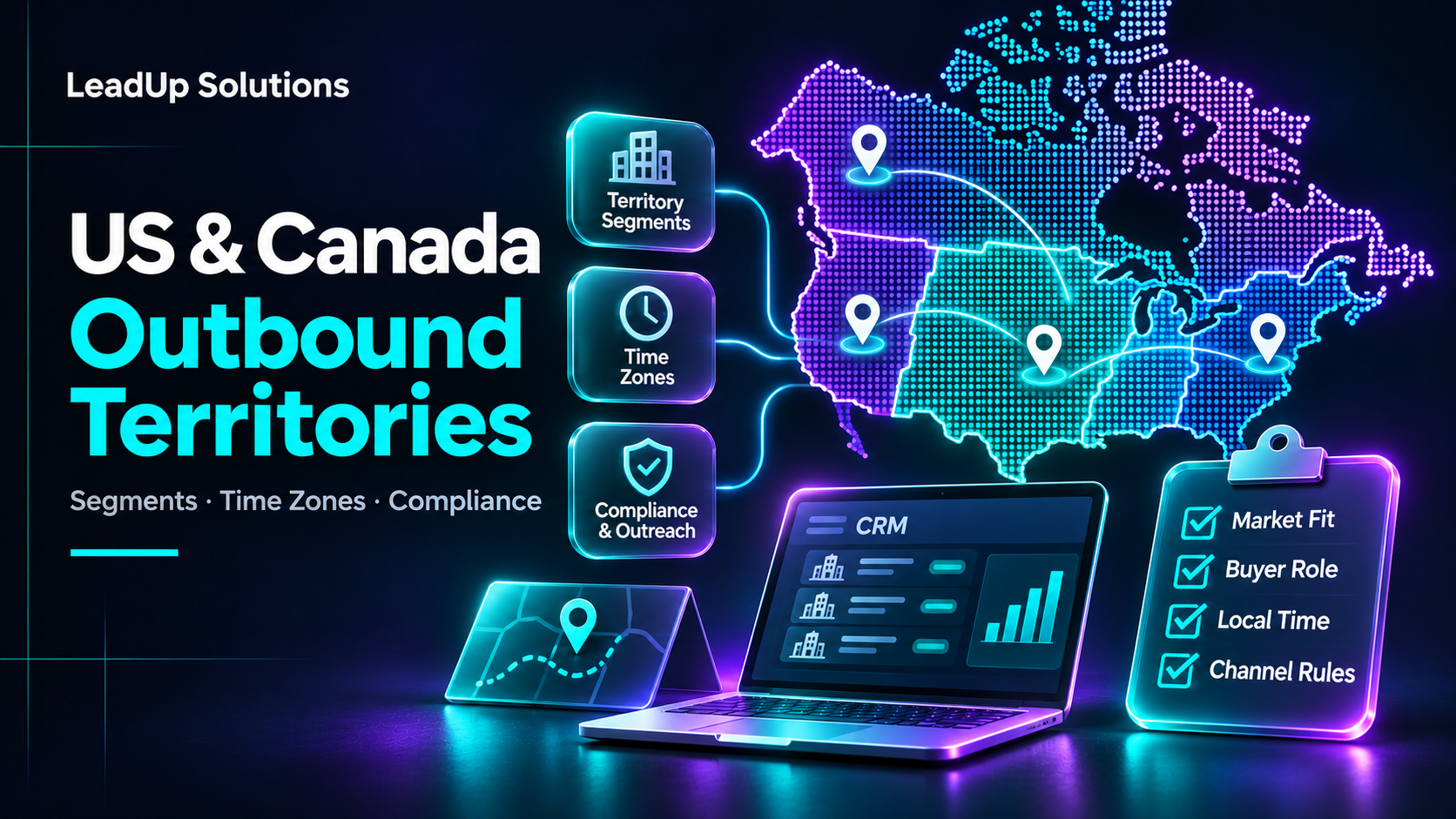
This guide gives SaaS and ERP revenue leaders a territory operating system: account-fit gates, segment and owner assignment, buyer-role planning, local-time scheduling, channel permission checks, CRM fields, a sample account allocation, and a 30-day test and review process. The examples are fictional and no region or campaign is promised a particular number of leads, meetings or opportunities.
Quick answer: Build a US and Canada B2B outbound territory plan by confirming product/ICP fit first; grouping companies into manageable segments; checking each account's actual buyer location, time zone and applicable channel eligibility; assigning exactly one accountable owner; then measuring quality-adjusted coverage and accepted meetings by consistent cohorts. Do not assume North America is one interchangeable market or that a public work contact is permission to use every channel.
Start with product fit, not the border
Your territory plan should begin with the companies your product can serve.
Define supported industries, organization size, business model, integration constraints and known exclusions. A product for complex manufacturers may have relevant buyers across multiple US states and Canadian provinces; another SaaS offer may fit only certain kinds of operations teams.
Geography should refine the ICP, not substitute for it. A large population or number of businesses in an area does not prove demand for your software.
For a company-level selection process, see our B2B SaaS ICP and account-list guide.
Start with pass/fail account gates
Before assigning any lead to a rep, confirm the business can actually buy and use your offer:
| Gate | Evidence required | If unknown or false |
|---|---|---|
| Supported product/use case | The vendor's real, approved capabilities match a plausible workflow | Research or exclude; do not invent integrations |
| ICP segment | Verified industry, size band, business model and key exclusions | Flag for fit review |
| Service territory | The vendor can actually deliver/support the requested market | Exclude unsupported geographies |
| Target role | A function plausibly owns or evaluates the issue | Research the appropriate role; don't fabricate authority |
| Legal/channel eligibility | The specific proposed email, call or other channel is permitted | Do not launch that channel until reviewed |
| Suppression status | No relevant opt-out or do-not-contact instruction | Stop the prohibited contact |
Channel eligibility is a hard gate, not a score that a large account or famous brand can outweigh. A research record is not itself evidence of purchase intent, funding, willingness to meet, or consent.
Create territory definitions that reflect delivery capacity
An SDR territory can be organized by geography, segment, named accounts, product line or a combination.
| Model | Best used when | Main risk |
|---|---|---|
| Geography | Local operating patterns and coverage matter | Uneven account fit or capacity |
| Industry vertical | Buyer needs differ by sector | Accounts across multiple time zones |
| Company size | Enterprise and mid-market motions differ | Size estimates can be inaccurate |
| Named accounts | Complex deals require coordinated account coverage | Ownership conflicts |
| Hybrid | Several criteria materially affect outreach | Rules become hard to maintain |
Choose the simplest model that allows responsible coverage and clear ownership. Do not invent complexity simply because the CRM supports many territory fields.
A decision tree for territory type
- Geographic ownership works when different local operating patterns, coverage hours or jurisdictional rules dominate the delivery problem.
- Vertical ownership can be useful when ERP manufacturing prospects need very different product expertise from SaaS services prospects.
- Named-account ownership is often better for complex deals with several contacts, several locations and a coordinated buying committee.
- Segment ownership helps a team compare similar account sizes and buying processes.
- Hybrid routing combines the criteria only if the CRM can make exceptions, assignment and rebalancing transparent.
Make account capacity visible
Account counts alone do not show effort. An enterprise account requiring several relevant stakeholders, researched workflows and custom qualification may need more work than a straightforward SMB account.
Define a workload unit for internal planning—for example, one simple account counts as one unit while a complex multi-stakeholder account is assigned more units after review. This is a local planning convention, not a market staffing benchmark. Track the rep's actual validated-account queue and review workload before assigning additional accounts.
At each assignment, record territory_rule_version, assigned_owner, assigned_at, assignment_reason, and any approved exception_owner. These fields make duplicate or arbitrary distribution easier to identify.
Map buyer roles within each segment
Territories should not only identify where an account is, but who should be approached for a relevant use case.
For ERP, the people involved may include operations leaders, finance executives, IT evaluators and executive sponsors. For SaaS, buyer roles depend on the particular workflow and budget ownership.
Use an account-level role map, then verify the actual people involved. A title alone is not proof of budget authority or a current buying initiative. Read our ERP buying committee guide for stakeholder mapping.
SaaS versus ERP buyer-role examples
| ICP and use case | First function to verify | Additional roles to map | Avoid assuming |
|---|---|---|---|
| Workflow SaaS for multi-site operations | Operations / process owner | IT, RevOps, finance as appropriate | That an ops leader approves software spend |
| Revenue operations software | RevOps / sales operations | Sales leader, IT/security, finance | That every CRM team needs replacement |
| ERP for distributors | Operations / inventory or finance owner | IT, controller, executive sponsor | That a new warehouse means an ERP project |
| ERP integration or implementation | ERP program or systems owner | Process leads, finance, architecture | That an integration or migration is technically feasible |
These are hypothetical targeting choices, not claims about actual LeadUp clients or verified regional demand. The first outreach should ask a truthful, role-relevant question rather than presume a buying project.
Plan local business hours and scheduling accurately
North America spans several time zones, and daylight-saving practices vary across US jurisdictions and Canadian provinces and territories. Using "3 PM EST" all year—or inferring buyer time from the company headquarters—creates avoidable scheduling problems.
Use a verified buyer-local time zone and a date-aware calendar. For example, a contact in New York might be stored as `America/New_York` and one in Toronto as `America/Toronto`; the specific appointment date determines the correct offset. Store a UTC timestamp for booked events and use an IANA zone where supported. Never assume a telephone area code confirms the buyer's present location.
US Department of Transportation guidance notes that most of Arizona and Hawaii do not observe daylight saving time. Canada's National Research Council time-zone reference describes province- and territory-specific practices, including exceptions. Do not hard-code a single North American seasonal offset.
Time-zone readiness for an offshore SDR team
| Check | Suggested implementation |
|---|---|
| Buyer location | Verify the contact's working location, not only the account HQ |
| Calendar representation | Store named local zone and UTC meeting timestamp |
| Local business hours | Choose reasonable buyer-local windows; review applicable calling rules |
| Seasonal clock changes | Compute from the actual event date and named time zone |
| SDR shift coverage | Assign a team member who can support the permitted local window |
| Meeting invite | Confirm date, buyer-local clock time, AE, link and topic |
| Exceptions | Recheck travel, remote work, holidays, cancellations and reschedules |
Fictional scheduling mistake: An offshore SDR sets an appointment based on a US office's main address, but the actual buyer works from another time zone. The calendar software can correctly convert a valid time; it cannot correct a wrong assumption about where the attendee works. Verify the location with the prospect.
Phone outreach may have jurisdiction-specific time restrictions. This table is an operational checklist, not a legal safe-harbor calling schedule. Do not promise that any single window is legal for every number in an assigned territory.
US and Canada: make channel eligibility part of territory routing
A company fitting your ICP does not create permission to contact its employees through any available channel. Build country- and channel-specific checks into the account-routing workflow before execution.
Canada: commercial electronic messages (CASL)
Under Canada's Anti-Spam Legislation, commercial electronic messages (CEMs) can be subject to consent, sender identification and unsubscribe requirements, with detailed conditions and exceptions. Review CRTC's official CASL overview and implied-consent guidance.
A publicly visible company email does not provide blanket consent. CRTC explains that reliance on conspicuous publication requires conditions including no related statement rejecting unsolicited commercial messages, a message relevant to the recipient's role or official duties, and the ability to substantiate the basis relied upon. An address surfaced only by a private enrichment service should not be described as conspicuously published merely because the service contains it.
Keep the evidence source, check date, relevant role and channel-eligibility rationale, where appropriate. CRTC's CASL FAQ also addresses cross-border messages. Offshore execution does not automatically avoid Canadian rules.
Canada: B2B telephone calls are a separate framework
The CRTC's business telemarketing guidance states that business-to-business calls are exempt from Part II, the National Do Not Call List Rules, but not automatically from all Unsolicited Telecommunications Rules: the Telemarketing and Automatic Dialing-Announcing Device provisions can still be relevant. Registration and internal do-not-call obligations require separate attention under applicable circumstances.
Do not interpret an exemption from one part of a telemarketing framework as general permission to call every business number. Check applicable technology, identification, time restrictions and suppression rules for the actual campaign.
United States: email and calls have different rules
The FTC's CAN-SPAM business guide confirms that commercial B2B email is covered, with truthful header and subject information, appropriate disclosures, a valid postal address and effective opt-out handling. Hiring a provider to send messages does not transfer away the promoted company's legal responsibilities.
For calling, the FTC Telemarketing Sales Rule, its business-to-business misrepresentation protections, other applicable federal requirements and state laws may matter. Calling method, target line and message purpose can change what applies. A general B2B exemption is not a blanket exemption from prohibitions against deceptive claims.
Professional-network outreach has its own platform and data-use rules. LinkedIn's automated-activity guidance warns against unauthorized scraping and automation.
Example channel-eligibility matrix
| Decision point | US commercial email | Canadian commercial email | B2B telephone outreach |
|---|---|---|---|
| Applicable rules | CAN-SPAM and other applicable requirements | CASL consent/exceptions, identification and unsubscribe | Country-specific calling rules; number and technology matter |
| Required research | Sender, message purpose and opt-out status | Applicable consent or exception and supporting evidence | Recipient type, calling method, contact preferences and local time |
| Account-level suppression | Preserve and enforce applicable opt-outs | Preserve and enforce applicable opt-outs | Maintain relevant internal do-not-call controls |
| Approval owner | Named compliance/campaign reviewer | Named reviewer familiar with Canadian requirements | Calling-policy reviewer for each operating territory |
This table is a planning aid, not legal advice, a compliance certification or a substitute for qualified legal review. Require a review of the actual audience, channels, location and technology before campaign execution.
Build a territory-ready CRM and ownership workflow
Your CRM should make it possible to answer which accounts are eligible, who owns them, what was verified, which channels are allowed, and what action is next.
| Recommended field | Level | Example or operational purpose |
|---|---|---|
| `account_id`, `verified_domain` | Account | Stable identity and duplicate prevention |
| `country`, `region`, `contact_work_location` | Account/contact | Correct jurisdiction and actual buyer location |
| `buyer_time_zone` | Contact | Named zone for date-aware scheduling |
| `industry`, `segment`, `icp_version` | Account | Reproducible fit criteria |
| `use_case_hypothesis`, `evidence_status` | Account | Confirmed versus Inferred versus Unknown |
| `buying_role`, `role_verified_at` | Contact | Relevant function without assumed authority |
| `territory_id`, `territory_rule_version` | Account | Routing rules and later audit |
| `assigned_owner`, `assignment_reason` | Account | Named accountable SDR and exception explanation |
| `source_url`, `source_checked_at` | Account/contact | Recency and source evidence |
| `email_eligibility`, `call_eligibility` | Contact/channel | Channel-specific legal and policy checks |
| `suppression_status`, `suppression_updated_at` | Contact | Do-not-contact history and preferences |
| `next_action`, `next_action_owner` | Task/CRM | No orphaned follow-up |
| `meeting_status`, `ae_acceptance` | Meeting | Separate booking, attendance and quality decisions |
Privacy and data minimization: These are example fields; collect only what is justified for the approved process. Restrict access to personal data and avoid recording unrelated private attributes or speculative judgments.
An account-assignment rule that prevents collisions
- Verify the company and check whether a matching account already exists.
- Apply product/ICP and geographic delivery exclusions.
- Check known suppression and the eligibility of each proposed channel.
- Determine the primary ownership rule: named account, industry, size or geography.
- Assign one account owner and document contact-level specialists or exceptions.
- If reassigned, preserve research, activity, meeting history and opt-out state; log old/new owner, reason and time.
- Resolve any ownership conflict before two teams approach the same stakeholder independently.
A global enterprise can have contacts across several territories. Separate account ownership from contact's work location and from the AE who eventually owns the sales opportunity. That prevents international account research from creating duplicate outreach.
A fictional distribution exercise
Consider a hypothetical pool of 120 candidate accounts for a SaaS workflow solution. After verification, assume 80 satisfy ICP and delivery gates; 25 fail those gates and 15 still need research. The 80 fit accounts are an addressable research cohort, not 80 contacts approved for outbound messages.
Suppose operations decides to prioritize 30 verified accounts for an initial pilot because the team can research and manage them well. It distributes 12 to a vertical specialist, 10 to a named-account owner and 8 to a geography-based owner. Those are illustrative workload choices, not regional demand statistics or sales-capacity benchmarks.
Before a single outreach action, the team still must confirm contact role, actual local zone, channel eligibility and suppression status. Record those checks individually. The remaining 50 fit accounts can wait in a research queue instead of becoming unwanted automated volume.
Avoid overlapping SDR contact at the same account
Two reps may legitimately manage different functions at a large account, but they must coordinate. Keep an account-level owner, a shared activity history, an approved contact/role map and a change log for transfers.
If one recipient opts out or asks for no further contact, carry the request through the relevant suppression workflow; switching territories or reps must never erase it. Where the request has a broader scope, do not artificially narrow it simply to keep marketing.
For coordinated calls, email and professional-network messaging, read our B2B multichannel outreach guide. Coordinate permitted channels only; a reply declining one method is not a green light to increase pressure on another.
Run one segment at a time when testing a new territory
A pilot doesn't need all US states and Canadian provinces on day one. Start with one defined industry/use-case segment and a verified, legally eligible set of contacts, then improve what you learn.
For example, a fictional ERP partner might test distribution businesses in one US coverage zone with operations roles as the initial hypothesis. A separate Canadian segment should begin only after reviewing the applicable communication rules and local operating requirements. These choices are planning examples, not claims that a location outperforms another.
A practical 30-day territory-planning sequence
| Phase | Deliverables | Gate before proceeding |
|---|---|---|
| Week 1 — Define | ICP, approved use cases, hard exclusions, source/channel rules, sales owner | Product-fit and lawful-channel review completed |
| Week 2 — Research | Sourced companies, buyer roles, real work locations, time zones, ownership and suppression checks | Sample quality reviewed; duplicates resolved |
| Week 3 — Pilot | Approved messages, logged conversations, correct scheduling, AE handoff and QA sampling | Issues and contact preferences actively monitored |
| Week 4 — Evaluate | Eligible account coverage, buyer conversations, bookings/held meetings, AE rejections, cost and exceptions | Continue / Refine / Pause / Stop decision with named owner |
This is a 30-day operating-learning plan, not a promise of a mature opportunity funnel. Long SaaS and ERP sales cycles may require later observation before revenue-related metrics can be interpreted.
Compare territories with consistent, useful metrics
| Metric | Suggested definition | Important caution |
|---|---|---|
| Verified ICP coverage | Unique ICP-fit accounts researched ÷ relevant accounts in the scoped pool | Do not imply every verified account is contactable |
| Eligible contact coverage | Contacts with approved next action ÷ contacts actually reviewed | Different jurisdictions/channels can change the eligible base |
| Relevant conversation rate | Meaningful role/need discussions ÷ eligible contact attempts under defined rules | "Connected" does not always mean relevant |
| Held meeting rate | Meetings held ÷ appropriately due meeting cohort | Exclude appointments whose date is still in the future |
| AE meeting acceptance | Meetings accepted ÷ completed AE decisions | Do not treat pending reviews as rejected |
| Opportunity conversion | Accepted meetings leading to qualifying opportunities in mature cohorts | Allow enough time for the buying process |
| Complaint and suppression trend | Reviewable opt-outs, errors and policy exceptions | Never optimize volume by ignoring these signals |
Keep activity-date reports separate from cohort reports: a booking created in one month and held the next belongs to different activity windows but one original booking journey. Avoid double-counting reschedules or comparing raw results across unequal account pools.
Our published B2B appointment-setting metrics guide details booked, held and AE-accepted measurements.
A simple territory review decision
Use the evidence to choose an explicit next step:
- Continue when account data, contact eligibility, buyer relevance and AE handoffs are consistently sound.
- Refine when one segment's ICP, messages or ownership rules need a controlled correction.
- Pause an affected channel or segment when there is an unresolved privacy, permission, time-zone or misleading-claims problem.
- Stop a segment when verified ICP or product-fit exclusions show it should not be pursued.
Document the reason, owner, date and version of the rules being reviewed. Do not interpret a small number of booked meetings as proof that an entire territory is "best."
Mistakes to avoid in US and Canada territory design
Treating both countries as identical. Regulations and operational contexts can differ.
Using headquarters time for every contact. A decision-maker may be based in another region.
Splitting territories without considering fit. The account's relevance matters more than map symmetry.
Allowing duplicate ownership. Conflicting outreach can frustrate prospects.
Assuming a valid database record creates contact permission. Channel rules remain separate.
Ranking regions by raw bookings alone. Compare quality and denominator context.
Frequently asked questions
Should US and Canadian accounts share one SDR team?
They can, if the team has suitable market knowledge, coverage, data processes and channel compliance controls. The operating model should fit workload and responsibility rather than follow a universal rule.
Which US state or Canadian province should a SaaS company target first?
Choose based on your actual ICP, product delivery capacity, account evidence and buyer needs—not a generic ranking. Validate one segment before scaling.
Should all territories use the same outbound messaging?
Keep the core truthful product positioning consistent, but tailor the use case, terminology, role and scheduling context to the segment. Review compliance separately.
Is territory performance the same as meeting volume?
No. Use account fit, eligible buyer coverage, accepted meeting quality and mature opportunity outcomes as well as activity counts.
Do North American time zones always follow one daylight-saving schedule?
No. The US and Canada have jurisdiction-specific exceptions. Verify the actual buyer's location and a date-aware time zone rather than applying a fixed offset to the whole region.
Can an overseas SDR call or email Canadian B2B prospects?
Physical location alone does not make the outreach lawful or unlawful. Apply Canadian requirements and any other applicable rules to the actual messages, callers, technology and recipients. Canadian B2B calling and commercial email have distinct frameworks.
Should a Canadian prospect's published work email be considered consent?
Not automatically. CASL implied consent through conspicuous publication is conditional, and the sender must be able to support the basis, including role relevance and absence of accompanying restrictions.
Should a global account be assigned to more than one SDR?
An account can have several specialists or contacts, but it should have an accountable owner and coordinated rules. Preserve all contact preferences, exclusions and activity history during any handoff.
Put the territory strategy into buyer conversations
For ERP programs, our role-specific ERP cold calling questions help turn a verified account and buying-role hypothesis into a respectful first conversation without inventing an implementation project.
For SaaS email outreach, the cold email personalization guide explains how to use research without fake claims. Apply the territory's separate channel eligibility and suppression checks before choosing to send any message.
Build a territory system that supports relevant conversations
A useful US and Canada B2B outbound territory plan links market fit, account ownership, local timing and channel rules to a consistent qualification process. It helps SDRs do focused work while giving sales leaders a clearer picture of where genuine conversations are coming from.
LeadUp Solutions supports SaaS, ERP and B2B technology businesses with managed cold calling, lead qualification and appointment setting aligned to a documented ICP and outreach plan.
If you're exploring US or Canadian outbound coverage, talk with LeadUp Solutions about your target segments, qualification criteria and operational priorities.